
下一代测序定义的人类免疫缺陷病毒预处理耐药对 ANRS 12249 治疗预防试验病毒学结局的影响。
Impact of Next-generation Sequencing Defined Human Immunodeficiency Virus Pretreatment Drug Resistance on Virological Outcomes in the ANRS 12249 Treatment-as-Prevention Trial.
机构信息
Africa Health Research Institute, Mtubatuba, South Africa.
Sorbonne University, l'université Pierre et Marie Curie, Institut national de la santé et de la recherche médicale, Institut Pierre Louis d'Epidémiologie et de Santé Publique Unité Mixte de Recherche en Santé (IPLESP UMRS 1136), Paris, France.
出版信息
Clin Infect Dis. 2019 Jul 2;69(2):207-214. doi: 10.1093/cid/ciy881.
BACKGROUND
Previous studies in human immunodeficiency virus (HIV)-positive individuals on thymidine analogue backbone antiretroviral therapy (ART) with either nevirapine or efavirenz have suggested poorer virological outcomes in the presence of pretreatment drug resistance (PDR). We assessed the impact of PDR on virological suppression (VS; <50 copies/mL) in individuals prescribed primarily tenofovir/emtricitabine/efavirenz in rural KwaZulu-Natal within a treatment-as-prevention trial.
METHODS
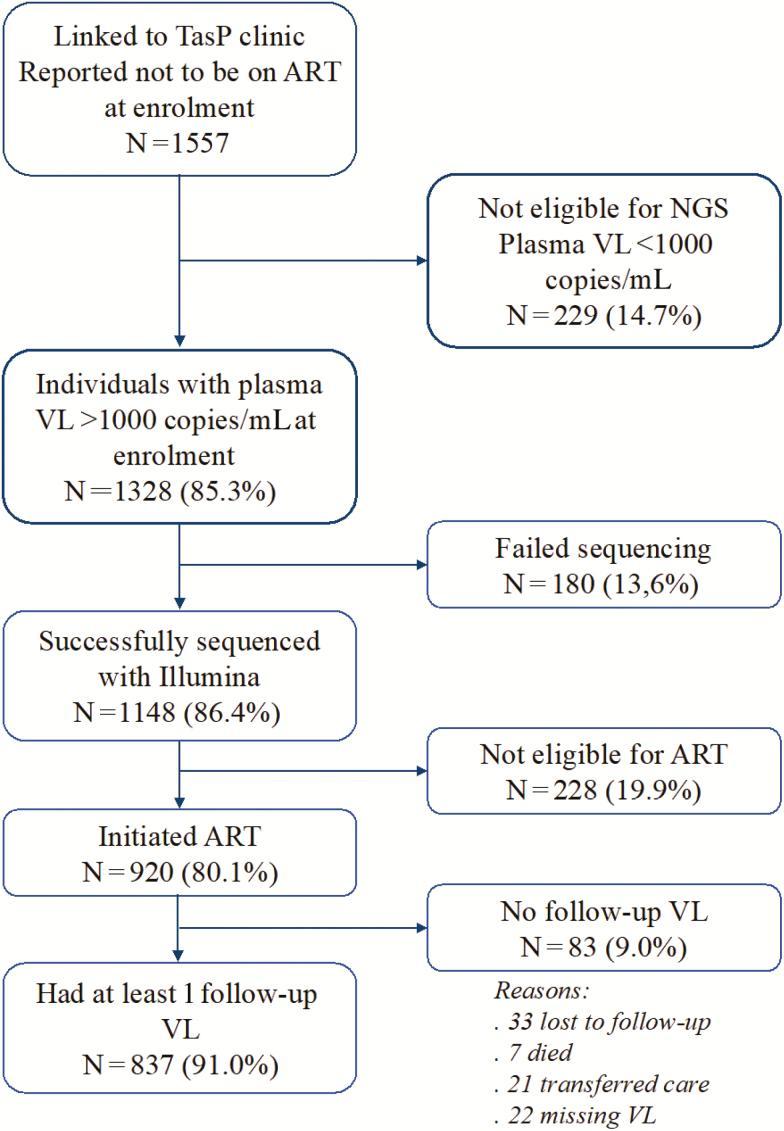
Among 1557 HIV-positive individuals who reported no prior ART at study entry and provided plasma samples, 1328 individuals with entry viral load (VL) >1000 copies/mL had next-generation sequencing (NGS) of the HIV pol gene with MiSeq technology. Results were obtained for 1148 individuals, and the presence of PDR was assessed at 5% and 20% detection thresholds. Virological outcome was assessed using Cox regression in 837 of 920 ART initiators with at least 1 follow-up VL after ART initiation.
RESULTS
PDR prevalence was 9.5% (109/1148) and 12.8% (147/1148) at 20% and 5% thresholds, respectively. After a median of 1.36 years (interquartile range, 0.91-2.13), mostly on fixed-dose combination tenofovir/emtricitabine/efavirenz, presence of both nonnucleoside reverse transcriptase inhibitor (NNRTI)/nucleoside reverse transcriptase inhibitor PDR vs no PDR was associated with longer time to VS (adjusted hazard ratio [aHR], 0.32; 95% confidence interval [CI], 0.12-0.86), while there was no difference between those with only NNRTI PDR vs no PDR (aHR, 1.05; 95% CI, 0.82-1.34) at the 5% threshold. Similar differences were observed for mutations detected at the 20% threshold, although without statistical significance.
CONCLUSIONS
NGS uncovered a high prevalence of PDR among participants enrolled in trial clinics in rural KwaZulu-Natal. Dual-class PDR to a mainly tenofovir/emtricitabine/efavirenz regimen was associated with poorer VS. However, there was no impact of NNRTI PDR alone.
CLINICAL TRIALS TEGISTRATION
NCT01509508; South African National Clinical Trials Register: DOH-27-0512-3974.
背景
先前在接受包含替诺福韦/恩曲他滨和奈韦拉平或依非韦伦的胸苷类似物为基础的抗逆转录病毒治疗(ART)的人类免疫缺陷病毒(HIV)阳性个体中进行的研究表明,存在治疗前耐药(PDR)时病毒学结果更差。我们评估了在农村夸祖鲁-纳塔尔地区的一项治疗即预防试验中,主要接受替诺福韦/恩曲他滨/依非韦伦治疗的个体中,PDR 对病毒学抑制(VS;<50 拷贝/mL)的影响。
方法
在研究入组时报告没有接受过 ART 的 1557 名 HIV 阳性个体中,有 1328 名个体的入组病毒载量(VL)>1000 拷贝/mL,对其 HIV pol 基因进行了下一代测序(NGS),采用 MiSeq 技术。获得了 1148 名个体的结果,并在 5%和 20%的检测阈值下评估了 PDR 的存在。对 920 名接受 ART 治疗的个体中的 837 名进行了 Cox 回归分析,这些个体在 ART 治疗开始后至少有一次随访 VL。
结果
PDR 的患病率分别为 9.5%(109/1148)和 12.8%(147/1148),在 20%和 5%的阈值下。中位随访时间为 1.36 年(四分位距,0.91-2.13),主要使用固定剂量组合替诺福韦/恩曲他滨/依非韦伦,与无 NNRTI/NRTI PDR 相比,同时存在 NNRTI/NRTI 和 NRTI PDR 与更长的 VS 时间相关(调整后的危险比[HR],0.32;95%置信区间[CI],0.12-0.86),而只有 NNRTI PDR 与无 PDR 相比无差异(HR,1.05;95% CI,0.82-1.34)在 5%的阈值下。在 20%的阈值下也观察到了类似的差异,尽管没有统计学意义。
结论
在农村夸祖鲁-纳塔尔地区的试验诊所入组的参与者中,NGS 发现了很高的 PDR 患病率。主要接受替诺福韦/恩曲他滨/依非韦伦治疗的个体中存在双重耐药至主要的替诺福韦/恩曲他滨/依非韦伦方案与较差的 VS 相关。然而,单独存在 NNRTI PDR 并无影响。
临床试验注册
NCT01509508;南非国家临床试验注册处:DOH-27-0512-3974。


 Zotero 插件