
亚利桑那州马里科帕县西尼罗河病毒的系统进化分析:美国西南部两个主要谱系中菌株动态行为的证据。
Phylogenetic analysis of West Nile Virus in Maricopa County, Arizona: Evidence for dynamic behavior of strains in two major lineages in the American Southwest.
机构信息
School of Informatics, Computing, and Cyber Systems, Northern Arizona University, Flagstaff, Arizona, United Sates of America.
The Pathogen and Microbiome Institute, Northern Arizona University, Flagstaff, Arizona, United States of America.
出版信息
PLoS One. 2018 Nov 26;13(11):e0205801. doi: 10.1371/journal.pone.0205801. eCollection 2018.
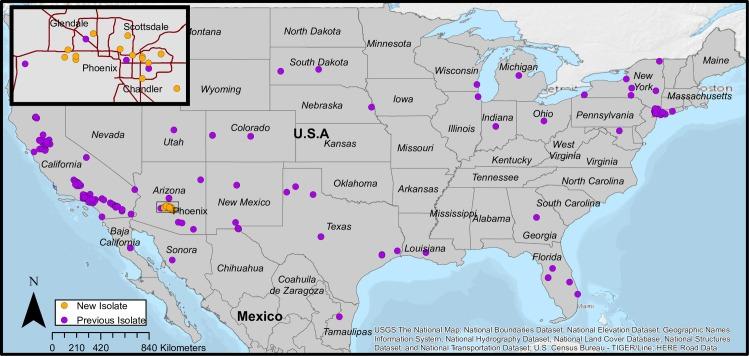
West Nile Virus (WNV) has been detected annually in Maricopa County, Arizona, since 2003. With this in mind, we sought to determine if contemporary strains are endemic to the county or are annually imported. As part of this effort, we developed a new protocol for tiled amplicon sequencing of WNV to efficiently attain greater than 99% coverage of 14 WNV genomes collected directly from positive mosquito pools distributed throughout Maricopa County between 2014 and 2017. Bayesian phylogenetic analyses revealed that contemporary genomes fall within two major lineages; NA/WN02 and SW/WN03. We found that all of the Arizona strains possessed an amino acid substitution known to be under positive selection, which has arisen independently at least four times in Arizona. The SW/WN03 strains exhibited transient behavior, with at least 10 separate introductions into Arizona when considering both historical and contemporary strains. However, NA/WN02 strains are geographically differentiated and appear to be endemic in Arizona, with two clades that have been circulating for four and seven years. This establishment in Maricopa County provides the first evidence of local overwintering by a WNV strain over the course of several years in Arizona. Within a national context, the placement of eleven contemporary Arizona strains in the NA/WN02 lineage indicates while WNV first entered the northeastern United States in 1999, the most ancestral extant strains of WNV are now circulating in the American southwest.
自 2003 年以来,亚利桑那州马里科帕县每年都检测到西尼罗河病毒(WNV)。考虑到这一点,我们试图确定当代毒株是否是该县的地方病,还是每年都有输入。作为这项工作的一部分,我们开发了一种新的 Tiled amplicon 测序方案,用于有效地对直接从 2014 年至 2017 年分布在马里科帕县的阳性蚊子池中收集的 14 个 WNV 基因组进行 99%以上的覆盖率。贝叶斯系统发育分析显示,当代基因组属于两个主要谱系;NA/WN02 和 SW/WN03。我们发现所有的亚利桑那州毒株都具有一个已知受到正选择的氨基酸取代,该取代至少在亚利桑那州独立出现了四次。SW/WN03 株表现出短暂的行为,考虑到历史和当代菌株,至少有 10 次单独引入亚利桑那州。然而,NA/WN02 株是地理分化的,并且似乎在亚利桑那州是地方病,两个分支已经循环了四年和七年。在马里科帕县的这种建立为 WNV 株在亚利桑那州多年来首次出现局部越冬提供了第一个证据。在全国范围内,11 个当代亚利桑那州毒株被置于 NA/WN02 谱系中,这表明尽管 WNV 于 1999 年首次进入美国东北部,但 WNV 最古老的现存毒株现在正在美国西南部流行。



 Zotero 插件