
米诺瓦尔(2-羟基油酸)通过解偶联氧化磷酸化和损害生物能量补偿能力,导致癌细胞选择性毒性。
Minerval (2-hydroxyoleic acid) causes cancer cell selective toxicity by uncoupling oxidative phosphorylation and compromising bioenergetic compensation capacity.
机构信息
Department of Neurology, Hadassah-Hebrew University Medical Center, Ein Kerem, 91120 Jerusalem, Israel.
Laboratory for Neurodegenerative Diseases and Personalized Medicine, Department of Cell Research and Immunology, The George S. Wise Faculty for Life Sciences, Sagol School of Neurosciences, Tel Aviv University, Ramat Aviv, 69978 Tel Aviv, Israel.
出版信息
Biosci Rep. 2019 Jan 18;39(1). doi: 10.1042/BSR20181661. Print 2019 Jan 31.
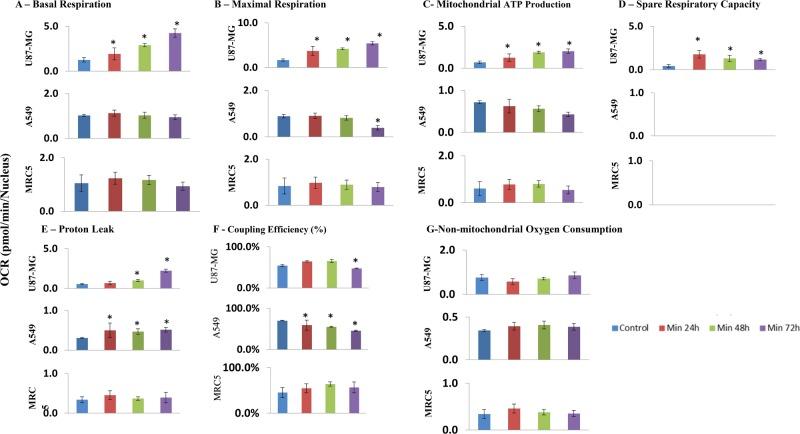
This work tests bioenergetic and cell-biological implications of the synthetic fatty acid Minerval (2-hydroxyoleic acid), previously demonstrated to act by activation of sphingomyelin synthase in the plasma membrane (PM) and lowering of phosphatidylethanolamine (PE) and phosphatidylcholine (PC) and their carcinogenic signaling. We show here that Minerval also acts, selectively in cancer cell lines, as an ATP depleting uncoupler of mitochondrial oxidative phosphorylation (OxPhos). As a function of its exposure time, Minerval compromised the capacity of glioblastoma U87-MG cells to compensate for aberrant respiration by up-modulation of glycolysis. This effect was not exposure time-dependent in the lung carcinoma A549 cell line, which was more sensitive to Minerval. Compared with OxPhos inhibitors FCCP (uncoupler), rotenone (electron transfer inhibitor), and oligomycin (F1F0-ATPase inhibitor), Minerval action was similar only to that of FCCP. This similarity was manifested by mitochondrial membrane potential (MMP) depolarization, facilitation of oxygen consumption rate (OCR), restriction of mitochondrial and cellular reactive oxygen species (ROS) generation and mitochondrial fragmentation. Additionally, compared with other OxPhos inhibitors, Minerval uniquely induced ER stress in cancer cell lines. These new modes of action for Minerval, capitalizing on the high fatty acid requirements of cancer cells, can potentially enhance its cancer-selective toxicity and improve its therapeutic capacity.
这项工作测试了合成脂肪酸 Minerval(2-羟基油酸)的生物能量学和细胞生物学意义,此前的研究表明它通过激活质膜(PM)中的鞘磷脂合酶并降低磷脂酰乙醇胺(PE)和磷脂酰胆碱(PC)及其致癌信号来发挥作用。我们在这里表明,Minerval 还选择性地作用于癌细胞系,作为线粒体氧化磷酸化(OxPhos)的 ATP 耗竭解偶联剂。随着暴露时间的延长,Minerval 损害了神经胶质瘤 U87-MG 细胞通过上调糖酵解来补偿异常呼吸的能力。在肺癌 A549 细胞系中,这种作用与暴露时间无关,A549 细胞系对 Minerval 更为敏感。与 OxPhos 抑制剂 FCCP(解偶联剂)、鱼藤酮(电子传递抑制剂)和寡霉素(F1F0-ATP 酶抑制剂)相比,Minerval 的作用仅与 FCCP 相似。这种相似性表现为线粒体膜电位(MMP)去极化、氧消耗率(OCR)的增加、线粒体和细胞活性氧(ROS)生成以及线粒体碎片化的限制。此外,与其他 OxPhos 抑制剂相比,Minerval 独特地诱导了癌细胞系中的内质网应激。Minerval 的这些新作用模式利用了癌细胞对脂肪酸的高需求,有可能增强其对癌症的选择性毒性并提高其治疗能力。




 Zotero 插件