
基于使用边缘增强权重的图搜索的食管光学相干断层扫描(OCT)图像稳健层分割
Robust layer segmentation of esophageal OCT images based on graph search using edge-enhanced weights.
作者信息
Gan Meng, Wang Cong, Yang Ting, Yang Na, Zhang Miao, Yuan Wu, Li Xingde, Wang Lirong
机构信息
Department of Electronic and Information Engineering, Soochow University, Suzhou 215006, China.
Suzhou Institute of Biomedical Engineering and Technology, Chinese Academy of Sciences, Suzhou 215163, China.
出版信息
Biomed Opt Express. 2018 Aug 27;9(9):4481-4495. doi: 10.1364/BOE.9.004481. eCollection 2018 Sep 1.
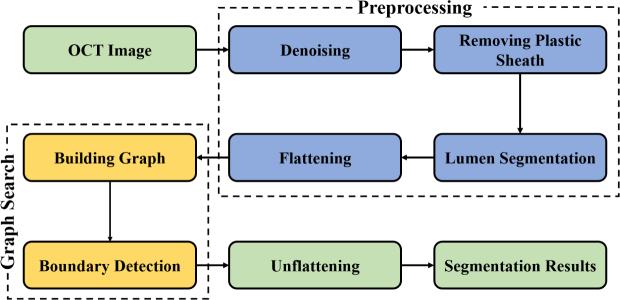
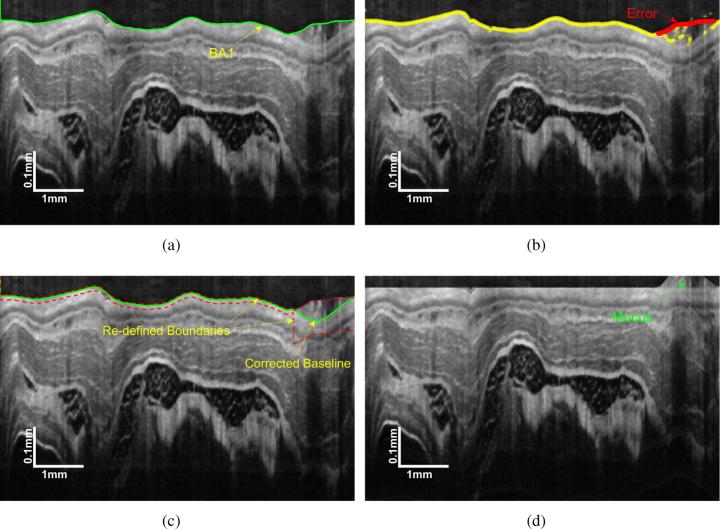
Automatic segmentation of esophageal layers in OCT images is crucial for studying esophageal diseases and computer-assisted diagnosis. This work aims to improve the current techniques to increase the accuracy and robustness for esophageal OCT image segmentation. A two-step edge-enhanced graph search (EEGS) framework is proposed in this study. Firstly, a preprocessing scheme is applied to suppress speckle noise and remove the disturbance in the esophageal structure. Secondly, the image is formulated into a graph and layer boundaries are located by graph search. In this process, we propose an edge-enhanced weight matrix for the graph by combining the vertical gradients with a Canny edge map. Experiments on esophageal OCT images from guinea pigs demonstrate that the EEGS framework is more robust and more accurate than the current segmentation method. It can be potentially useful for the early detection of esophageal diseases.
在光学相干断层扫描(OCT)图像中自动分割食管各层对于研究食管疾病和计算机辅助诊断至关重要。这项工作旨在改进当前技术,以提高食管OCT图像分割的准确性和鲁棒性。本研究提出了一种两步边缘增强图搜索(EEGS)框架。首先,应用一种预处理方案来抑制斑点噪声并消除食管结构中的干扰。其次,将图像构建为一个图,并通过图搜索来定位层边界。在此过程中,我们通过将垂直梯度与Canny边缘图相结合,为该图提出了一种边缘增强权重矩阵。对豚鼠食管OCT图像的实验表明,EEGS框架比当前的分割方法更鲁棒、更准确。它可能对食管疾病的早期检测有潜在帮助。






 Zotero 插件