
果胶去甲基化和阿拉伯半乳聚糖蛋白增加促进细胞壁重塑,并且在……的体细胞胚胎发生过程中是必需的。
Pectin De-methylesterification and AGP Increase Promote Cell Wall Remodeling and Are Required During Somatic Embryogenesis of .
作者信息
Pérez-Pérez Yolanda, Carneros Elena, Berenguer Eduardo, Solís María-Teresa, Bárány Ivett, Pintos Beatriz, Gómez-Garay Aránzazu, Risueño María C, Testillano Pilar S
机构信息
Pollen Biotechnology of Crop Plants Group, Biological Research Center - Spanish National Research Council, Madrid, Spain.
Department of Genetics, Microbiology and Physiology, Complutense University of Madrid, Madrid, Spain.
出版信息
Front Plant Sci. 2019 Jan 8;9:1915. doi: 10.3389/fpls.2018.01915. eCollection 2018.
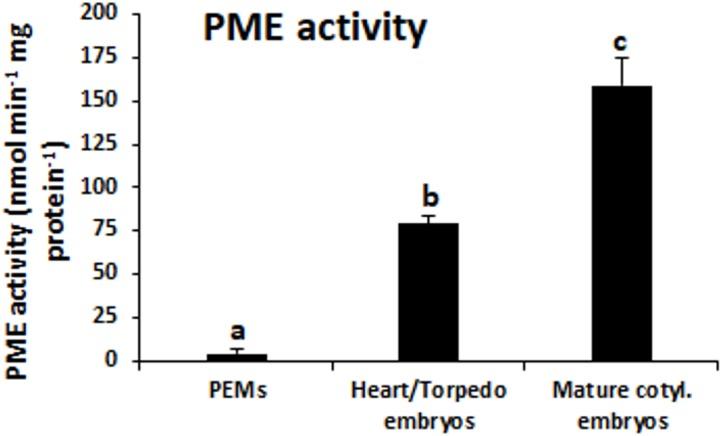
Somatic embryogenesis is a reliable system for plant regeneration, with biotechnological applications in trees, but the regulating mechanisms are largely unknown. Changes in cell wall mechanics controlled by methylesterification of pectins, mediated by pectin methylesterases (PMEs) and pectin methyl esterase inhibitors (PMEIs) underlie many developmental processes. Arabinogalactan proteins (AGPs) are highly glycosylated proteins located at the surface of plasma membranes, in cell walls, and in extracellular secretions, with key roles in a range of different processes. In this study, we have investigated changes in two cell wall components, pectins and AGPs, during somatic embryogenesis in , a forest tree of high economic and ecologic value. At early embryogenesis stages, cells of proembryogenic masses showed high levels of esterified pectins and expression of and genes encoding a PME and a putative PMEI, respectively. At advanced stages, differentiating cells of heart, torpedo and cotyledonary embryos exhibited walls rich in de-esterified pectins, while gene expression and PME activity progressively increased. AGPs were detected in cell walls of proembryogenic masses and somatic embryos. , and gene expression increased with embryogenesis progression, as did the level of total AGPs, detected by dot blot with β-glucosyl Yariv reagent. Immuno dot blot, immunofluorescence assays and confocal analysis using monoclonal antibodies to high- (JIM7, LM20) and low- (JIM5, LM19) methylesterified pectins, and to certain AGP epitopes (LM6, LM2) showed changes in the amount and distribution pattern of esterified/de-esterified pectins and AGP epitopes, that were associated with proliferation and differentiation and correlated with expression of the and genes analyzed. Pharmacological treatments with catechin, an inhibitor of PME activity, and Yariv reagent, which blocks AGPs, impaired the progression of embryogenesis, with pectin de-esterification and an increase in AGP levels being necessary for embryo development. Findings indicate a role for pectins and AGPs during somatic embryogenesis of cork oak, promoting the cell wall remodeling during the process. They also provide new insights into the regulating mechanisms of somatic embryogenesis in woody species, for which information is still scarce, opening up new possibilities to improve embryo production in tree breeding.
体细胞胚胎发生是一种可靠的植物再生系统,在树木的生物技术应用中具有重要意义,但其调控机制在很大程度上尚不清楚。果胶的甲基酯化作用由果胶甲酯酶(PMEs)和果胶甲酯酶抑制剂(PMEIs)介导,从而控制细胞壁力学变化,这是许多发育过程的基础。阿拉伯半乳聚糖蛋白(AGPs)是高度糖基化的蛋白质,位于质膜表面、细胞壁和细胞外分泌物中,在一系列不同过程中发挥关键作用。在本研究中,我们调查了具有高经济和生态价值的林木栓皮栎体细胞胚胎发生过程中两种细胞壁成分——果胶和AGPs的变化。在胚胎发生早期阶段,原胚团细胞显示出高水平的酯化果胶以及分别编码一种PME和一种假定PMEI的 和 基因的表达。在后期阶段,心形胚、鱼雷形胚和子叶胚的分化细胞表现出富含去酯化果胶 的细胞壁,而 基因表达和PME活性逐渐增加。在原胚团和体细胞胚胎的细胞壁中检测到了AGPs。随着胚胎发生进程, 和 基因表达增加,用β - 葡萄糖基Yariv试剂进行斑点印迹检测的总AGP水平也随之增加。使用针对高甲基酯化(JIM7、LM20)和低甲基酯化(JIM5、LM19)果胶以及某些AGP表位(LM6、LM2)的单克隆抗体进行免疫斑点印迹、免疫荧光分析和共聚焦分析,结果显示酯化/去酯化果胶和AGP表位的数量和分布模式发生了变化,这些变化与增殖和分化相关,并与所分析的 和 基因的表达相关。用儿茶素(一种PME活性抑制剂)和Yariv试剂(可阻断AGPs)进行药理学处理会损害胚胎发生进程,果胶去酯化和AGP水平增加是胚胎发育所必需的。研究结果表明果胶和AGPs在栓皮栎体细胞胚胎发生过程中发挥作用,促进了该过程中的细胞壁重塑。它们还为木本植物体细胞胚胎发生的调控机制提供了新的见解,目前关于这方面的信息仍然匮乏,为改善树木育种中的胚胎生产开辟了新的可能性。




 Zotero 插件