
脆性X综合征与成熟齿状颗粒细胞中的NMDA受体功能低下及树突复杂性降低有关。
Fragile-X Syndrome Is Associated With NMDA Receptor Hypofunction and Reduced Dendritic Complexity in Mature Dentate Granule Cells.
作者信息
Yau Suk-Yu, Bettio Luis, Chiu Jason, Chiu Christine, Christie Brian R
机构信息
Division of Medical Sciences, Island Medical Program, University of Victoria, Victoria, BC, Canada.
出版信息
Front Mol Neurosci. 2019 Jan 17;11:495. doi: 10.3389/fnmol.2018.00495. eCollection 2018.
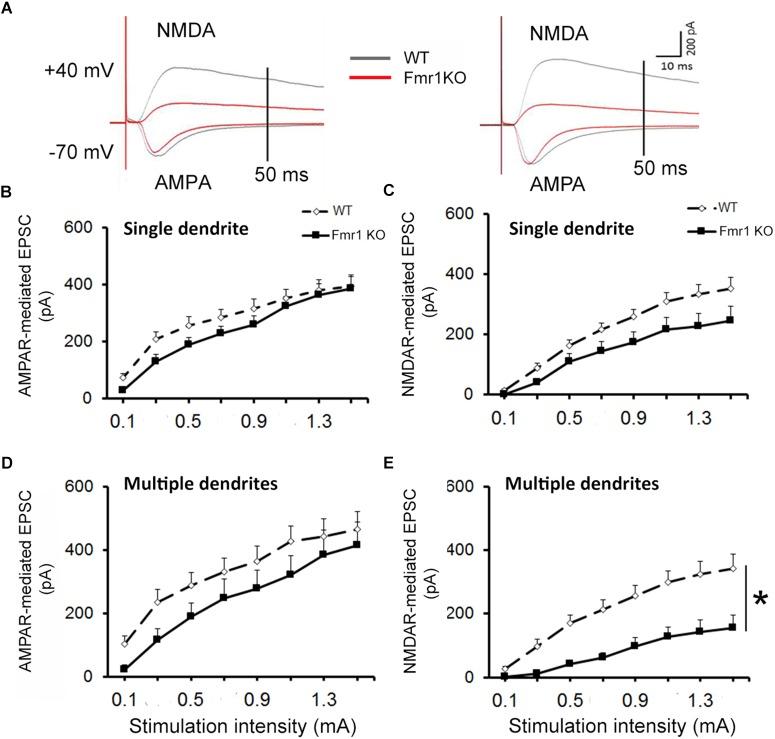
Fragile X syndrome (FXS) is the most common form of inherited intellectual disability. It is caused by the overexpansion of cytosine-guanine-guanine (CGG) trinucleotide in gene, resulting in complete loss of the fragile X mental retardation protein (FMRP). Previous studies using knockout ( KO) mice have suggested that a -methyl-D-aspartate receptors (NMDAR) hypofunction in the hippocampal dentate gyrus may partly contribute to cognitive impairments in FXS. Since activation of NMDAR plays an important role in dendritic arborization during neuronal development, we examined whether deficits in NMDAR function are associated with alterations in dendritic complexity in the hippocampal dentate region. The dentate granule cell layer (GCL) presents active postnatal neurogenesis, and consists of a heterogenous neuronal population with gradient ages from the superficial to its deep layer. Here, we show that neurons with multiple primary dendrites that reside in the outer GCL of KO mice display significantly smaller NMDAR excitatory post-synaptic currents (EPSCs) and a higher α-amino-3-hydroxy-5-methyl-4-isoxazolepropionic acid (AMPA) to NMDA ratio in comparison to their wild-type counterparts. These deficits were associated with a significant decrease in dendritic complexity, with both dendritic length and number of intersections being significantly reduced. In contrast, although neurons with a single primary dendrite resided in the inner GCL of KO mice had a trend toward a reduction in NMDAR EPSCs and a higher AMPA/NMDA ratio, no alterations were found in dendritic complexity at this developmental stage. Our data indicate that the loss of FMRP causes NMDAR deficits and reduced dendritic complexity in granule neurons with multiple primary dendrites which are thought to be more mature in the GCL.
脆性X综合征(FXS)是遗传性智力残疾最常见的形式。它是由基因中胞嘧啶-鸟嘌呤-鸟嘌呤(CGG)三核苷酸的过度扩增引起的,导致脆性X智力低下蛋白(FMRP)完全缺失。先前使用基因敲除(KO)小鼠的研究表明,海马齿状回中α-甲基-D-天冬氨酸受体(NMDAR)功能低下可能部分导致了FXS的认知障碍。由于NMDAR的激活在神经元发育过程中的树突分支形成中起重要作用,我们研究了NMDAR功能缺陷是否与海马齿状区域树突复杂性的改变有关。齿状颗粒细胞层(GCL)呈现活跃的出生后神经发生,由从浅层到深层具有梯度年龄的异质性神经元群体组成。在这里,我们表明,与野生型对应物相比,KO小鼠外GCL中具有多个初级树突的神经元表现出明显更小的NMDAR兴奋性突触后电流(EPSCs)和更高的α-氨基-3-羟基-5-甲基-4-异恶唑丙酸(AMPA)与NMDA的比率。这些缺陷与树突复杂性的显著降低有关,树突长度和交叉点数量均显著减少。相比之下,虽然KO小鼠内GCL中具有单个初级树突的神经元有NMDAR EPSCs减少和AMPA/NMDA比率升高的趋势,但在这个发育阶段未发现树突复杂性有改变。我们的数据表明,FMRP的缺失导致NMDAR缺陷,并降低了GCL中被认为更成熟的具有多个初级树突的颗粒神经元的树突复杂性。



 Zotero 插件