
一项基于网络的干预措施(MotivATE)以提高饮食失调服务评估预约的出勤率:泽伦随机对照试验
A Web-Based Intervention (MotivATE) to Increase Attendance at an Eating Disorder Service Assessment Appointment: Zelen Randomized Controlled Trial.
作者信息
Denison-Day James, Muir Sarah, Newell Ciarán, Appleton Katherine M
机构信息
Research Centre for Behaviour Change, Psychology Department, Bournemouth University, Poole, United Kingdom.
Dorset Healthcare University, NHS Foundation Trust, Poole, United Kingdom.
出版信息
J Med Internet Res. 2019 Feb 27;21(2):e11874. doi: 10.2196/11874.
BACKGROUND
Early assessment and treatment of eating disorder patients is important for patient outcomes. However, up to a third of people referred for treatment do not access services and 16.4% do not attend their first scheduled assessment appointment. MotivATE is a fully automated, novel, Web-based program intended to increase motivation to change eating disorder behaviors, designed for delivery at the point of invitation to an eating disorder service, with the aim of increasing service attendance.
OBJECTIVE
This paper assesses the impact of MotivATE on attendance at assessment when compared with treatment-as-usual.
METHODS
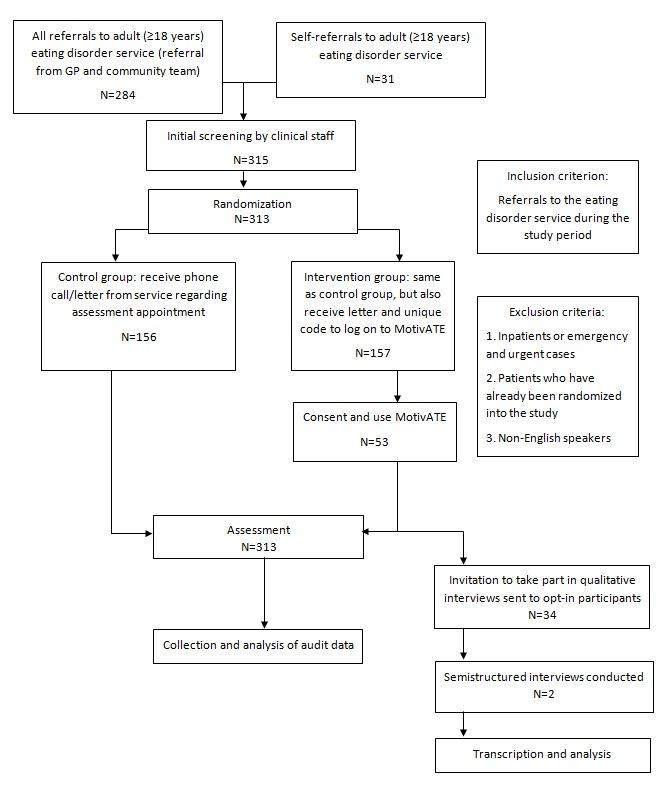
A Zelen randomized controlled design was used. All individuals referred to a specialist eating disorder service, Kimmeridge Court in Dorset, UK, over the course of a year (October 24, 2016-October 23, 2017) were randomized to treatment-as-usual only or treatment-as-usual plus an additional letter offering access to MotivATE. Attendance at the initial scheduled assessment appointment was documented. Logistic regression analysis assessed the impact of MotivATE on attendance at assessment. Additional analyses based on levels of engagement with MotivATE were also undertaken.
RESULTS
A total of 313 participants took part: 156 (49.8%) were randomized to treatment-as-usual and 157 (50.2%) were randomized to receive the additional offer to access MotivATE. Intention-to-treat analysis between conditions showed no impact of MotivATE on attendance at assessment (odds ratio [OR] 1.35, 95% CI 0.69-2.66, P=.38). Examination of the usage data indicated that only 53 of 157 participants (33.8%) in the MotivATE condition registered with the Web-based intervention. An analysis comparing those that registered with the intervention with those that did not found greater attendance at assessment in those that had registered (OR 9.46, 95% CI 1.22-73.38, P=.03).
CONCLUSIONS
Our primary analyses suggest no impact of MotivATE on attendance at the first scheduled assessment appointment, but secondary analyses revealed limited engagement with the program and improved attendance in those who did engage. It is unclear, however, if engagement with the program increased motivation and, in turn, attendance or if more motivated individuals were more likely to access the intervention. Further research is required to facilitate engagement with Web-based interventions and to understand the full value of MotivATE for users.
TRIAL REGISTRATION
ClinicalTrials.gov NCT02777944; https://clinicaltrials.gov/ct2/show/NCT02777944 (Archived by WebCite at http://www.webcitation.org/75VDEFZZ4).
背景
对饮食失调患者进行早期评估和治疗对患者的治疗效果至关重要。然而,高达三分之一被转介接受治疗的人未获得服务,16.4%的人未参加首次预定的评估预约。MotivATE是一个完全自动化的新型基于网络的项目,旨在增强改变饮食失调行为的动力,设计用于在邀请患者接受饮食失调服务时提供,目的是提高服务就诊率。
目的
本文评估MotivATE与常规治疗相比对评估就诊率的影响。
方法
采用Zelen随机对照设计。在一年(2016年10月24日至2017年10月23日)期间,所有转介到英国多塞特郡金默里奇法院的专业饮食失调服务机构的个体被随机分为仅接受常规治疗或常规治疗加一封提供MotivATE访问权限的附加信件。记录首次预定评估预约的就诊情况。逻辑回归分析评估MotivATE对评估就诊率的影响。还基于与MotivATE的参与程度进行了额外分析。
结果
共有313名参与者:156名(49.8%)被随机分配接受常规治疗,157名(50.2%)被随机分配接受额外的MotivATE访问权限。组间意向性分析显示MotivATE对评估就诊率没有影响(优势比[OR]1.35,95%可信区间0.69 - 2.66,P = 0.38)。对使用数据的检查表明,在MotivATE组的157名参与者中,只有53名(33.8%)注册了基于网络的干预措施。一项比较注册干预措施者与未注册者的分析发现,注册者的评估就诊率更高(OR 9.46,95%可信区间1.22 - 73.38,P = 0.03)。
结论
我们的主要分析表明MotivATE对首次预定评估预约的就诊率没有影响,但次要分析显示对该项目的参与有限,且参与的人就诊率有所提高。然而,尚不清楚参与该项目是否增加了动力,进而提高了就诊率,还是更有动力的个体更有可能使用该干预措施。需要进一步研究以促进对基于网络的干预措施的参与,并了解MotivATE对用户的全部价值。
试验注册
ClinicalTrials.gov NCT02777944;https://clinicaltrials.gov/ct2/show/NCT02777944(由WebCite存档于http://www.webcitation.org/75VDEFZZ4)
 Zotero 插件