
冻结肩中的成纤维细胞激活和炎症。
Fibroblast activation and inflammation in frozen shoulder.
机构信息
Institute of Infection, Immunity and Inflammation, College of Medicine, Veterinary and Life Sciences University of Glasgow, Glasgow, Scotland, United Kingdom.
Department of Orthopaedic Surgery, Queen Elizabeth University Hospital Glasgow, Scotland, United Kingdom.
出版信息
PLoS One. 2019 Apr 23;14(4):e0215301. doi: 10.1371/journal.pone.0215301. eCollection 2019.
INTRODUCTION
Frozen shoulder is a common, fibro-proliferative disease characterised by the insidious onset of pain and progressively restricted range of shoulder movement. Despite the prevalence of this disease, there is limited understanding of the molecular mechanisms underpinning the pathogenesis of this debilitating disease. Previous studies have identified increased myofibroblast differentiation and proliferation, immune cell influx and dysregulated cytokine production. We hypothesised that subpopulations within the fibroblast compartment may take on an activated phenotype, thus initiating the inflammatory processes observed in frozen shoulder. Therefore, we sought to evaluate the presence and possible pathogenic role of known stromal activation proteins in Frozen shoulder.
METHODS
Shoulder capsule samples were collected from 10 patients with idiopathic frozen shoulder and 10 patients undergoing shoulder stabilisation surgery. Fibroblast activation marker expression (CD248, CD146, VCAM and PDPN, FAP) was quantified using immunohistochemistry. Control and diseased fibroblasts were cultured for in vitro studies from capsule biopsies from instability and frozen shoulder surgeries, respectively. The inflammatory profile and effects of IL-1β upon diseased and control fibroblasts was assessed using ELISA, immunohistochemistry and qPCR.
RESULTS
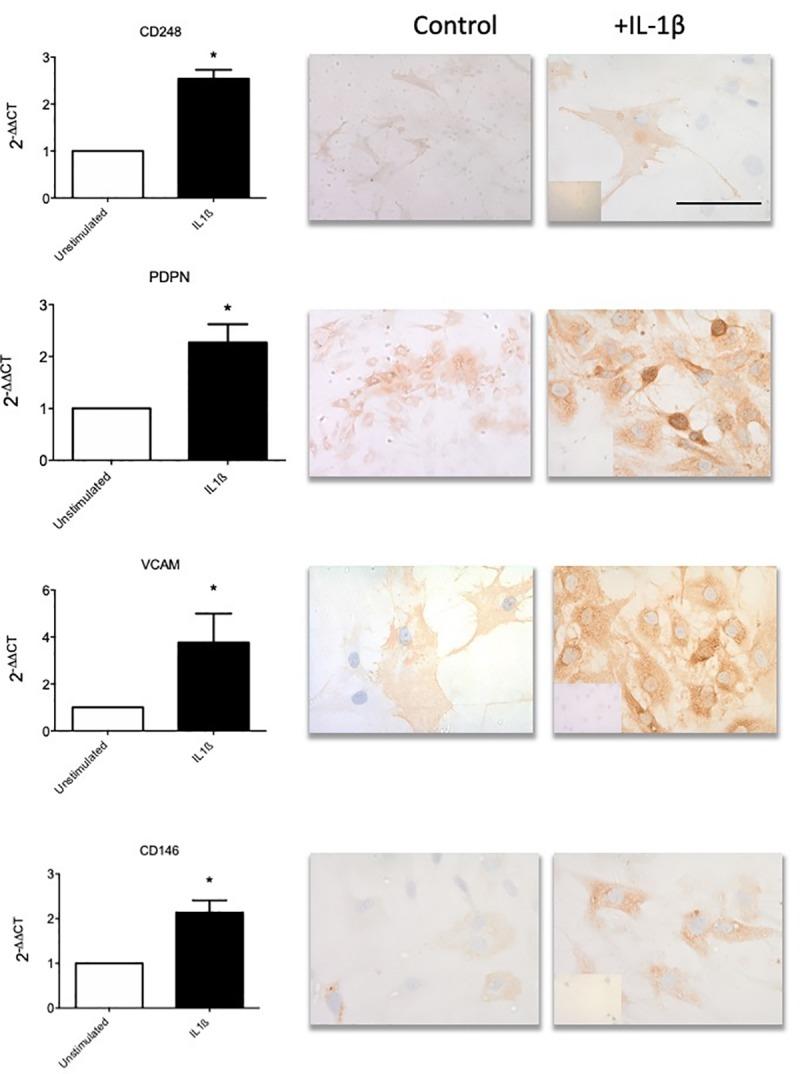
Immunohistochemistry demonstrated increased expression of fibroblast activation markers CD248, CD146, VCAM and PDPN in the frozen shoulder group compared with control (p < 0.05). Fibroblasts cultured from diseased capsule produced elevated levels of inflammatory protein (IL-6, IL-8 & CCL-20) in comparison to control fibroblasts. Exposing control fibroblasts to an inflammatory stimuli, (IL-1ß) significantly increased stromal activation marker transcript and protein expression (CD248, PDPN and VCAM).
CONCLUSIONS
These results show that fibroblasts have an activated phenotype in frozen shoulder and this is associated with inflammatory cytokine dysregulation. Furthermore, it supports the hypothesis that activated fibroblasts may be involved in regulating the inflammatory and fibrotic processes involved in this disease.
简介
冻结肩是一种常见的纤维增生性疾病,其特征为疼痛隐匿发作和肩部活动范围逐渐受限。尽管这种疾病很常见,但对于其发病机制的分子机制的理解有限。先前的研究已经确定了肌成纤维细胞分化和增殖增加、免疫细胞浸润和细胞因子产生失调。我们假设成纤维细胞群内的亚群可能会表现出激活表型,从而引发冻结肩中观察到的炎症过程。因此,我们试图评估已知基质激活蛋白在冻结肩中的存在和可能的致病作用。
方法
从 10 例特发性冻结肩患者和 10 例行肩稳定手术的患者中收集肩囊样本。使用免疫组织化学定量测定成纤维细胞激活标志物表达(CD248、CD146、VCAM 和 PDPN、FAP)。分别从不稳定和冻结肩手术的囊活检中培养控制和患病的成纤维细胞,进行体外研究。使用 ELISA、免疫组织化学和 qPCR 评估 IL-1β对患病和对照成纤维细胞的炎症谱和影响。
结果
与对照组相比,冻结肩组的免疫组织化学显示成纤维细胞激活标志物 CD248、CD146、VCAM 和 PDPN 的表达增加(p<0.05)。与对照成纤维细胞相比,来自患病囊的成纤维细胞产生更高水平的炎症蛋白(IL-6、IL-8 和 CCL-20)。将对照成纤维细胞暴露于炎症刺激物(IL-1β)会显著增加基质激活标志物的转录和蛋白表达(CD248、PDPN 和 VCAM)。
结论
这些结果表明,冻结肩中的成纤维细胞具有激活表型,这与炎症细胞因子失调有关。此外,它支持这样的假设,即激活的成纤维细胞可能参与调节这种疾病中涉及的炎症和纤维化过程。



 Zotero 插件