
GH4169合金在900℃交变氧化和溶液浸泡下的腐蚀行为
Corrosion Behavior of GH4169 Alloy under Alternating Oxidation at 900 °C and Solution Immersion.
作者信息
Yu Zhongfen, Liu Li, Liu Rui, Cao Min, Fan Lei, Li Ying, Geng Shujiang, Wang Fuhui
机构信息
School of metallurgy, Northeastern University, Shenyang, 110819, China.
Institute of Metal Research, Chinese Academy of Sciences, Shenyang 110016, China.
出版信息
Materials (Basel). 2019 May 8;12(9):1503. doi: 10.3390/ma12091503.
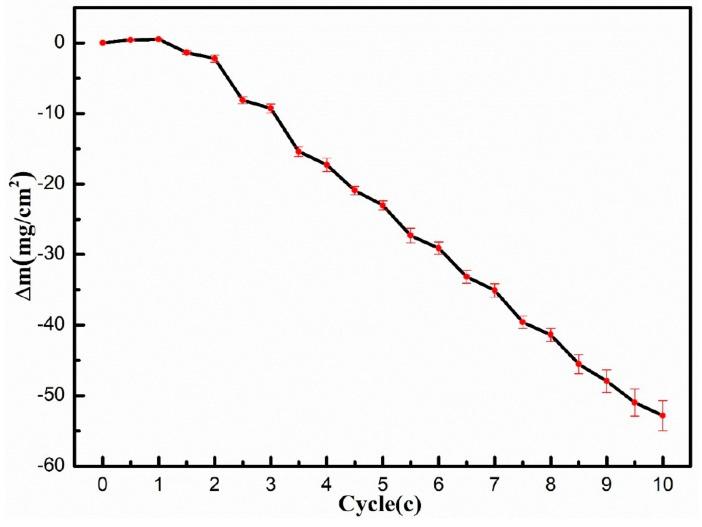
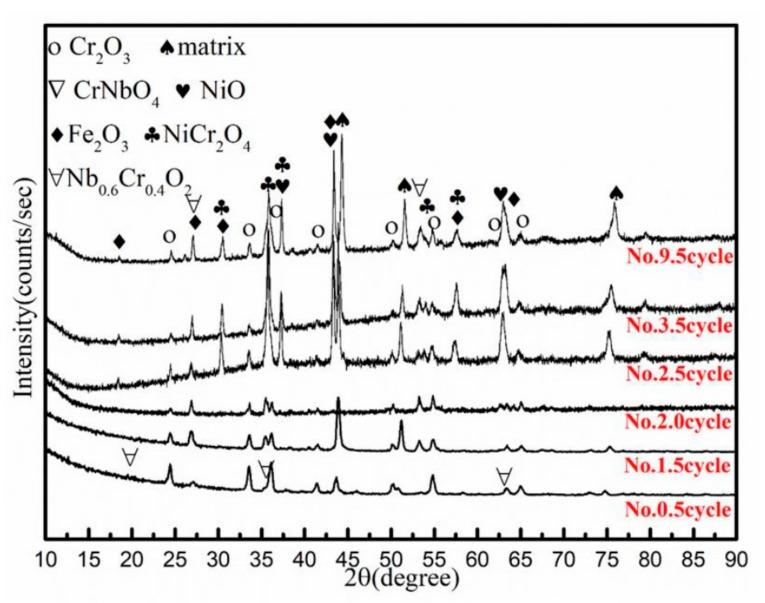
In this paper, the corrosion behavior of GH4169 superalloy under alternating oxidation (at 900 °C) and solution immersion (in 3.5% NaCl solution, 30 ± 1 °C) has been studied by SEM, XRD, XPS, and electron probe microanalysis (EPMA). The results show that the alternating environment increases the corrosion rate of GH4169. The reaction of NaCl and CrO generates various volatile and soluble corrosion products, such as NaCrO, CrCl, Cl, and NaCrO, at a high temperature. The destruction of the protective CrO film leads to the increase of defects in the oxide scale, promoting the formation of oxides, such as NiO and FeO, and changes the composition and structure of the oxide film. After repeated iterations, the mixed oxides will result in the spalling of the oxide film because they can reduce the fracture toughness of the corrosion scale. Therefore, the corrosion is comprehensively intensified.
本文通过扫描电子显微镜(SEM)、X射线衍射仪(XRD)、X射线光电子能谱仪(XPS)和电子探针微分析仪(EPMA)研究了GH4169高温合金在交替氧化(900℃)和溶液浸泡(3.5%NaCl溶液,30±1℃)环境下的腐蚀行为。结果表明,交替环境提高了GH4169的腐蚀速率。在高温下,NaCl与CrO反应生成各种挥发性和可溶性腐蚀产物,如NaCrO、CrCl、Cl和NaCrO。保护性CrO膜的破坏导致氧化膜中缺陷增加,促进了NiO和FeO等氧化物的形成,并改变了氧化膜的成分和结构。经过反复循环,混合氧化物会导致氧化膜剥落,因为它们会降低腐蚀氧化皮的断裂韧性。因此,腐蚀作用全面加剧。




 Zotero 插件