
有氧运动训练可降低糖尿病大鼠肝脏中的阿朴脂蛋白
Aerobic Exercise Training Decreases Hepatic Asprosin in Diabetic Rats.
作者信息
Ko Jeong Rim, Seo Dae Yun, Kim Tae Nyun, Park Se Hwan, Kwak Hyo-Bum, Ko Kyung Soo, Rhee Byoung Doo, Han Jin
机构信息
National Research Laboratory for Mitochondrial Signaling, Department of Physiology, BK21 Plus Project Team, College of Medicine, Cardiovascular and Metabolic Disease Center, Inje University, Busan 47392, Korea.
Institute of Sports Medicine, Hannam University, Daejeon 34430, Korea.
出版信息
J Clin Med. 2019 May 12;8(5):666. doi: 10.3390/jcm8050666.
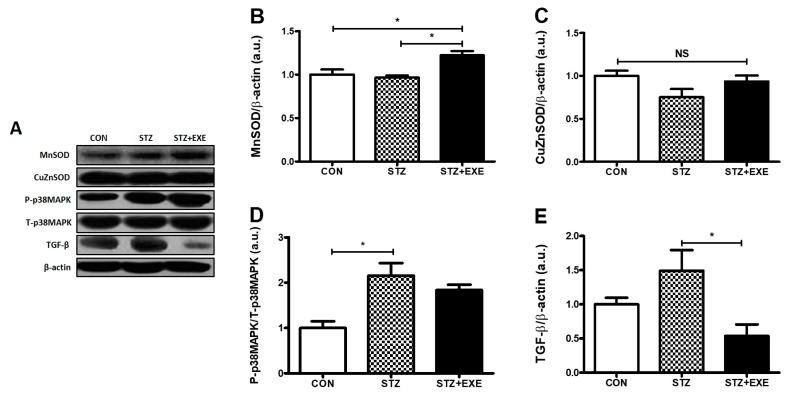
Asprosin, a novel hormone released from white adipose tissue, regulates hepatic glucose metabolism and is pathologically elevated in the presence of insulin resistance. It is unknown whether aerobic exercise training affects asprosin levels in type 1 diabetes mellitus (T1DM). The aim of this study was to determine whether (1) aerobic exercise training could decrease asprosin levels in the liver of streptozotocin (STZ)-induced diabetic rats and (2) the reduction in asprosin levels could induce asprosin-dependent downstream pathways. Five-week-old male Sprague-Dawley rats were randomly divided into control, STZ-induced diabetes (STZ), and STZ with aerobic exercise training groups ( = 6/group). T1DM was induced by a single dose of STZ (65 mg/kg intraperitoneally (i.p.)). The exercise group was made to run on a treadmill for 60 min at a speed of 20 m/min, 4 days per week for 8 weeks. Aerobic exercise training reduced the protein levels of asprosin, PKA, and TGF-β but increased those of AMPK, Akt, PGC-1β, and MnSOD. These results suggest that aerobic exercise training affects hepatic asprosin-dependent PKA/TGF-β and AMPK downstream pathways in T1DM.
阿朴脂蛋白是一种从白色脂肪组织释放的新型激素,它调节肝脏葡萄糖代谢,并且在存在胰岛素抵抗的情况下会病理性升高。目前尚不清楚有氧运动训练是否会影响1型糖尿病(T1DM)患者体内的阿朴脂蛋白水平。本研究的目的是确定:(1)有氧运动训练是否能降低链脲佐菌素(STZ)诱导的糖尿病大鼠肝脏中的阿朴脂蛋白水平;(2)阿朴脂蛋白水平的降低是否会诱导阿朴脂蛋白依赖性下游通路。将5周龄雄性Sprague-Dawley大鼠随机分为对照组、STZ诱导糖尿病组(STZ组)和STZ有氧运动训练组(每组n = 6)。通过单次腹腔注射STZ(65 mg/kg)诱导T1DM。运动组大鼠在跑步机上以20 m/min的速度跑步60分钟,每周4天,共8周。有氧运动训练降低了阿朴脂蛋白、蛋白激酶A(PKA)和转化生长因子-β(TGF-β)的蛋白水平,但提高了腺苷酸活化蛋白激酶(AMPK)、蛋白激酶B(Akt)、过氧化物酶体增殖物激活受体γ共激活因子1β(PGC-1β)和锰超氧化物歧化酶(MnSOD)的蛋白水平。这些结果表明,有氧运动训练会影响T1DM中肝脏阿朴脂蛋白依赖性PKA/TGF-β和AMPK下游通路。


 Zotero 插件