
房室结:成年人心房中祖细胞的潜在龛位区域。
The Atrioventricular Junction: A Potential Niche Region for Progenitor Cells in the Adult Human Heart.
机构信息
1Department of Laboratory Medicine, Institute of Biomedicine, University of Gothenburg Sahlgrenska Academy, Gothenburg, Sweden.
2Department of Clinical Chemistry, Sahlgrenska University Hospital, Gothenburg, Sweden.
出版信息
Stem Cells Dev. 2019 Aug 15;28(16):1078-1088. doi: 10.1089/scd.2019.0075. Epub 2019 Jun 27.
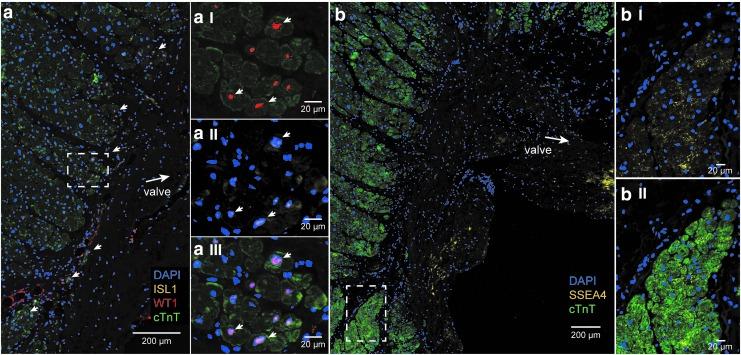
A stem cell niche is a microenvironment where stem cells reside in a quiescent state, until activated. In a previous rat model, we combined 5-bromo-2-deoxy-uridine labeling with activation of endogenous stem cells by physical exercise and revealed a distinct region, in the atrioventricular junction (AVj), with features of a stem cell niche. In this study, we aim to investigate whether a similar niche exists in the human heart. Paired biopsies from AVj and left ventricle (LV) were collected both from explanted hearts of organ donors, not used for transplantation ( = 7) and from severely failing hearts from patients undergoing heart transplantation ( = 7). Using antibodies, we investigated the expression of stem cell, hypoxia, proliferation and migration biomarkers. In the collagen-dense region of the AVj in donor hearts, progenitor markers, MDR1, SSEA4, ISL1, WT1, and hypoxia marker, HIF1-α, were clearly detected. The expression gradually decreased with distance from the valve. At the myocardium border in the AVj costaining of the proliferation marker Ki67 with cardiomyocyte nuclei marker PCM1 and cardiac Troponin-T (cTnT) indicated proliferation of small cardiomyocytes. In the same site we also detected ISL1/WT1/cTnT cells. In addition, heterogeneity in cardiomyocyte sizes was noted. Altogether, these findings indicate different developmental stages of cardiomyocytes below the region dense in stem cell marker expression. In patients suffering from heart failure the AVj region showed signs of impairment generally displaying much weaker or no expression of progenitor markers. We describe an anatomic structure in the human hearts, with features of a progenitor niche that coincided with the same region previously identified in rats with densely packed cells expressing progenitor and hypoxia markers. The data provided in this study indicate that the adult heart contains progenitor cells and that AVj might be a specific niche region from which the progenitors migrate at the time of regeneration.
干细胞龛是干细胞处于静止状态的微环境,直到被激活。在之前的大鼠模型中,我们将 5-溴-2-脱氧尿苷标记与物理运动激活内源性干细胞相结合,揭示了房室结(AVj)中存在具有干细胞龛特征的独特区域。在这项研究中,我们旨在研究人类心脏中是否存在类似的龛位。我们从器官捐献者的心脏中采集了房室结和左心室(LV)的配对活检,这些心脏都未用于移植(n = 7),并且来自因心力衰竭而接受心脏移植的患者的心脏(n = 7)。我们使用抗体检测了干细胞、缺氧、增殖和迁移生物标志物的表达。在供体心脏房室结胶原丰富的区域,祖细胞标志物 MDR1、SSEA4、ISL1、WT1 和缺氧标志物 HIF1-α 被明确检测到。这些标志物的表达随与瓣膜的距离增加而逐渐减少。在房室结的心肌边界处,增殖标志物 Ki67 与肌节蛋白 1 (PCM1)和心肌肌钙蛋白-T (cTnT)的核标志物共染色表明,小心肌细胞增殖。在同一部位,我们还检测到 ISL1/WT1/cTnT 细胞。此外,还观察到心肌细胞大小的异质性。总的来说,这些发现表明,在表达干细胞标志物丰富的区域下方,存在着不同发育阶段的心肌细胞。在心力衰竭患者中,AVj 区域通常显示出损伤迹象,其祖细胞标志物的表达较弱或缺失。我们在人类心脏中描述了一种具有祖细胞龛特征的解剖结构,该结构与之前在大鼠中发现的密集细胞表达祖细胞和缺氧标志物的区域相吻合。本研究提供的数据表明,成人心脏中存在祖细胞,并且 AVj 可能是祖细胞在再生时迁移的特定龛位区域。



 Zotero 插件