
烟曲霉通过调节 M1 巨噬细胞极化增强人自然杀伤细胞活性。
Aspergillus fumigatus enhances human NK cell activity by regulating M1 macrophage polarization.
机构信息
Department of Pathogenobiology, Jilin University Mycology Research Center, College of Basic Medical Sciences, Jilin University, Changchun, Jilin 130021, P.R. China.
出版信息
Mol Med Rep. 2019 Aug;20(2):1241-1249. doi: 10.3892/mmr.2019.10365. Epub 2019 Jun 6.
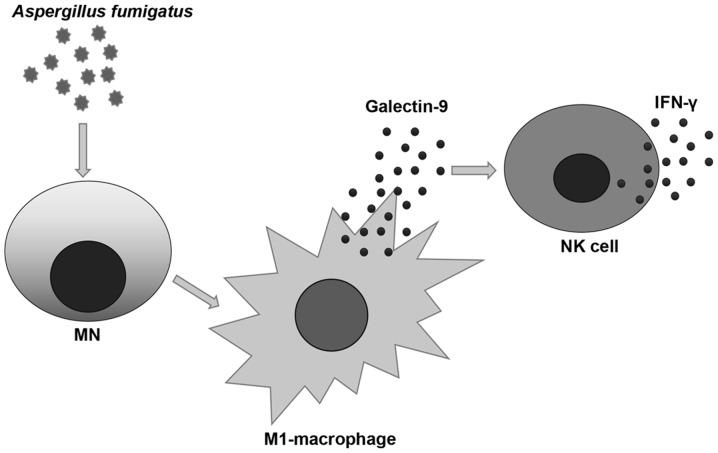
The progression of disease caused by fungal infection is closely associated with the human immune system. Macrophages and natural killer cells (NK cells) are two important types of innate immune cells that serve an important role in anti‑infection immunity. There has been limited research into the interactions between fungi and macrophages. In the present in vitro study, reverse transcription‑quantitative PCR, ELISA and flow cytometry were performed to reveal that the interaction between macrophages and NK cells, regulated by Aspergillus fumigatus conidia, induced macrophages to polarize into M1 macrophages by secreting large quantities of tumor necrosis factor‑α, interleukin‑18 and Galectin‑9. In addition, when NK cells were co‑cultured with the conidia of A. fumigatus‑stimulated M1 macrophages, they exhibited increased activation levels and secretion of interferon‑γ (IFN‑γ). It was further demonstrated via antibody neutralization and gene silencing experiments that galectin‑9 served an important role in the interaction between macrophages and NK cells regulated by A. fumigatus. In conclusion, it was demonstrated that A. fumigatus induced the polarization of macrophages into M1 macrophages by secreting Galectin‑9, which then promoted NK cell activity and IFN‑γ secretion. The results provided improved understanding of the role of innate immune cells in invasive fungal infections. The present study also provided novel insight into the study of macrophages and NK cells in inflammatory infections caused by A. fumigatus and potential strategies to control the progression of inflammation.
真菌感染引起的疾病进展与人体免疫系统密切相关。巨噬细胞和自然杀伤细胞(NK 细胞)是两种重要的固有免疫细胞,在抗感染免疫中发挥着重要作用。真菌与巨噬细胞之间的相互作用研究较少。在本体外研究中,通过逆转录定量 PCR、ELISA 和流式细胞术揭示了由烟曲霉分生孢子调节的巨噬细胞与 NK 细胞之间的相互作用,通过分泌大量肿瘤坏死因子-α、白细胞介素-18 和半乳糖凝集素-9 诱导巨噬细胞极化为 M1 巨噬细胞。此外,当 NK 细胞与 A. fumigatus 刺激的 M1 巨噬细胞的分生孢子共培养时,它们的激活水平和干扰素-γ(IFN-γ)的分泌增加。通过抗体中和和基因沉默实验进一步证明,半乳糖凝集素-9 在烟曲霉调节的巨噬细胞与 NK 细胞之间的相互作用中发挥重要作用。总之,研究结果表明,烟曲霉通过分泌半乳糖凝集素-9 诱导巨噬细胞极化为 M1 巨噬细胞,进而促进 NK 细胞的活性和 IFN-γ 的分泌。这些结果提高了对固有免疫细胞在侵袭性真菌感染中的作用的认识。本研究还为研究烟曲霉引起的炎症性感染中的巨噬细胞和 NK 细胞提供了新的见解,并为控制炎症进展提供了潜在的策略。


 Zotero 插件