
晚期胃癌患者在接受纳武单抗或伊立替康治疗期间出现的超进展性疾病。
Hyperprogressive disease during nivolumab or irinotecan treatment in patients with advanced gastric cancer.
作者信息
Aoki Masahiko, Shoji Hirokazu, Nagashima Kengo, Imazeki Hiroshi, Miyamoto Takahiro, Hirano Hidekazu, Honma Yoshitaka, Iwasa Satoru, Okita Natsuko, Takashima Atsuo, Kato Ken, Higuchi Kazuhide, Boku Narikazu
机构信息
Gastrointestinal Medical Oncology Division, National Cancer Center Hospital, Tokyo, Japan.
Internal Medicine (II), Osaka Medical College, Osaka, Japan.
出版信息
ESMO Open. 2019 May 21;4(3):e000488. doi: 10.1136/esmoopen-2019-000488. eCollection 2019.
BACKGROUND
Nivolumab showed a survival benefit for advanced gastric cancer (AGC). However, an acceleration of tumour growth during immunotherapy, (hyperprogressive disease, HPD) has been reported in various cancers. This study reviewed the HPD in patients with AGC treated with nivolumab or irinotecan.
METHODS
The subjects of this retrospective study were patients with AGC with measurable lesions, and their tumour growth rates (TGR) during nivolumab or irinotecan were compared with those during prior therapy. HPD was defined as an increase in TGR more than twofold.
RESULTS
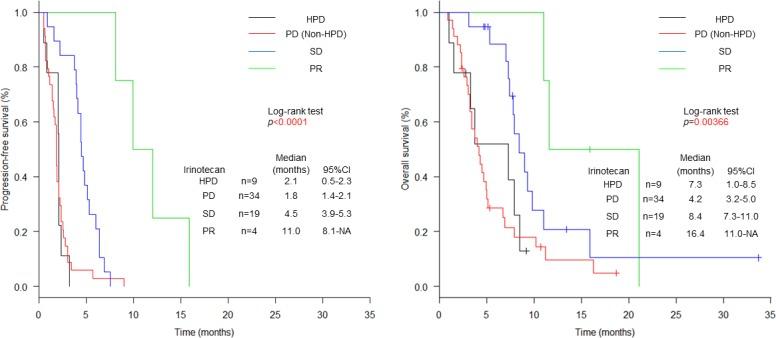
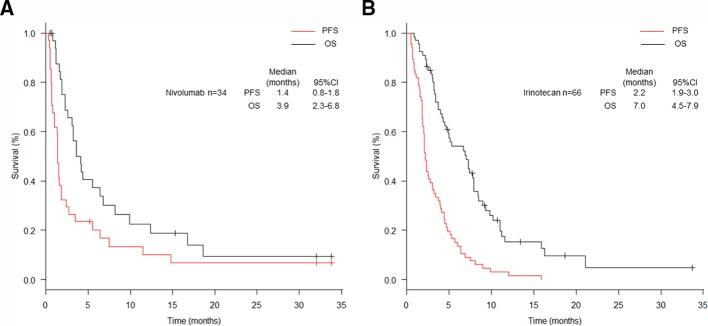
34 and 66 patients received nivolumab and irinotecan in third or later line between June 2009 and September 2018 at our hospital; 22 patients receiving nivolumab had prior treatment with irinotecan, and one patient received irinotecan after nivolumab. Nivolumab and irinotecan showed no differences in disease control rates (38.2% and 34.8%) and in progression-free survival (PFS) (HR 1.1, 95% CI 0.7 to 1.6, p=0.802). The incidence of HPD was slightly higher after nivolumab (29.4%) than after irinotecan (13.5%) (p=0.0656), showing no differences in background between the patients with and without HPD. Compared between HPD and PD other than HPD after nivolumab, the HRs for PFS and overall survival (OS) were 1.1 (95% CI 0.5 to 2.7; p=0.756), and 2.1 (95% CI 0.7 to 5.8; p=0.168), but such clear difference in OS was not observed after irinotecan.
CONCLUSIONS
HPD was observed more frequently after nivolumab compared with irinotecan, which was associated with a poor prognosis after nivolumab but not so clearly after irinotecan.
背景
纳武利尤单抗对晚期胃癌(AGC)显示出生存获益。然而,在各种癌症中均有免疫治疗期间肿瘤生长加速(超进展性疾病,HPD)的报道。本研究回顾了接受纳武利尤单抗或伊立替康治疗的AGC患者中的HPD情况。
方法
本回顾性研究的对象为具有可测量病灶的AGC患者,并将其在接受纳武利尤单抗或伊立替康治疗期间的肿瘤生长率(TGR)与先前治疗期间的进行比较。HPD定义为TGR增加超过两倍。
结果
2009年6月至2018年9月期间,我院分别有34例和66例患者在三线及以后接受了纳武利尤单抗和伊立替康治疗;22例接受纳武利尤单抗治疗的患者先前接受过伊立替康治疗,1例患者在接受纳武利尤单抗治疗后接受了伊立替康治疗。纳武利尤单抗和伊立替康在疾病控制率(分别为38.2%和34.8%)和无进展生存期(PFS)方面无差异(HR 1.1,95%CI 0.7至1.6,p=0.802)。纳武利尤单抗治疗后HPD的发生率(29.4%)略高于伊立替康治疗后(13.5%)(p=0.0656),HPD患者与非HPD患者在背景方面无差异。纳武利尤单抗治疗后HPD与非HPD的PD相比,PFS和总生存期(OS)的HR分别为1.1(95%CI 0.5至2.7;p=0.756)和2.1(95%CI 0.7至5.8;p=0.168),但伊立替康治疗后未观察到如此明显的OS差异。
结论
与伊立替康相比,纳武利尤单抗治疗后HPD更常见,这与纳武利尤单抗治疗后的不良预后相关,但伊立替康治疗后并非如此明显。


 Zotero 插件