
中东呼吸综合征冠状病毒(MERS-CoV)治疗药物的系统评价。
A Systematic Review of therapeutic agents for the treatment of the Middle East Respiratory Syndrome Coronavirus (MERS-CoV).
机构信息
Department of Pharmacy Services, King Khalid Hospital, Najran, Saudi Arabia.
Department of Pharmacy Services, Dhahran Eye Specialist Hospital, Dhahran, Saudi Arabia.
出版信息
Travel Med Infect Dis. 2019 Jul-Aug;30:9-18. doi: 10.1016/j.tmaid.2019.06.012. Epub 2019 Jun 25.
BACKGROUND
The Middle East Respiratory Syndrome Coronavirus (MERS-CoV) was first described in 2012 and attracted a great international attention due to multiple healthcare associated outbreaks. The disease carries a high case fatality rate of 34.5%, and there is no internationally or nationally recommended therapy.
METHOD
We searched MEDLINE, Science Direct, Embase and Scopus databases for relevant papers published till March 2019 describing in vitro, in vivo or human therapy of MERS.
RESULTS
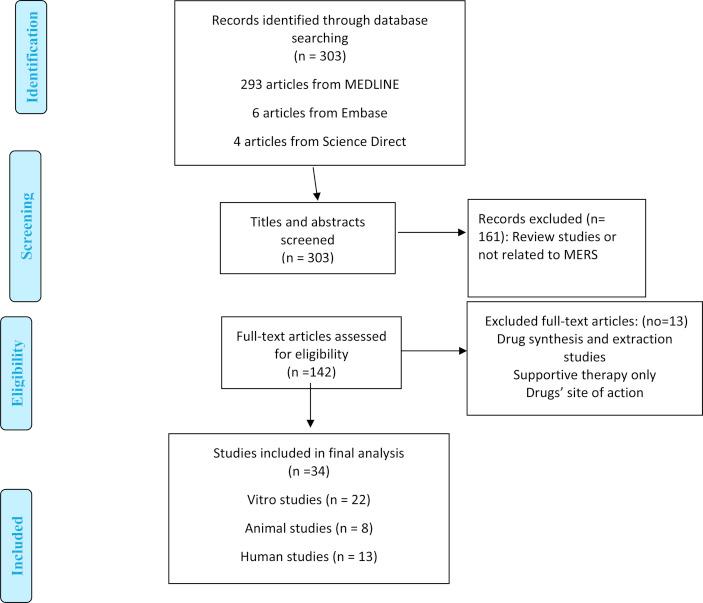
Initial search identified 62 articles: 52 articles were from Medline, 6 from Embase, and 4 from Science Direct. Based on the inclusions and exclusions criteria, 30 articles were included in the final review and comprised: 22 in vitro studies, 8 studies utilizing animal models, 13 studies in humans, and one study included both in vitro and animal model. There are a few promising therapeutic agents on the horizon. The combination of lopinavir/ritonavir and interferon-beta- 1b showed excellent results in common marmosets and currently is in a randomized control trial. Ribavirin and interferon were the most widely used combination and experience comes from a number of observational studies. Although, the data are heterogenous, this combination might be of potential benefit and deserve further investigation. There were no randomized clinical trials to recommend specific therapy for the treatment of MERS-CoV infection. Only one such study is planned for randomization and is pending completion. The study is based on a combination of lopinavir/ritonavir and interferon-beta- 1b. A fully human polyclonal IgG antibody (SAB-301) was safe and well tolerated in healthy individuals and this agent may deserve further testing for efficacy.
CONCLUSION
Despite multiple studies in humans there is no consensus on the optimal therapy for MERS-CoV. Randomized clinical trials are needed and potential therapies should be evaluated only in such clinical trials. In order to further enhance the therapeutic aroma for MERS-CoV infection, repurposing old drugs against MERS-CoV is an interesting strategy and deserves further consideration and use in clinical settings.
背景
中东呼吸综合征冠状病毒(MERS-CoV)于 2012 年首次被描述,由于多次与医疗保健相关的暴发,引起了国际社会的极大关注。该疾病的病死率高达 34.5%,目前尚无国际或国家推荐的治疗方法。
方法
我们检索了 MEDLINE、Science Direct、Embase 和 Scopus 数据库,以获取截至 2019 年 3 月描述 MERS 体外、体内或人体治疗的相关论文。
结果
初步搜索确定了 62 篇文章:52 篇来自 Medline,6 篇来自 Embase,4 篇来自 Science Direct。根据纳入和排除标准,有 30 篇文章被纳入最终综述,包括:22 项体外研究、8 项动物模型研究、13 项人体研究和 1 项同时包括体外和动物模型的研究。有一些有前途的治疗药物即将出现。洛匹那韦/利托那韦和干扰素-β-1b 的联合治疗在普通狨猴中显示出极好的效果,目前正在进行随机对照试验。利巴韦林和干扰素是最广泛使用的联合治疗方法,经验来自许多观察性研究。尽管数据存在异质性,但这种联合治疗可能具有潜在的益处,值得进一步研究。没有随机临床试验推荐特定的治疗方法用于治疗 MERS-CoV 感染。只有一项此类研究计划进行随机分组,目前正在等待完成。该研究基于洛匹那韦/利托那韦和干扰素-β-1b 的联合治疗。一种完全人源化的多克隆 IgG 抗体(SAB-301)在健康个体中安全且耐受性良好,该药物可能值得进一步评估其疗效。
结论
尽管有多项针对人类的研究,但对于 MERS-CoV 的最佳治疗方法仍没有共识。需要进行随机临床试验,只有在这种临床试验中才能评估潜在的治疗方法。为了进一步提高 MERS-CoV 感染的治疗效果,重新利用针对 MERS-CoV 的老药是一种有趣的策略,值得进一步考虑和在临床环境中使用。
 Zotero 插件