
TRPV4 在骨髓来源的 CD11c 细胞中的表达和功能作用。
Expression and Functional Role of TRPV4 in Bone Marrow-Derived CD11c Cells.
机构信息
Laboratory of Ion Channel Research, Dept. of Cellular and Molecular Medicine, KU Leuven, 3000 Leuven, Belgium.
VIB Center for Brain & Disease Research, 3000 Leuven, Belgium.
出版信息
Int J Mol Sci. 2019 Jul 10;20(14):3378. doi: 10.3390/ijms20143378.
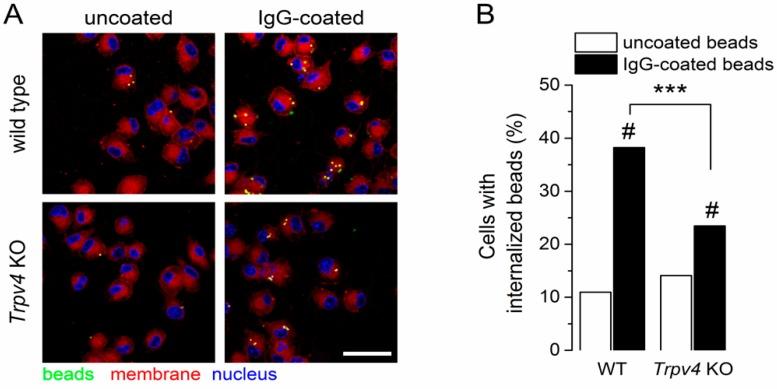
The increase in cytosolic Ca is essential in key effector functions of dendritic cells (DCs), including differentiation, maturation, cytokine expression, and phagocytosis. Although several Ca-permeable ion channels have been described in DCs, the contribution of transient receptor potential (TRP) channels remains poorly understood. Here, we investigated whether TRPV4 plays a role in the differentiation, maturation, and phagocytosis of granulocyte-macrophage colony-stimulating factor (GM-CSF)-induced mouse bone marrow-derived cells (BMDCs). Using intracellular Ca imaging experiments, we found that TRPV4 was functionally expressed in the plasma membrane of immature CD11c BMDCs and that its activity and expression were downregulated in CD11c BMDCs matured with lipopolysaccharide (LPS). Comparative analysis of the GM-CSF-stimulated cells showed that knockout and wild-type bone marrow cultures had a similar distribution of differentiated cells, generating a heterogenous culture population rich in CD11c, CD11b cells, and low levels of F4/80 cells. The lack of TRPV4 did not prevent the LPS-induced nuclear translocation of NF-κB, the upregulation of the proinflammatory cytokines IL-6 and IL-12, or the upregulation of the maturation markers CD40, CD80, and CD86. In contrast, TRPV4-deficient CD11c BMDCs exhibited a significantly reduced endocytic capacity of IgG-coated beads, but the internalization of uncoated beads in the absence of TRPV4 was not affected. Taken together, our results demonstrate that TRPV4 was dispensable in the differentiation and maturation of mouse CD11c BMDCs but contributed to the mechanism underlying Fc receptor-mediated phagocytosis. Overall, our results further strengthen the role of TRPV4 in immune-related processes.
细胞质 Ca 增加对于树突状细胞 (DCs) 的关键效应功能至关重要,包括分化、成熟、细胞因子表达和吞噬作用。尽管已经在 DCs 中描述了几种 Ca 渗透性离子通道,但瞬时受体电位 (TRP) 通道的贡献仍知之甚少。在这里,我们研究了 TRPV4 是否在粒细胞-巨噬细胞集落刺激因子 (GM-CSF)诱导的小鼠骨髓来源细胞 (BMDCs)的分化、成熟和吞噬作用中发挥作用。通过细胞内 Ca 成像实验,我们发现 TRPV4 在未成熟的 CD11c BMDCs 的质膜中功能性表达,并且其活性和表达在 LPS 成熟的 CD11c BMDCs 中下调。对 GM-CSF 刺激的细胞进行比较分析表明,TRPV4 敲除和野生型骨髓培养物具有相似的分化细胞分布,产生富含 CD11c、CD11b 细胞的异质培养物群体,并且 F4/80 细胞水平较低。TRPV4 的缺失并未阻止 NF-κB 的核易位,促炎细胞因子 IL-6 和 IL-12 的上调,或成熟标志物 CD40、CD80 和 CD86 的上调。相反,TRPV4 缺陷型 CD11c BMDCs 的 IgG 包被珠的内吞能力显著降低,但在没有 TRPV4 的情况下未包被珠的内化不受影响。总之,我们的结果表明 TRPV4 在小鼠 CD11c BMDCs 的分化和成熟中不是必需的,但有助于 Fc 受体介导的吞噬作用的机制。总体而言,我们的结果进一步加强了 TRPV4 在免疫相关过程中的作用。


 Zotero 插件