
PolyCRACKER,一种通过重复 DNA 进化特征进行多倍体亚基因组无监督分区的强大方法。
PolyCRACKER, a robust method for the unsupervised partitioning of polyploid subgenomes by signatures of repetitive DNA evolution.
机构信息
DOE Joint Genome Institute, 2800 Mitchell Dr, Walnut Creek, CA, 94598, USA.
University of California Berkeley, Berkeley, CA, USA.
出版信息
BMC Genomics. 2019 Jul 12;20(1):580. doi: 10.1186/s12864-019-5828-5.
BACKGROUND
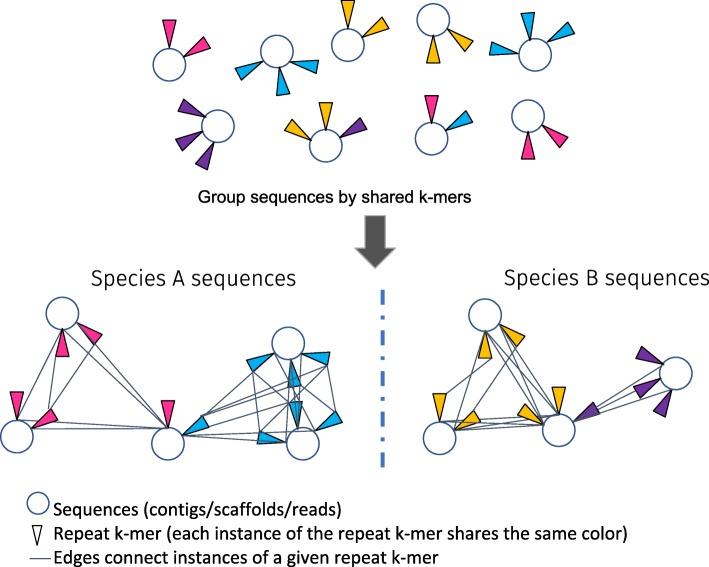
Our understanding of polyploid genomes is limited by our inability to definitively assign sequences to a specific subgenome without extensive prior knowledge like high resolution genetic maps or genome sequences of diploid progenitors. In theory, existing methods for assigning sequences to individual species from metagenome samples could be used to separate subgenomes in polyploid organisms, however, these methods rely on differences in coarse genome properties like GC content or sequences from related species. Thus, these approaches do not work for subgenomes where gross features are indistinguishable and related genomes are lacking. Here we describe a method that uses rapidly evolving repetitive DNA to circumvent these limitations.
RESULTS
By using short, repetitive, DNA sequences as species-specific signals we separated closely related genomes from test datasets and subgenomes from two polyploid plants, tobacco and wheat, without any prior knowledge.
CONCLUSION
This approach is ideal for separating the subgenomes of polyploid species with unsequenced or unknown progenitor genomes.
背景
由于缺乏高分辨率遗传图谱或二倍体祖先基因组序列等广泛的先验知识,我们无法明确地将序列分配给特定的亚基因组,从而限制了我们对多倍体基因组的理解。从理论上讲,可以将现有的从宏基因组样本中分配序列到单个物种的方法用于分离多倍体生物中的亚基因组,但是,这些方法依赖于粗基因组特性(如 GC 含量)或来自相关物种的序列的差异。因此,这些方法不适用于粗特征无法区分且缺乏相关基因组的亚基因组。在这里,我们描述了一种使用快速进化的重复 DNA 来规避这些限制的方法。
结果
通过使用短的重复 DNA 序列作为物种特异性信号,我们无需任何先验知识即可从测试数据集和两个多倍体植物(烟草和小麦)的亚基因组中分离出密切相关的基因组。
结论
对于分离具有未测序或未知祖先基因组的多倍体物种的亚基因组,这种方法是理想的选择。



 Zotero 插件