
微 RNA 表达谱筛选 miR-3557/324-靶向帕金森病大鼠纹状体的规律有氧运动。
MicroRNA Expression Profiling Screen miR-3557/324-Targeted in the Rat Striatum of Parkinson's Disease in Regular Aerobic Exercise.
机构信息
Hunan Provincial Key Laboratory of Physical Fitness and Sports Rehabilitation, Hunan Normal University, Changsha, Hunan, 410012, China.
Department of Experimental and Clinical Pharmacology, University of Minnesota, Minneapolis, MN 55455, USA.
出版信息
Biomed Res Int. 2019 Jun 12;2019:7654798. doi: 10.1155/2019/7654798. eCollection 2019.
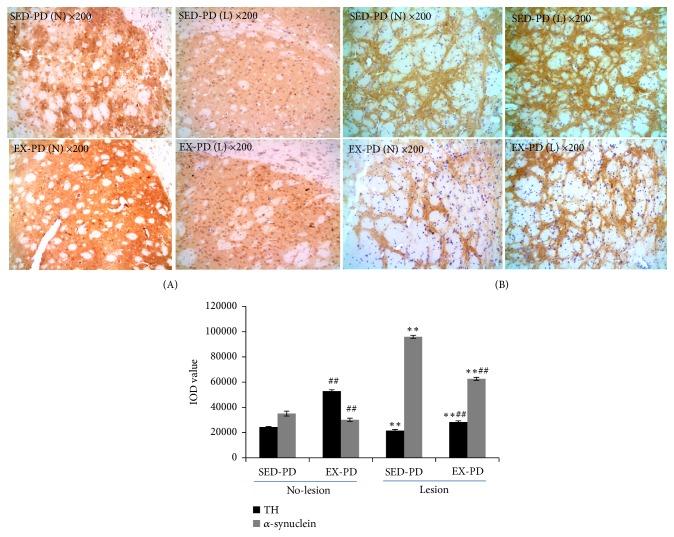
This study aimed to screen the target miRNAs and to investigate the differential miR-3557/324-targeted signal mechanisms in the rats' model of Parkinson's disease (PD) with regular aerobic exercise. Rats were divided into sedentary control PD group (SED-PD, = 18) and aerobic exercise PD group (EX-PD, = 22). After 8 weeks of regular aerobic exercise, a 6-hydroxydopamine- (6-OHDA-) induced PD lesion model was constructed. Preregular aerobic exercises enhanced the injury resistance of rats with 6-OHDA-induced PD. The rotational behavior after injection of apomorphine hydrochloride was alleviated. Under the scanning electron microscopy, we found the neurons, axons, and villi of the striatum were clearly and tightly arranged, and neurons and axons significantly becoming larger. Tyrosine hydroxylase (TH) was increased significantly and -synuclein protein expression was reduced in the EX-PD group compared to the SED-PD group. Screening from miRNA microarray chip, we further found upregulation of miR-3557 and downregulation of miR-324 were closely related to the calcium-modulating signaling pathway, remitting the progress of Parkinson's disease on aerobic exercise. Compared to the SED-PD group, Ca/calmodulin dependent protein kinase II () was upregulated, but and voltage-dependent anion-selective channel protein 1 () were significantly downregulated in the EX-PD group. Additionally, phosphatidylinositol-3-kinase ()/mammalian target of rapamycin () expression were activated, and ubiquitin carboxy-terminal hydrolase L1 () expression was upregulated in the EX-PD group. Conclusions: the adaptive mechanism of regular aerobic exercise delaying neurodegenerative diseases and lesions was that miR-3557/324 was activated to regulate one of its targets CaMKs signaling pathways. CaMKs, coordinated with mTOR pathway-related gene expression, improved UCH-L1 level to favor for delaying neurodegeneration or improving the pathogenesis of PD lesions.
这项研究旨在筛选靶 miRNAs,并探讨常規有氧運動对帕金森病(PD)大鼠模型中差异 miR-3557/324 靶向信号机制。大鼠分为安静对照组 PD 组(SED-PD,n=18)和有氧運動 PD 组(EX-PD,n=22)。8 周后,建立了常規有氧運動后 6-羟多巴胺(6-OHDA)诱导的 PD 损伤模型。有氧運動前可增强大鼠 6-OHDA 诱导的 PD 损伤抵抗。盐酸阿朴吗啡注射后旋转行为得到缓解。扫描电子显微镜下发现纹状体神经元、轴突和微绒毛排列清晰、紧密,神经元和轴突明显增大。与 SED-PD 组相比,EX-PD 组酪氨酸羟化酶(TH)显著增加,-突触核蛋白表达减少。从 miRNA 微阵列芯片筛选中,我们发现 miR-3557 上调和 miR-324 下调与钙调节信号通路密切相关,可缓解有氧運動对帕金森病的进展。与 SED-PD 组相比,EX-PD 组 Ca/calmodulin 依赖性蛋白激酶 II(CaMKII)上调,但钙调蛋白依赖性蛋白激酶抑制剂(CaMKIN)和电压依赖性阴离子选择通道蛋白 1(VDAC1)显著下调。此外,磷酸肌醇-3-激酶(PI3K)/哺乳动物雷帕霉素靶蛋白(mTOR)表达被激活,泛素羧基末端水解酶 L1(UCH-L1)表达上调。结论:常規有氧運動延缓神经退行性疾病和损伤的适应机制是通过激活 miR-3557/324 来调节其靶标之一的 CaMKs 信号通路。CaMKs 与 mTOR 通路相关基因表达协调,提高 UCH-L1 水平,有利于延缓神经退行性变或改善 PD 病变的发病机制。




 Zotero 插件