
了解计划生育方法选择与现代避孕方法使用之间的关系:对海地地理关联的人口与卫生设施数据的分析
Understanding the relationship between family planning method choices and modern contraceptive use: an analysis of geographically linked population and health facilities data in Haiti.
作者信息
Wang Wenjuan, Mallick Lindsay
机构信息
The Demographic and Health Surveys (DHS) Program, Division of International Health and Development, ICF, Rockville, Maryland, USA.
The DHS Program, Avenir Health, Glastonbury, Connecticut, USA.
出版信息
BMJ Glob Health. 2019 Jul 1;4(Suppl 5):e000765. doi: 10.1136/bmjgh-2018-000765. eCollection 2019.
INTRODUCTION
This study linked data from the 2012 Haiti Demographic and Health Survey (DHS) and the 2013 Haiti Service Provision Assessment (SPA) to estimate the extent to which women's contraceptive use is associated with the method choices available in Haiti's health facilities.
METHODS
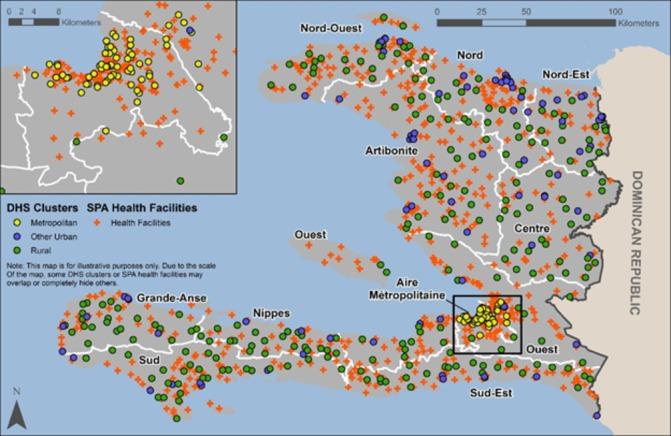
Using Global Positioning System (GPS) data for DHS clusters and for health facilities, we linked each DHS cluster to all of the family planning facilities located within a specified distance, and then measured the cluster's level of contraceptive method choice based on the number of facilities within the buffer zone that offered three or more modern contraceptive methods. Random intercept logistic regressions were used to model the variation in individual modern contraceptive use and the availability of multiple method choices at the cluster level.
RESULTS
Limited number of family planning facilities in Haiti offered at least three modern contraceptive methods (51% in urban and 23% in rural). Seventeen percent of both rural and urban women lived in an area with low availability of multiple methods-meaning that no facility in the specified buffer zone offered three or more contraceptive methods. Another 29% of rural women and 41% of urban women had medium availability-that is, only one facility in the buffer zone offered three or more methods. In rural areas, compared with women living in a cluster with low availability of multiple methods, the odds of using a modern method are 73% higher for women living in a cluster with medium availability, and over twice as high for women living in a cluster with high availability. A similar positive relationship was also found in urban areas.
CONCLUSIONS
Women in Haiti have only limited proximity to a health facility offering a variety of contraceptive methods. Improving access to a range of methods available at health facilities near where people live is critical for increasing contraceptive use in both urban and rural areas of Haiti.
引言
本研究将2012年海地人口与健康调查(DHS)和2013年海地服务提供评估(SPA)的数据相联系,以估计海地女性的避孕措施使用情况与海地医疗机构所提供的方法选择之间的关联程度。
方法
利用针对DHS群组和医疗机构的全球定位系统(GPS)数据,我们将每个DHS群组与指定距离内的所有计划生育机构相联系,然后根据缓冲区中提供三种或更多现代避孕方法的机构数量来衡量该群组的避孕方法选择水平。随机截距逻辑回归用于对个体现代避孕措施使用情况的变化以及群组层面多种方法选择的可得性进行建模。
结果
海地提供至少三种现代避孕方法的计划生育机构数量有限(城市地区为51%,农村地区为23%)。农村和城市地区均有17%的女性生活在多种方法可得性较低的地区,即指定缓冲区中没有机构提供三种或更多避孕方法。另外,29%的农村女性和41%的城市女性所在地区的可得性为中等水平,也就是说缓冲区中只有一个机构提供三种或更多方法。在农村地区,与生活在多种方法可得性较低群组的女性相比,生活在可得性为中等水平群组的女性使用现代方法的几率高73%,而生活在可得性高的群组的女性使用现代方法的几率则高出两倍多。在城市地区也发现了类似的正相关关系。
结论
海地女性距离提供多种避孕方法的医疗机构较近的机会有限。改善人们居住地点附近的医疗机构提供的一系列避孕方法的可及性,对于增加海地城乡地区的避孕措施使用至关重要。



 Zotero 插件