
中国宁波市登革热疫情的发病动态及关键干预措施的研究。
Incidence dynamics and investigation of key interventions in a dengue outbreak in Ningbo City, China.
机构信息
Ningbo Municipal Center for Disease Control and Prevention, Ningbo City, Zhejiang Province, People's Republic of China.
State Key Laboratory of Molecular Vaccinology and Molecular Diagnostics, School of Public Health, Xiamen University, Xiamen City, Fujian Province, People's Republic of China.
出版信息
PLoS Negl Trop Dis. 2019 Aug 15;13(8):e0007659. doi: 10.1371/journal.pntd.0007659. eCollection 2019 Aug.
BACKGROUND
The reported incidence of dengue fever increased dramatically in recent years in China. This study aimed to investigate and to assess the effectiveness of intervention implemented in a dengue outbreak in Ningbo City, Zhejiang Province, China.
METHODS
Data of a dengue outbreak were collected in Ningbo City in China by a field epidemiological survey according to a strict protocol and case definition. Serum specimens of all cases were collected for diagnosis and the virological characteristics were detected by using polymerase chain reaction (PCR) and gene sequencing. Vector surveillance was implemented during the outbreak to collect the larva and adult mosquito densities to calculate the Breteau Index (BI) and human biting rate (HBR), respectively. Data of monthly BI and light-trap density in 2018 were built to calculate the seasonality of the vector. A transmission mathematical model was developed to dynamic the incidence of the disease. The parameters of the model were estimated by the data of the outbreak and vector surveillance data in 2018. The effectiveness of the interventions implemented during the outbreak was assessed by the data and the modelling.
RESULTS
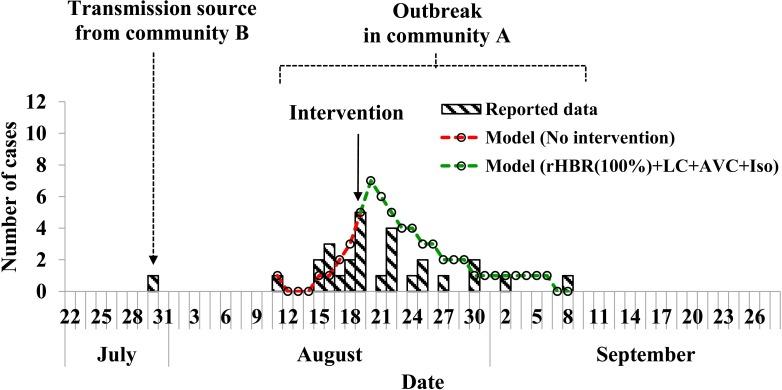
From 11 August to 8 September, 2018, a dengue outbreak was reported with 27 confirmed cases in a population of 5536-people community (community A) of Ningbo City. Whole E gene sequences were obtained from 24 cases and were confirmed as dengue virus type 1 (DENV-1). The transmission source of the outbreak was origin from community B where a dengue case having the same E gene sequence was onset on 30 July. Aedes albopictus was the only vector species in the area. The value of BI and HBR was 57.5 and 12 per person per hour respectively on 18 August, 2018 and decreased dramatically after interventions. The transmission model fitted well (χ2 = 6.324, P = 0.388) with the reported cases data. With no intervention, the total simulated number of the cases would be 1728 with a total attack rate (TAR) of 31.21% (95%CI: 29.99%- 32.43%). Case isolation and larva control (LC) have almost the same TAR and duration of outbreak (DO) as no intervention. Different levels of reducing HBR (rHBR) had different effectiveness with TARs ranging from 1.05% to 31.21% and DOs ranging from 27 days to 102 days. Adult vector control (AVC) had a very low TAR and DO. "LC+AVC" had a similar TAR and DO as that of AVC. "rHBR100%+LC", "rHBR100%+AVC", "rHBR100%+LC+AVC" and "rHBR100%+LC+AVC+Iso" had the same effectiveness.
CONCLUSIONS
Without intervention, DENV-1 could be transmitted rapidly within a short period of time and leads to high attack rate in community in China. AVC or rHBR should be recommended as primary interventions to control rapid transmission of the dengue virus at the early stage of an outbreak.
背景
近年来,中国登革热报告发病率显著上升。本研究旨在调查和评估在中国浙江省宁波市登革热疫情中实施的干预措施的效果。
方法
通过严格的方案和病例定义,在中国宁波市进行了登革热疫情的现场流行病学调查,收集了疫情数据。采集所有病例的血清标本进行诊断,并采用聚合酶链反应(PCR)和基因测序检测病毒学特征。在疫情期间进行媒介监测,收集幼虫和成蚊密度,分别计算布雷特指数(BI)和人蚊叮咬率(HBR)。建立了 2018 年每月 BI 和诱蚊灯密度的数据,以计算媒介的季节性。建立了传播数学模型,以动态模拟疾病的发病率。利用疫情数据和 2018 年媒介监测数据对模型参数进行了估计。通过数据和建模评估了疫情期间实施的干预措施的效果。
结果
2018 年 8 月 11 日至 9 月 8 日,在宁波市一个 5536 人的社区(社区 A)报告了一起登革热疫情,共有 27 例确诊病例。从 24 例病例中获得了全长 E 基因序列,并证实为登革病毒 1 型(DENV-1)。疫情的传播源来自社区 B,那里有一例发病日期为 7 月 30 日、具有相同 E 基因序列的登革热病例。该地区唯一的媒介物种为白纹伊蚊。2018 年 8 月 18 日,BI 和 HBR 值分别为 57.5 和 12 人/小时,干预后急剧下降。传播模型拟合良好(χ2=6.324,P=0.388),与报告病例数据相符。如果没有干预,预计总模拟病例数为 1728 例,总发病率(TAR)为 31.21%(95%CI:29.99%-32.43%)。病例隔离和幼虫控制(LC)的 TAR 和疫情持续时间(DO)与无干预基本相同。不同程度降低 HBR(rHBR)的效果不同,TAR 范围为 1.05%-31.21%,DO 范围为 27 天-102 天。成蚊媒介控制(AVC)的 TAR 和 DO 非常低。“LC+AVC”的 TAR 和 DO 与 AVC 相似。“rHBR100%+LC”、“rHBR100%+AVC”、“rHBR100%+LC+AVC”和“rHBR100%+LC+AVC+Iso”具有相同的效果。
结论
在中国,如果没有干预,登革热病毒可以在短时间内迅速传播,并导致社区发病率很高。在疫情早期,应推荐 AVC 或 rHBR 作为主要干预措施,以控制登革热病毒的快速传播。




 Zotero 插件