
基于无线通信的小型化水质监测系统的开发
Development of Miniaturized Water Quality Monitoring System Using Wireless Communication.
作者信息
Yu Hsing-Cheng, Tsai Ming-Yang, Tsai Yuan-Chih, You Jhih-Jyun, Cheng Chun-Lin, Wang Jung-How, Li Szu-Ju
机构信息
Department of Systems Engineering and Naval Architecture, National Taiwan Ocean University, 2 Pei-Ning Road, Keelung 20224, Taiwan.
Material and Chemical Research Laboratories, Industrial Technology Research Institute, 195, Sec. 4, Chung Hsing Road, Chutung, Hsinchu 31040, Taiwan.
出版信息
Sensors (Basel). 2019 Aug 30;19(17):3758. doi: 10.3390/s19173758.
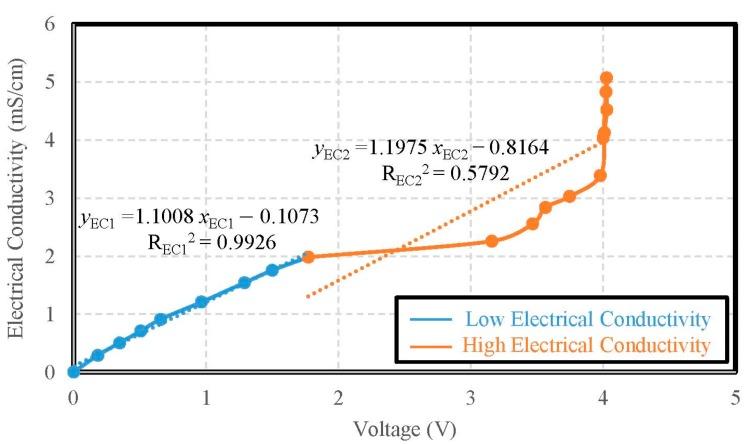
Recently, environmental pollution resulting from industrial waste has been emerging in an endless stream. The industrial waste contains chemical materials, heavy metal ions, and other toxic materials. Once the industrial waste is discharged without standards, it might lead to water or environmental pollution. Hence, it has become more important to provide evidence-based water quality monitoring. The use of a multifunctional miniaturized water quality monitoring system (WQMS), that contains continuous monitoring, water quality monitoring, and wireless communication applications, simultaneously, is infrequent. Thus, electrodes integrated with polydimethylsiloxane flow channels were presented in this study to be a compound sensor, and the sensor can be adopted concurrently to measure temperature, pH, electrical conductivity, and copper ion concentration, whose sensitivities are determined as 0.0193 °C/mV, -0.0642 pH/mV, 1.1008 mS/V·cm (from 0 mS/cm to 2 mS/cm) and 1.1975 mS/V·cm (from 2 mS/cm to 5.07 mS/cm), and 0.0111 ppm/mV, respectively. A LoRa shield connected into the system could provide support as a node of long range wide area network (LoRaWAN) for wireless communication application. As mentioned above, the sensors, LoRa, and circuit have been integrated in this study to a continuous monitoring system, WQMS. The advantages of the multifunctional miniaturized WQMS are low cost, small size, easy maintenance, continuous sampling and long-term monitoring for many days. Every tested period is 180 min, and the measured rate is 5 times per 20 min. The feedback signals of the miniaturized WQMS and measured values of the instrument were obtained to compare the difference. In the measured results at three different place-to-place locations the errors of electrical conductivity are 0.051 mS/cm, 0.106 mS/cm, and 0.092 mS/cm, respectively. The errors of pH are 0.68, 0.87, and 0.56, respectively. The errors of temperature are 0.311 °C, 0.252 °C, and 0.304 °C, respectively. The errors of copper ion concentration are 0.051 ppm, 0.058 ppm, 0.050 ppm, respectively.
近年来,工业废弃物造成的环境污染层出不穷。工业废弃物含有化学物质、重金属离子及其他有毒物质。一旦工业废弃物未经规范排放,可能导致水污染或环境污染。因此,提供循证水质监测变得愈发重要。同时具备连续监测、水质监测及无线通信应用功能的多功能小型化水质监测系统(WQMS)并不常见。因此,本研究提出将电极与聚二甲基硅氧烷流动通道集成,制成复合传感器,该传感器可同时用于测量温度、pH值、电导率和铜离子浓度,其灵敏度分别为0.0193℃/mV、-0.0642pH/mV、1.1008mS/V·cm(从0mS/cm至2mS/cm)和1.1975mS/V·cm(从2mS/cm至5.07mS/cm),以及0.0111ppm/mV。连接到系统中的LoRa屏蔽可作为长距离广域网(LoRaWAN)的节点为无线通信应用提供支持。如上所述,本研究已将传感器、LoRa和电路集成到一个连续监测系统WQMS中。多功能小型化WQMS的优点是成本低、体积小、易于维护、可连续采样并能进行多日长期监测。每个测试周期为180分钟,测量频率为每20分钟5次。获取小型化WQMS的反馈信号和仪器的测量值以比较差异。在三个不同地点的测量结果中,电导率的误差分别为0.051mS/cm、0.106mS/cm和0.092mS/cm。pH值的误差分别为0.68、0.87和0.56。温度的误差分别为0.311℃、0.252℃和0.304℃。铜离子浓度的误差分别为0.051ppm、0.058ppm、0.050ppm。




 Zotero 插件