
沙特阿拉伯随机对照试验质量的系统评价。
Systematic review on the quality of randomized controlled trials from Saudi Arabia.
作者信息
Rajab Ahmad Mamoun, Hamza Abdulmalik, Aldairi Roshdi Kotiba, Alaloush Mohamad Mahmoud, Saquib Juliann, Saquib Nazmus
机构信息
College of Medicine, Sulaiman Al Rajhi Colleges, P.O. Box 777, Al Bukayriah, Qassim, 51941, Saudi Arabia.
College of Medicine, Qassim University, P.O. Box 6655, Buraidah, Qassim, 51452, Saudi Arabia.
出版信息
Contemp Clin Trials Commun. 2019 Aug 26;16:100441. doi: 10.1016/j.conctc.2019.100441. eCollection 2019 Dec.
BACKGROUND
The quality of randomized controlled trials from Saudi Arabia is unknown since most are observational studies.
OBJECTIVE
To determine (1) the quantity and quality of randomized controlled trials published from Saudi Arabia, and (2) whether significance of intervention effect varied by study quality.
METHODS
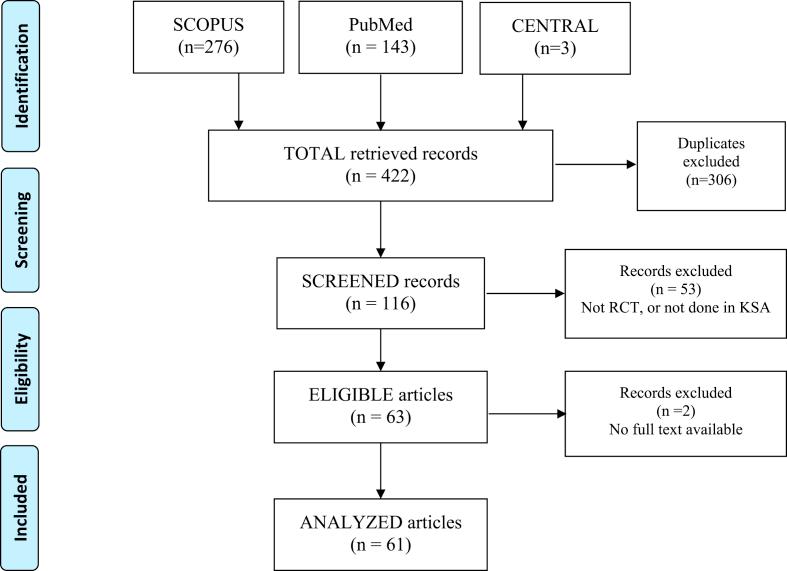
PubMed, SCOPUS, and Cochrane were searched with keywords for trials published from Saudi Arabia until February 2018. A total of 422 records were identified and screened, resulting in 61 eligible trials for analysis. Two researchers abstracted trial characteristics and assessed quality in seven domains (randomization, allocation concealment, blinding of assessors or participants, incomplete outcome data, selective reporting, and other sources of bias) using the Cochrane Collaboration Risk of Bias Tool.
RESULTS
A majority of the trials (57%) were published during 2010-2018. High risk of bias was present for blinding (outcome: 13%; participants and personnel: 28%). Biases could not be assessed due to lack of information (unclear risk) in the domains of randomization (54%), allocation concealment (44%), and blinding of outcome assessment (57%). When all seven domains were considered together (summary risk of bias), 0% of the trials had low risk, 39% had high risk, and 61% had unclear risk of biases. A greater proportion of high-risk trials had significant intervention effect than unclear-risk trials (79% vs. 67%).
CONCLUSION
The volume and quality of trials in Saudi Arabia was low. More high-quality randomized controlled trials are warranted to address chronic diseases.
背景
沙特阿拉伯的随机对照试验质量尚不清楚,因为大多数都是观察性研究。
目的
确定(1)沙特阿拉伯发表的随机对照试验的数量和质量,以及(2)干预效果的显著性是否因研究质量而异。
方法
在PubMed、SCOPUS和Cochrane数据库中检索截至2018年2月发表的沙特阿拉伯试验的关键词。共识别并筛选出422条记录,最终有61项符合条件的试验用于分析。两名研究人员使用Cochrane协作偏倚风险工具提取试验特征,并在七个领域(随机化、分配隐藏、评估者或参与者的盲法、不完整的结局数据、选择性报告以及其他偏倚来源)评估质量。
结果
大多数试验(57%)发表于2010 - 2018年。盲法存在高偏倚风险(结局:13%;参与者和人员:28%)。由于随机化(54%)、分配隐藏(44%)和结局评估盲法(57%)领域缺乏信息(风险不明确),无法评估偏倚。当综合考虑所有七个领域(偏倚汇总风险)时,0%的试验风险低,39%的试验风险高,61%的试验偏倚风险不明确。高风险试验中具有显著干预效果的比例高于风险不明确的试验(79%对67%)。
结论
沙特阿拉伯的试验数量和质量较低。需要更多高质量的随机对照试验来应对慢性病。


 Zotero 插件