
Effects of Compaction Velocity on the Sinterability of Al-Fe-Cr-Ti PM Alloy.
作者信息
Yuan Xianjie, Qu Xuanhui, Yin Haiqing, Yan Zhenwei, Tan Zhaojun
机构信息
Colleage Mechanic, North China University of Water Resources and Electric Power, Zhengzhou 450045, China.
Institute for Advanced Material and Technology, University of Science and Technology Beijing, Beijing 100083, China.
出版信息
Materials (Basel). 2019 Sep 16;12(18):3005. doi: 10.3390/ma12183005.
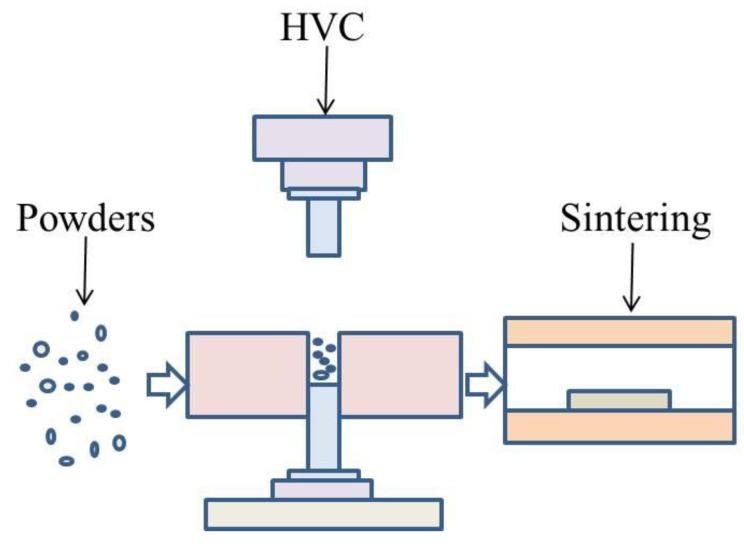
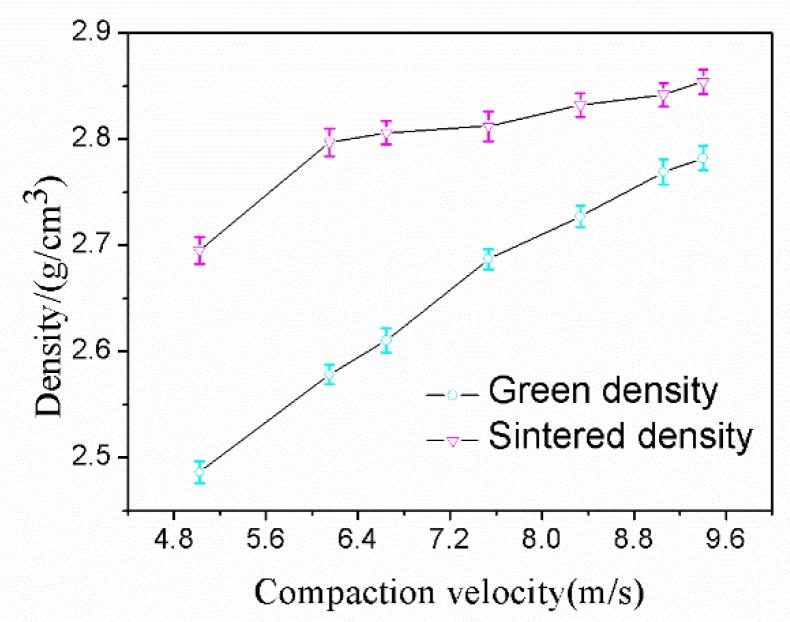
In this research, the effects of the compaction velocity on the sinterability of the Al-Fe-Cr-Ti powder metallurgy (PM) alloy by high velocity compaction were investigated. The Al-Fe-Cr-Ti alloy powder was compacted with different velocities by high velocity compaction and then sintered under a flow of high pure (99.999 wt%) nitrogen gas. Results indicated that both the sintered density and mechanical properties increased with increasing compaction velocity. By increasing the compaction velocity, the shrinkage of the sintered samples decreased. A maximum sintered density of 2.85 gcm (relative density is 98%) was obtained when the compaction velocity was 9.4 ms. The radial and axial shrinkage were controlled to less than 1% at a compaction velocity of 9.4 ms. At a compaction velocity of 9.4 ms, sintered compacts with an ultimate tensile strength of 222 MPa and a yield strength of 160 MPa were achieved. The maximum elongation was observed to be 2.6%. The enhanced tensile properties of the Al-Fe-Cr-Ti alloy were mainly due to particle boundary strengthening.






 Zotero 插件