
脊髓损伤后未训练肌肉的睾酮和电诱发抗阻训练与仅睾酮(TEREX-SCI)的二次分析:一项初步随机临床试验。
A secondary analysis of testosterone and electrically evoked resistance training versus testosterone only (TEREX-SCI) on untrained muscles after spinal cord injury: a pilot randomized clinical trial.
机构信息
Spinal Cord Injury and Disorders, Hunter Holmes McGuire VA Medical Center, Richmond, VA, USA.
Department of Physical Medicine and Rehabilitation; School of Medicine, Virginia Commonwealth University Richmond, Richmond, VA, USA.
出版信息
Spinal Cord. 2020 Mar;58(3):298-308. doi: 10.1038/s41393-019-0364-3. Epub 2019 Oct 22.
STUDY DESIGN
Secondary analysis of a clinical trial.
OBJECTIVES
To perform a secondary analysis on the effects of neuromuscular electrical stimulation resistance training (RT) combined with testosterone replacement therapy (TRT) compared with TRT on the untrained muscles after spinal cord injury (SCI).
SETTING
Medical research center.
METHODS
Twenty-two men with chronic motor complete SCI were randomized into TRT + RT group (n = 11) or TRT group (n = 11). Both groups received 16 weeks of TRT (2-6 mg/day) via testosterone patches. The TRT + RT group received twice weekly progressive RT of the knee extensor muscles using electrical stimulation and ankle weights. Magnetic resonance images were captured to measure cross-sectional areas (CSAs) of trunk, glutei, and leg muscles.
RESULTS
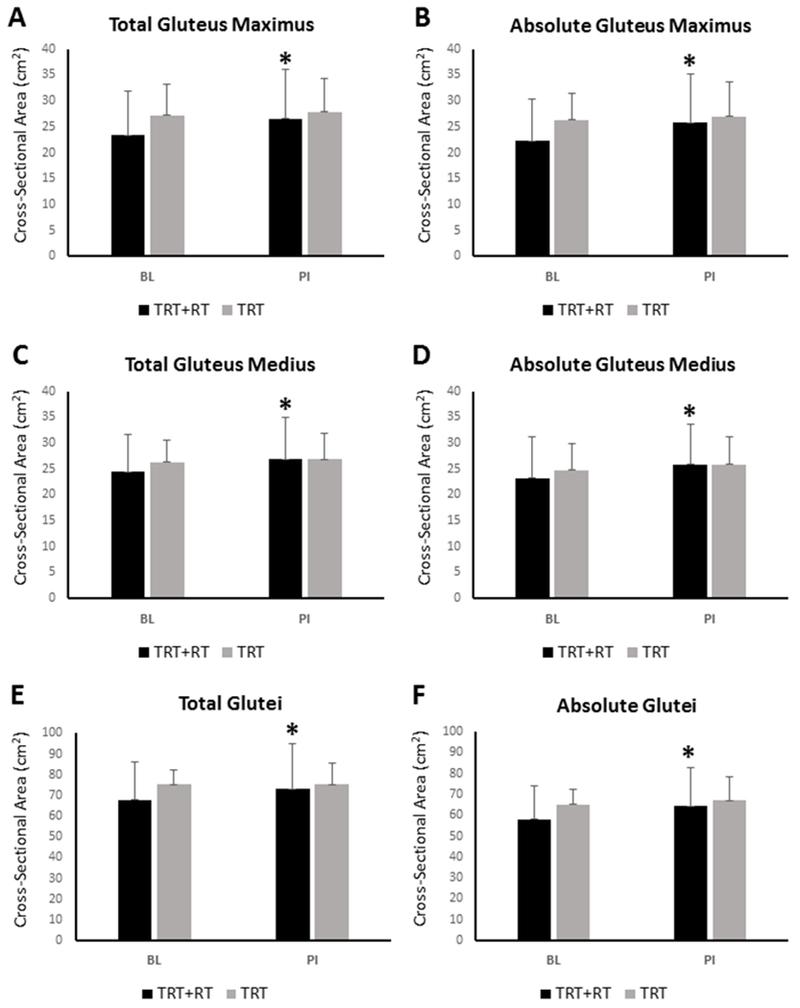
Total and absolute gluteus maximus m. (14%, P = 0.003 and 16%, P = 0.001), gluteus medius m. (10%; P = 0.008 and 14%; P = 0.02), and total glutei m. (8%, P = 0.01 and 11%, P = 0.005) CSAs increased overtime for the TRT + RT group. Mean between-group differences of 2.86 (95% CI: 0.30, 5.4), 1.89 (95% CI: 0.23, 3.58) and 5.27 (95% CI: 0.90, 9.69) cm were noted for absolute gluteus maximus, total gluteus medius and total glutei CSAs, respectively (P < 0.05). Trunk muscle CSAs showed a trend towards an interaction between groups.
CONCLUSIONS
RT combined with low-dose TRT results in significant hypertrophy compared with TRT only on the adjacent untrained glutei muscles. Trunk muscles may require direct stimulation to evoke hypertrophy. These exploratory findings may be of clinical relevance in the reduction of incidence and severity of pelvic pressure injuries.
研究设计
临床试验的二次分析。
目的
对脊髓损伤(SCI)后未经训练的肌肉进行神经肌肉电刺激抗阻训练(RT)联合睾酮替代疗法(TRT)与单纯 TRT 的疗效进行二次分析。
设置
医学研究中心。
方法
22 名慢性运动完全性 SCI 男性患者随机分为 TRT+RT 组(n=11)和 TRT 组(n=11)。两组均接受为期 16 周的睾酮贴剂(2-6mg/天)TRT。TRT+RT 组每周接受 2 次渐进性膝伸肌 RT,使用电刺激和脚踝重量。磁共振成像(MRI)用于测量躯干、臀肌和腿部肌肉的横截面积(CSA)。
结果
TRT+RT 组的臀大肌(14%,P=0.003 和 16%,P=0.001)、臀中肌(10%,P=0.008 和 14%,P=0.02)和臀肌总 CSA(8%,P=0.01 和 11%,P=0.005)在治疗期间逐渐增加。绝对臀大肌、臀中肌和臀肌总 CSA 的组间平均差异分别为 2.86(95%CI:0.30,5.4)、1.89(95%CI:0.23,3.58)和 5.27(95%CI:0.90,9.69)cm(P<0.05)。躯干肌肉 CSA 表现出组间交互作用的趋势。
结论
与单纯 TRT 相比,低剂量 TRT 联合 RT 可显著增加相邻未训练臀肌的肥大。躯干肌肉可能需要直接刺激才能引起肥大。这些探索性发现可能与减少骨盆压疮的发生率和严重程度具有临床相关性。

 Zotero 插件