
功能医学护理模式与患者报告的健康相关生活质量结果的关联。
Association of the Functional Medicine Model of Care With Patient-Reported Health-Related Quality-of-Life Outcomes.
机构信息
Center for Functional Medicine, Cleveland Clinic, Cleveland, Ohio.
Quantitative Health Sciences, Cleveland Clinic, Cleveland, Ohio.
出版信息
JAMA Netw Open. 2019 Oct 2;2(10):e1914017. doi: 10.1001/jamanetworkopen.2019.14017.
IMPORTANCE
The incidence of chronic disease is increasing along with health care-related costs. The functional medicine model of care provides a unique operating system to reverse illness, promote health, and optimize function. The association between this model of care and patient's health-related quality of life (HRQoL) is unknown.
OBJECTIVE
To assess the association between functional medicine and patient-reported HRQoL using Patient-Reported Outcome Measurement Information System (PROMIS) global health measures.
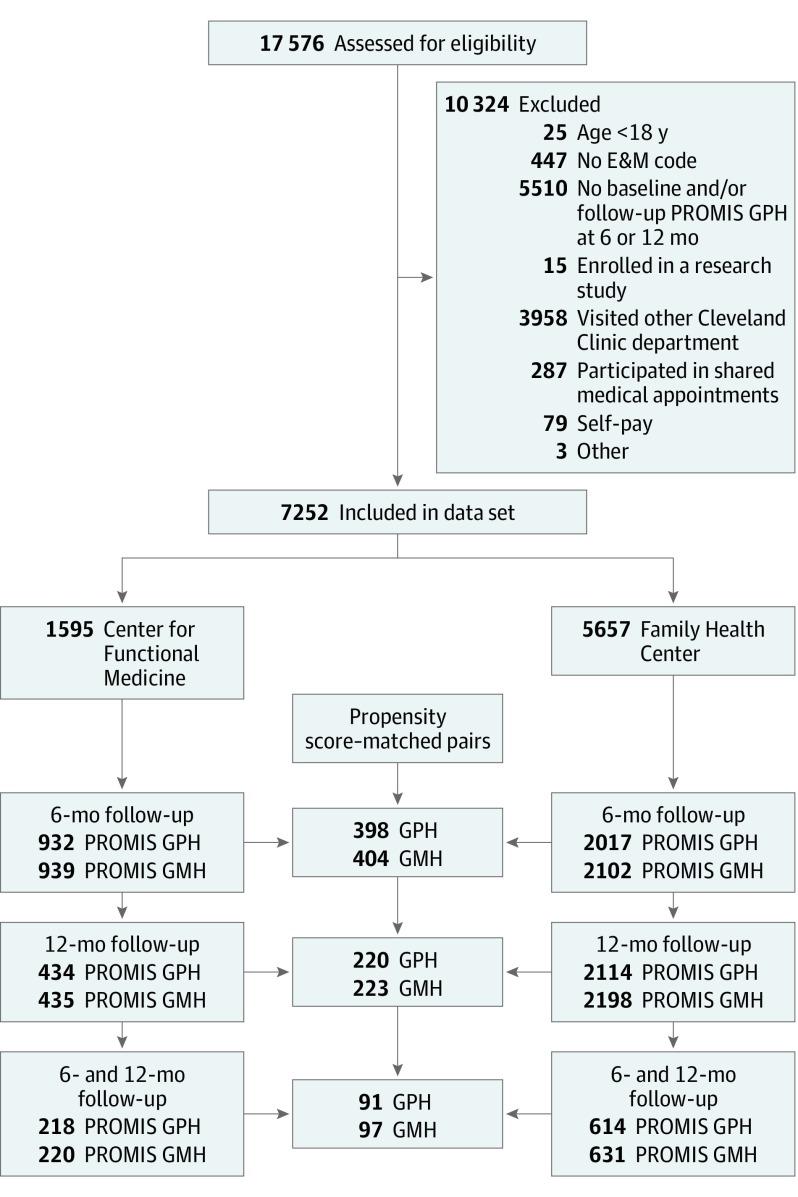
DESIGN, SETTING, AND PARTICIPANTS: A retrospective cohort study was performed to compare 7252 patients aged 18 years or older treated in a functional medicine setting with propensity score (PS)-matched patients in a primary care setting. Sensitivity analyses assessed improvement limited to patients seen at both 6 and 12 months. The study included patients who visited the Cleveland Clinic Center for Functional Medicine or a Cleveland Clinic family health center between April 1, 2015, and March 1, 2017.
MAIN OUTCOMES AND MEASURES
The primary outcome was change in PROMIS Global Physical Health (GPH) at 6 months. Secondary outcomes included PROMIS Global Mental Health (GMH) at 6 months and PROMIS GPH and GMH at 12 months. The PROMIS GPH and GMH scores were transformed to a T-score from 0 to 100 with a mean of 50. Higher scores indicate a better health-related quality of life.
RESULTS
Of the 7252 patients (functional medicine center: 1595; family health center: 5657), 4780 (65.9%) were women; mean (SD) age was 54.1 (16.0) years. At 6 months, functional medicine patients exhibited significantly larger improvements in PROMIS GPH T-score points than were seen in patients treated at a family health center (mean [SD] change, functional medicine center: 1.59 [6.29] vs family health center: 0.33 [6.09], P = .004 in 398 PS-matched pairs). At 12 months, functional medicine patients showed improvement similar to that observed at 6 months; however, comparisons with patients seen at the family health center were not significant. Patients in the functional medicine center with data at both 6 and 12 months demonstrated improvements in PROMIS GPH (mean [SD], 2.61 [6.53]) that were significantly larger compared with patients seen at a family health center (mean [SD], 0.25 [6.54]) (P = .02 in 91 PS-matched pairs).
CONCLUSIONS AND RELEVANCE
In this study, the functional medicine model of care demonstrated beneficial and sustainable associations with patient-reported HRQoL. Prospective studies are warranted to confirm these findings.
重要性
随着医疗保健相关成本的增加,慢性病的发病率也在上升。功能医学护理模式提供了一个独特的操作系统,可以逆转疾病、促进健康和优化功能。这种护理模式与患者的健康相关生活质量(HRQoL)之间的关联尚不清楚。
目的
使用患者报告的结局测量信息系统(PROMIS)全球健康测量来评估功能医学与患者报告的 HRQoL 之间的关联。
设计、地点和参与者:进行了一项回顾性队列研究,以比较在功能医学环境中接受治疗的 7252 名年龄在 18 岁或以上的患者与在初级保健环境中经倾向评分(PS)匹配的患者。敏感性分析评估了仅在 6 个月和 12 个月就诊的患者的改善情况。该研究包括 2015 年 4 月 1 日至 2017 年 3 月 1 日期间在克利夫兰诊所功能医学中心或克利夫兰诊所家庭健康中心就诊的患者。
主要结局和测量
主要结局是 6 个月时 PROMIS 全球生理健康(GPH)的变化。次要结局包括 6 个月时的 PROMIS 全球心理健康(GMH)和 12 个月时的 PROMIS GPH 和 GMH。PROMIS GPH 和 GMH 评分从 0 到 100 转换为 T 评分,平均值为 50。分数越高表示健康相关生活质量越好。
结果
在 7252 名患者(功能医学中心:1595 名;家庭健康中心:5657 名)中,4780 名(65.9%)为女性;平均(SD)年龄为 54.1(16.0)岁。6 个月时,与在家庭健康中心接受治疗的患者相比,在功能医学中心接受治疗的患者在 PROMIS GPH T 评分上的改善幅度明显更大(功能医学中心:1.59 [6.29] vs 家庭健康中心:0.33 [6.09],P = .004 在 398 对 PS 匹配的对中)。12 个月时,功能医学组患者的表现与 6 个月时相似;然而,与家庭健康中心的比较并不显著。在功能医学中心同时具有 6 个月和 12 个月数据的患者,其 PROMIS GPH(平均 [SD],2.61 [6.53])的改善明显大于家庭健康中心的患者(平均 [SD],0.25 [6.54])(在 91 对 PS 匹配的对中,P = .02)。
结论和相关性
在这项研究中,功能医学护理模式与患者报告的 HRQoL 之间存在有益且可持续的关联。需要前瞻性研究来证实这些发现。

 Zotero 插件