
基于癫痫患者皮下 EEG 的自动睡眠阶段分类。
Automatic sleep stage classification based on subcutaneous EEG in patients with epilepsy.
机构信息
Department of Applied Mathematics and Computer Science, Technical University of Denmark, Richard Petersens Plads, Bygning 324, 2800, Kgs. Lyngby, Denmark.
UNEEG medical A/S, Nymoellevej 6, 3540, Lynge, Denmark.
出版信息
Biomed Eng Online. 2019 Oct 30;18(1):106. doi: 10.1186/s12938-019-0725-3.
BACKGROUND
The interplay between sleep structure and seizure probability has previously been studied using electroencephalography (EEG). Combining sleep assessment and detection of epileptic activity in ultralong-term EEG could potentially optimize seizure treatment and sleep quality of patients with epilepsy. However, the current gold standard polysomnography (PSG) limits sleep recording to a few nights. A novel subcutaneous device was developed to record ultralong-term EEG, and has been shown to measure events of clinical relevance for patients with epilepsy. We investigated whether subcutaneous EEG recordings can also be used to automatically assess the sleep architecture of epilepsy patients.
METHOD
Four adult inpatients with probable or definite temporal lobe epilepsy were monitored simultaneously with long-term video scalp EEG (LTV EEG) and subcutaneous EEG. In total, 11 nights with concurrent recordings were obtained. The sleep EEG in the two modalities was scored independently by a trained expert according to the American Academy of Sleep Medicine (AASM) rules. By using the sleep stage labels from the LTV EEG as ground truth, an automatic sleep stage classifier based on 30 descriptive features computed from the subcutaneous EEG was trained and tested.
RESULTS
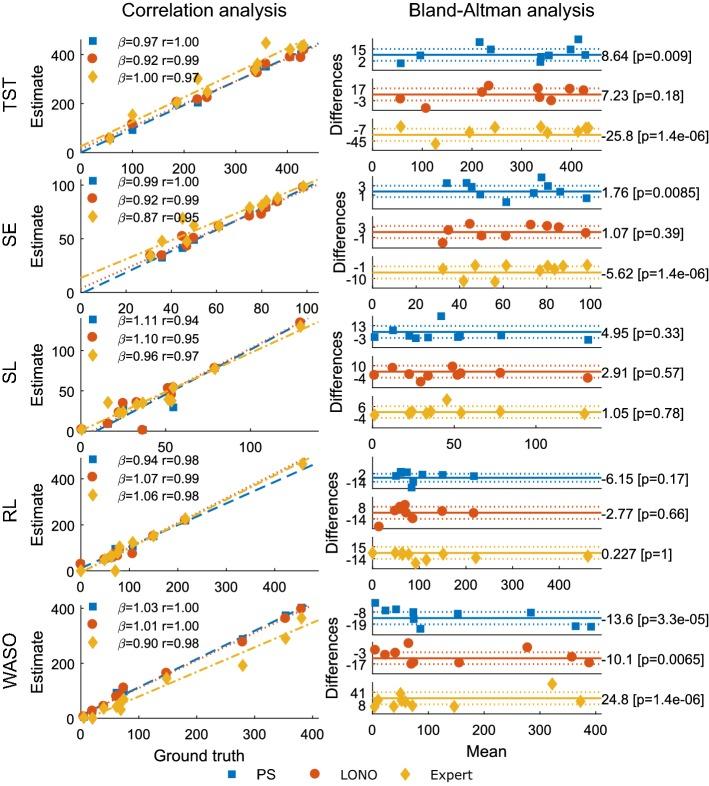
An average Cohen's kappa of [Formula: see text] was achieved using patient specific leave-one-night-out cross validation. When merging all sleep stages into a single class and thereby evaluating an awake-sleep classifier, we achieved a sensitivity of 94.8% and a specificity of 96.6%. Compared to manually labeled video-EEG, the model underestimated total sleep time and sleep efficiency by 8.6 and 1.8 min, respectively, and overestimated wakefulness after sleep onset by 13.6 min.
CONCLUSION
This proof-of-concept study shows that it is possible to automatically sleep score patients with epilepsy based on two-channel subcutaneous EEG. The results are comparable with the methods currently used in clinical practice. In contrast to comparable studies with wearable EEG devices, several nights were recorded per patient, allowing for the training of patient specific algorithms that can account for the individual brain dynamics of each patient. Clinical trial registered at ClinicalTrial.gov on 19 October 2016 (ID:NCT02946151).
背景
先前已有研究使用脑电图(EEG)来研究睡眠结构与癫痫发作概率之间的相互作用。将睡眠评估与超长时间 EEG 中的癫痫活动检测相结合,有可能优化癫痫患者的癫痫治疗和睡眠质量。但是,目前的金标准多导睡眠图(PSG)将睡眠记录限制在几个晚上。一种新的皮下设备已被开发出来用于记录超长时间 EEG,并已证明可以测量癫痫患者具有临床相关性的事件。我们研究了皮下 EEG 记录是否也可用于自动评估癫痫患者的睡眠结构。
方法
四名可能或确诊的颞叶癫痫成年住院患者同时接受长期视频头皮 EEG(LTV EEG)和皮下 EEG 监测。总共获得了 11 个具有同步记录的夜晚。两名经过培训的专家根据美国睡眠医学学会(AASM)规则独立对两种方式的睡眠 EEG 进行评分。通过使用 LTV EEG 的睡眠阶段标签作为基准,我们训练和测试了一种基于从皮下 EEG 计算的 30 个描述性特征的自动睡眠阶段分类器。
结果
采用患者特定的留一夜间交叉验证方法,平均 Cohen's kappa 值达到[Formula: see text]。当将所有睡眠阶段合并为一个单一类别,从而评估清醒-睡眠分类器时,我们实现了 94.8%的敏感性和 96.6%的特异性。与手动标记的视频 EEG 相比,该模型分别低估了总睡眠时间和睡眠效率 8.6 分钟和 1.8 分钟,并且高估了睡眠后清醒时间 13.6 分钟。
结论
这项概念验证研究表明,基于双通道皮下 EEG 自动对癫痫患者进行睡眠评分是可行的。结果与目前临床实践中使用的方法相当。与具有可穿戴 EEG 设备的类似研究相比,每位患者记录了多个夜晚,从而可以训练出针对每个患者个体大脑动态的患者特定算法。该研究于 2016 年 10 月 19 日在 ClinicalTrials.gov 上注册(ID:NCT02946151)。



 Zotero 插件