
烟花对狭窄山谷中颗粒物浓度的影响:以麦德林大都市区为例。
Effects of fireworks on particulate matter concentration in a narrow valley: the case of the Medellín metropolitan area.
机构信息
Departamento de Geociencias y Medio Ambiente, Facultad de Minas, Universidad Nacional de Colombia, Sede Medellín, Medellín, Colombia.
Sistema de Alerta Temprana de Medellín y el Valle de Aburrá (SIATA), Área Metropolitana del Valle de Aburrá (AMVA), Medellín, Colombia.
出版信息
Environ Monit Assess. 2019 Dec 3;192(1):6. doi: 10.1007/s10661-019-7838-9.
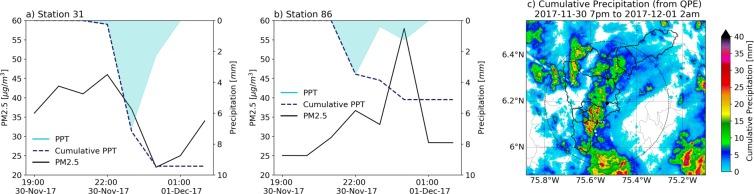
The extensive use of fireworks generates large amounts of pollutants, deteriorating air quality and potentially causing adverse health impacts. In Medellín and its metropolitan area, although fireworks are banned during December, their use is widespread during the Christmas season, particularly during the midnight of November 30 (La Alborada) and New Year's Eve (NYE). It is therefore essential to assess the effects of these celebrations on air quality in the region. Air-quality data from the official monitoring network and a low-cost particulate matter (PM) citizen science project, backscattering intensity (BI) retrievals from a ceilometer network, potential temperature from a microwave radiometer, and information from a radar wind profiler provide an excellent platform to study the spatio-temporal distribution of contaminants resulting from the La Alborada and NYE celebrations. Substantial increases in PM2.5 and PM10 mass concentrations due to La Alborada and NYE, ranging in some cases from 50 to 100 μgm, are observed in the Aburrá Valley and particularly in the densely populated communes of Medellín, with most concentration changes corresponding to ultrafine and fine particles. The PM increments resulting from fireworks show almost no increase in the net amount of black carbon in the atmosphere. Ceilometer BI profiles show a substantial change immediately after the La Alborada and NYE midnights, confined to the atmospheric boundary layer (ABL). Strong thermal inversions lead to fairly homogeneous increments in BI within the ABL, lasting until the onset of the convective boundary layer. In contrast, weak thermal inversions lead to rapid dispersion of aerosols, allowing them to episodically escape above the ABL.
烟花的广泛使用会产生大量污染物,恶化空气质量,并可能对健康造成不良影响。在麦德林及其大都市区,尽管 12 月禁止燃放烟花,但在圣诞节期间,尤其是在 11 月 30 日午夜(拉阿尔博拉达)和新年前夜(NYE)期间,烟花的使用非常普遍。因此,评估这些庆祝活动对该地区空气质量的影响至关重要。官方监测网络和一个低成本颗粒物(PM)公民科学项目的空气质量数据、一个激光雷达网络的反向散射强度(BI)反演、一个微波辐射计的位温数据以及一个雷达风廓线仪的信息,为研究拉阿尔博拉达和 NYE 庆祝活动导致的污染物的时空分布提供了极好的平台。在阿布拉谷,特别是在人口稠密的麦德林社区,由于拉阿尔博拉达和 NYE,PM2.5 和 PM10 质量浓度大幅增加,在某些情况下,增加了 50 到 100μg/m3。烟花产生的 PM 增量几乎没有增加大气中黑碳的净含量。激光雷达 BI 剖面显示,在拉阿尔博拉达和 NYE 午夜之后立即发生了显著变化,仅限于大气边界层(ABL)。强烈的热力逆温导致 ABL 内 BI 相当均匀地增加,持续到对流边界层开始。相比之下,较弱的热力逆温会导致气溶胶迅速扩散,使它们能够间歇性地逸出 ABL 之上。




 Zotero 插件