
竹纤维的表面改性以增强通过树脂传递模塑制备的环氧树脂基复合材料的界面粘结力
Surface Modification of Bamboo Fibers to Enhance the Interfacial Adhesion of Epoxy Resin-Based Composites Prepared by Resin Transfer Molding.
作者信息
Wang Dong, Bai Tian, Cheng Wanli, Xu Can, Wang Ge, Cheng Haitao, Han Guangping
机构信息
Key Laboratory of Bio-based Material Science and Technology (Ministry of Education), Northeast Forestry University, Harbin 150040, China.
International Centre for Bamboo and Rattan, Beijing 100102, China.
出版信息
Polymers (Basel). 2019 Dec 15;11(12):2107. doi: 10.3390/polym11122107.
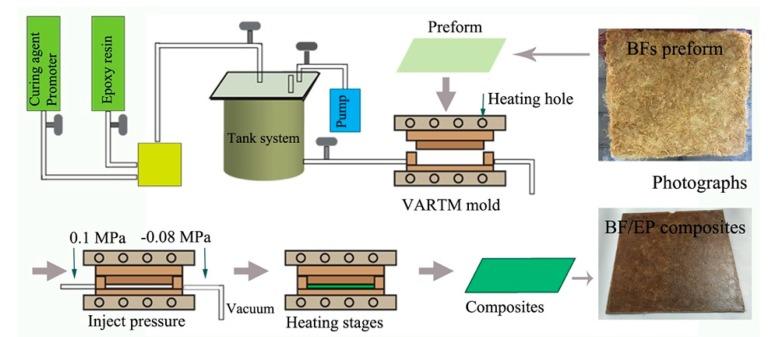
Bamboo fibers (BFs)-reinforced epoxy resin (EP) composites are prepared by resin transfer molding (RTM). The influence of BFs surface modification (NaOH solution or coupling agents, i.e., KH550 and KH560) on interfacial properties of BFs/EP composites is systematically investigated. The synergistic effect of hydrolysis, peeling reaction of BFs, and the condensation reaction of hydrolyzed coupling agents are confirmed by FTIR. Scanning electron microscopy (SEM) and atomic force microscopy (AFM) reveal that the interfacial compatibility of NaOH- and silane-modified BFs/EP composites was significantly improved. KH550-modified BFs/EP composite renders optimal tensile, flexural, and impact strength values of 68 MPa, 86 MPa, and 226 J/m. The impact resistance mechanism at the interface of BFs/EP composites was proposed. Moreover, the dynamic mechanical properties, creep behavior, and differential scanning calorimetry of BFs/EP composites have also been carried out to understand thermal stabilities. Overall, the surface-modified BFs-reinforced EP composites exhibited superior interfacial bonding.
采用树脂传递模塑成型(RTM)制备了竹纤维(BFs)增强环氧树脂(EP)复合材料。系统研究了BFs表面改性(NaOH溶液或偶联剂,即KH550和KH560)对BFs/EP复合材料界面性能的影响。通过傅里叶变换红外光谱(FTIR)证实了BFs的水解、剥离反应与水解偶联剂的缩合反应之间的协同效应。扫描电子显微镜(SEM)和原子力显微镜(AFM)表明,NaOH和硅烷改性的BFs/EP复合材料的界面相容性得到显著改善。KH550改性的BFs/EP复合材料的拉伸强度、弯曲强度和冲击强度最佳,分别为68 MPa、86 MPa和226 J/m。提出了BFs/EP复合材料界面的抗冲击机理。此外,还对BFs/EP复合材料的动态力学性能、蠕变行为和差示扫描量热法进行了研究,以了解其热稳定性。总体而言,表面改性的BFs增强EP复合材料表现出优异的界面结合性能。



 Zotero 插件