
一种用于基于主成分分析的有害气体混合物多监测的微机械金属氧化物复合双气体传感器系统。
A Micromachined Metal Oxide Composite Dual Gas Sensor System for Principal Component Analysis-Based Multi-Monitoring of Noxious Gas Mixtures.
作者信息
Yang In-Hwan, Jin Joon-Hyung, Min Nam Ki
机构信息
Department of Chemical Engineering, Kyonggi University, 154-42 Gwanggyosan-ro, Yeongtong-gu, Suwon-si, Gyeonggi-do 16227, Korea.
Department of Electro-Mechanical Systems Engineering, Korea University, 2511 Sejong-ro, Sejong City 30019, Korea.
出版信息
Micromachines (Basel). 2019 Dec 24;11(1):24. doi: 10.3390/mi11010024.
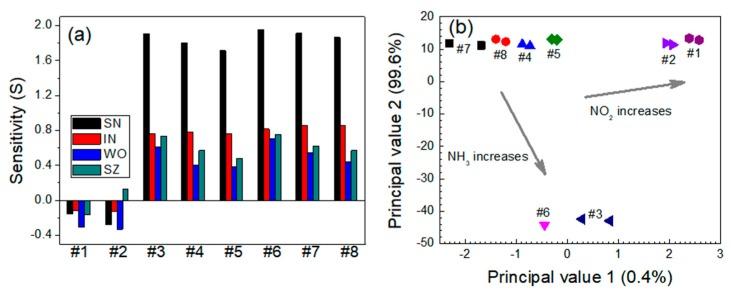
Microelectronic gas-sensor devices were developed for the detection of carbon monoxide (CO), nitrogen dioxides (NO), ammonia (NH) and formaldehyde (HCHO), and their gas-sensing characteristics in six different binary gas systems were examined using pattern-recognition methods. Four nanosized gas-sensing materials for these target gases, i.e., Pd-SnO for CO, InO for NO, Ru-WO for NH, and SnO-ZnO for HCHO, were synthesized using a sol-gel method, and sensor devices were fabricated using a microsensor platform. Principal component analysis of the experimental data from the microelectromechanical systems gas-sensor arrays under exposure to single gases and their mixtures indicated that identification of each individual gas in the mixture was successful. Additionally, the gas-sensing behavior toward the mixed gas indicated that the traditional adsorption and desorption mechanism of the n-type metal oxide semiconductor (MOS) governs the sensing mechanism of the mixed gas systems.
开发了微电子气体传感器设备用于检测一氧化碳(CO)、二氧化氮(NO)、氨(NH₃)和甲醛(HCHO),并使用模式识别方法研究了它们在六种不同二元气体系统中的气敏特性。采用溶胶-凝胶法合成了用于这些目标气体的四种纳米气敏材料,即用于CO的Pd-SnO₂、用于NO的In₂O₃、用于NH₃的Ru-WO₃和用于HCHO的SnO₂-ZnO,并使用微传感器平台制造了传感器设备。对微机电系统气体传感器阵列在暴露于单一气体及其混合物时的实验数据进行主成分分析表明,混合物中每种单一气体的识别是成功的。此外,对混合气体的气敏行为表明,n型金属氧化物半导体(MOS)的传统吸附和解吸机制支配着混合气体系统的传感机制。



 Zotero 插件