
双通道圆 SAR/GMTI 系统的动目标指示。
Moving Target Indication for Dual-Channel Circular SAR/GMTI Systems.
机构信息
College of Electronic Science and Technology, National University of Defense Technology, Changsha 410073, China.
Unit 13, the No. 92493 Troop of PLA, Huludao 125001, China.
出版信息
Sensors (Basel). 2019 Dec 25;20(1):158. doi: 10.3390/s20010158.
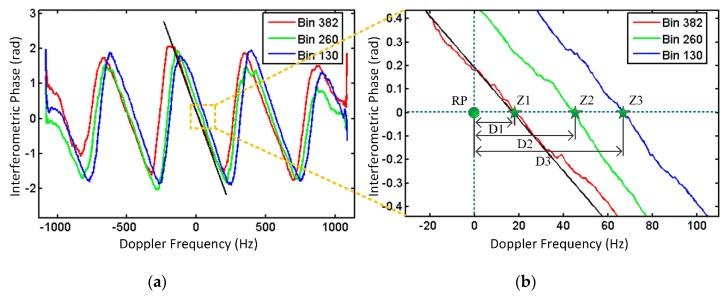
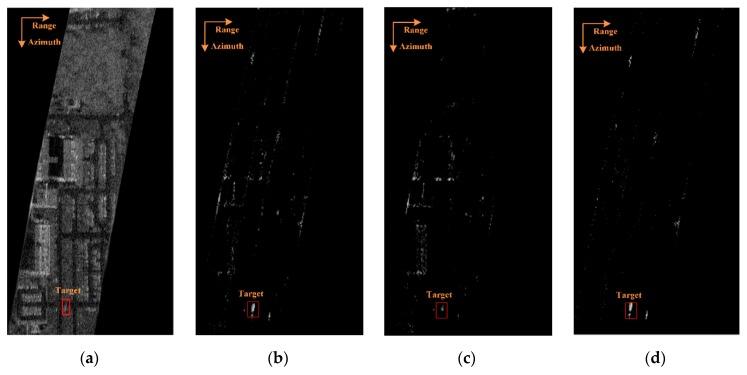
In a dual-channel circular synthetic aperture radar (CSAR) and ground moving target indication (GMTI) system, the antenna baseline is not parallel with the flight path due to a yaw angle. The angle causes a varying group-phase shift between the dual-channel signals and therefore degrades the correlation between the image pair. Therefore, the group-phase shift needs to be removed before channel equalization. To resolve the problem, the interferometric phase term was deduced and analyzed based on the geometry of a dual-channel CSAR system. Then, the varying phase term with respect to the Doppler frequency and the varying group-phase shift over the range were compensated for in the channel registration. Furthermore, blind channel equalization, including two-dimensional calibration and amplitude equalization, was applied to eliminate the amplitude and residual phase differences between the channels. Finally, the amplitude image obtained using a displaced phase center antenna (DPCA) was multiplied by the phase image obtained with along-track interferometry (ATI) to detect moving targets. The experimental results verified the effectiveness of the method for both uniform and non-uniform clutter suppression.
在双通道圆合成孔径雷达(CSAR)和地面动目标指示(GMTI)系统中,由于偏航角,天线基线与飞行路径不平行。该角度会导致双通道信号之间产生变化的群相位偏移,从而降低图像对之间的相关性。因此,在通道均衡之前需要去除群相位偏移。为了解决这个问题,基于双通道 CSAR 系统的几何形状推导出并分析了干涉相位项。然后,在通道配准中补偿了多普勒频率和距离上的变化群相位偏移。此外,应用了二维校准和幅度均衡的盲通道均衡来消除通道之间的幅度和残余相位差。最后,使用偏置相位中心天线(DPCA)获得的幅度图像乘以沿迹干涉(ATI)获得的相位图像以检测运动目标。实验结果验证了该方法对均匀和非均匀杂波抑制的有效性。




 Zotero 插件