
中脑星型胶质细胞源性神经营养因子在脊椎动物视网膜神经元再生过程中对 Muller 胶质细胞细胞周期进程起关键作用。
Midkine-a Is Required for Cell Cycle Progression of Müller Glia during Neuronal Regeneration in the Vertebrate Retina.
机构信息
Department of Ophthalmology and Visual Sciences, and.
Department of Molecular, Cellular and Developmental Biology, University of Michigan, Ann Arbor, Michigan 48105.
出版信息
J Neurosci. 2020 Feb 5;40(6):1232-1247. doi: 10.1523/JNEUROSCI.1675-19.2019. Epub 2019 Dec 27.
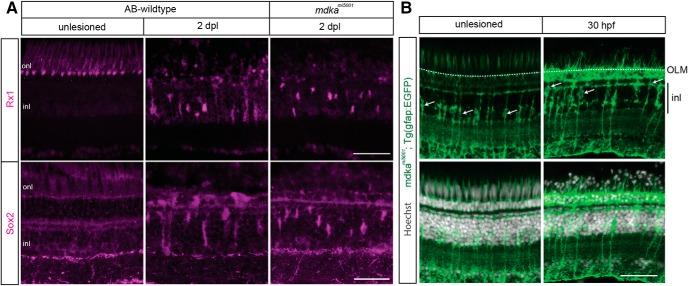
In the retina of zebrafish, Müller glia have the ability to reprogram into stem cells capable of regenerating all classes of retinal neurons and restoring visual function. Understanding the cellular and molecular mechanisms controlling the stem cell properties of Müller glia in zebrafish may provide cues to unlock the regenerative potential in the mammalian nervous system. Midkine is a cytokine/growth factor with multiple roles in neural development, tissue repair, and disease. In loss-of-function mutants of both sexes, Müller glia initiate the appropriate reprogramming response to photoreceptor death by increasing expression of stem cell-associated genes, and entering the G phase of the cell cycle. However, transition from G to S phase is blocked in the absence of Midkine-a, resulting in significantly reduced proliferation and selective failure to regenerate cone photoreceptors. Failing to progress through the cell cycle, Müller glia undergo reactive gliosis, a pathological hallmark in the injured CNS of mammals. Finally, we determined that the Midkine-a receptor, anaplastic lymphoma kinase, is upstream of the HLH regulatory protein, Id2a, and of the retinoblastoma gene, , which regulates progression through the cell cycle. These results demonstrate that Midkine-a functions as a core component of the mechanisms that regulate proliferation of stem cells in the injured CNS. The death of retinal neurons and photoreceptors is a leading cause of vision loss. Regenerating retinal neurons is a therapeutic goal. Zebrafish can regenerate retinal neurons from intrinsic stem cells, Müller glia, and are a powerful model to understand how stem cells might be used therapeutically. Midkine-a, an injury-induced growth factor/cytokine that is expressed by Müller glia following neuronal death, is required for Müller glia to progress through the cell cycle. The absence of Midkine-a suspends proliferation and neuronal regeneration. With cell cycle progression stalled, Müller glia undergo reactive gliosis, a pathological hallmark of the mammalian retina. This work provides a unique insight into mechanisms that control the cell cycle during neuronal regeneration.
在斑马鱼的视网膜中,Müller 胶质细胞具有重编程为干细胞的能力,这些干细胞能够再生所有类型的视网膜神经元并恢复视觉功能。了解控制斑马鱼 Müller 胶质细胞干细胞特性的细胞和分子机制,可能为揭示哺乳动物神经系统的再生潜力提供线索。中期因子(Midkine)是一种细胞因子/生长因子,在神经发育、组织修复和疾病中具有多种作用。在两性的功能丧失突变体中,Müller 胶质细胞通过增加与干细胞相关的基因表达并进入细胞周期的 G 期,从而启动对光感受器死亡的适当重编程反应。然而,在没有 Midkine-a 的情况下,从 G 期到 S 期的过渡被阻断,导致增殖显著减少且选择性地无法再生锥状光感受器。Müller 胶质细胞无法通过细胞周期,会发生反应性神经胶质增生,这是哺乳动物中枢神经系统损伤的一个病理标志。最后,我们确定 Midkine-a 受体,间变性淋巴瘤激酶(anaplastic lymphoma kinase),位于 HLH 调节蛋白 Id2a 和视网膜母细胞瘤基因 的上游,该基因调节细胞周期的进程。这些结果表明,Midkine-a 是调节损伤中枢神经系统中干细胞增殖的机制的核心组成部分。视网膜神经元和光感受器的死亡是视力丧失的主要原因。再生视网膜神经元是一个治疗目标。斑马鱼可以从内在干细胞、Müller 胶质细胞中再生视网膜神经元,并且是一个强大的模型,可以用来了解如何将干细胞用于治疗。Midkine-a 是一种损伤诱导的生长因子/细胞因子,在神经元死亡后由 Müller 胶质细胞表达,是 Müller 胶质细胞通过细胞周期所必需的。缺少 Midkine-a 会暂停增殖和神经元再生。随着细胞周期的停滞,Müller 胶质细胞发生反应性神经胶质增生,这是哺乳动物视网膜的一个病理标志。这项工作提供了一个独特的视角,了解了在神经元再生过程中控制细胞周期的机制。




 Zotero 插件