
荧光扩增下一代测序(FA-NGS)文库制备。
Fluorescent amplification for next generation sequencing (FA-NGS) library preparation.
机构信息
Biological Systems & Engineering Division, Lawrence Berkeley National Laboratory, Berkeley, CA, 94720, USA.
U.S. Department of Energy Agile BioFoundry, Emeryville, CA, USA.
出版信息
BMC Genomics. 2020 Jan 28;21(1):85. doi: 10.1186/s12864-020-6481-8.
BACKGROUND
Next generation sequencing (NGS) has become a universal practice in modern molecular biology. As the throughput of sequencing experiments increases, the preparation of conventional multiplexed libraries becomes more labor intensive. Conventional library preparation typically requires quality control (QC) testing for individual libraries such as amplification success evaluation and quantification, none of which occur until the end of the library preparation process.
RESULTS
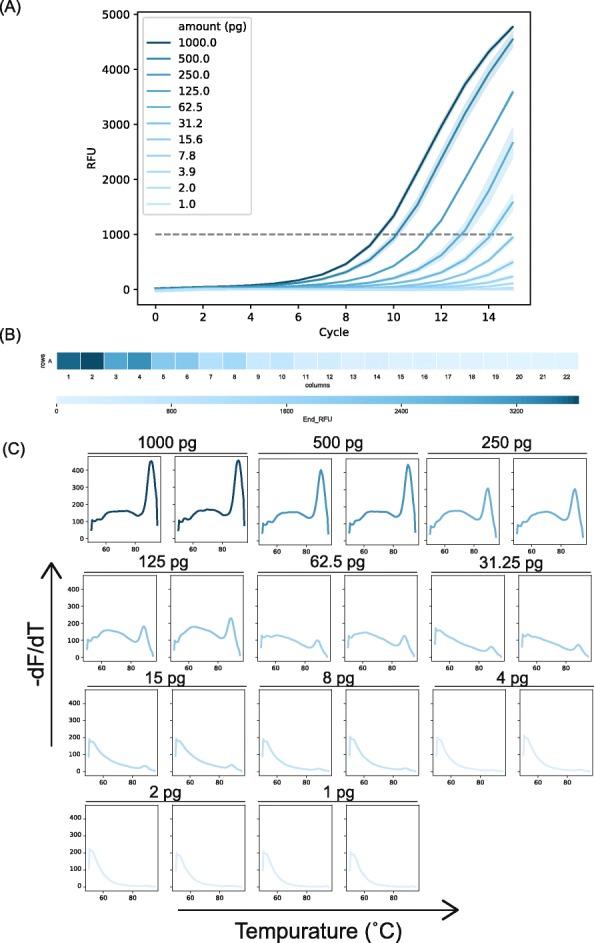
In this study, we address the need for a more streamlined high-throughput NGS workflow by tethering real-time quantitative PCR (qPCR) to conventional workflows to save time and implement single tube and single reagent QC. We modified two distinct library preparation workflows by replacing PCR and quantification with qPCR using SYBR Green I. qPCR enabled individual library quantification for pooling in a single tube without the need for additional reagents. Additionally, a melting curve analysis was implemented as an intermediate QC test to confirm successful amplification. Sequencing analysis showed comparable percent reads for each indexed library, demonstrating that pooling calculations based on qPCR allow for an even representation of sequencing reads. To aid the modified workflow, a software toolkit was developed and used to generate pooling instructions and analyze qPCR and melting curve data.
CONCLUSIONS
We successfully applied fluorescent amplification for next generation sequencing (FA-NGS) library preparation to both plasmids and bacterial genomes. As a result of using qPCR for quantification and proceeding directly to library pooling, the modified library preparation workflow has fewer overall steps. Therefore, we speculate that the FA-NGS workflow has less risk of user error. The melting curve analysis provides the necessary QC test to identify and troubleshoot library failures prior to sequencing. While this study demonstrates the value of FA-NGS for plasmid or gDNA libraries, we speculate that its versatility could lead to successful application across other library types.
背景
下一代测序(NGS)已成为现代分子生物学的通用实践。随着测序实验通量的增加,常规多重文库的制备变得更加劳动密集。常规文库制备通常需要对各个文库进行质量控制(QC)测试,例如扩增成功评估和定量,直到文库制备过程结束才进行这些测试。
结果
在这项研究中,我们通过将实时定量 PCR(qPCR)与常规工作流程结合起来,解决了更简化的高通量 NGS 工作流程的需求,从而节省了时间并实现了单管和单试剂 QC。我们通过使用 SYBR Green I 取代 PCR 和定量来修改了两种不同的文库制备工作流程。qPCR 使单个文库能够在单个管中进行定量,而无需额外的试剂。此外,还实施了熔解曲线分析作为中间 QC 测试,以确认成功扩增。测序分析显示每个索引文库的读段百分比相当,这表明基于 qPCR 的混合计算可以实现测序读段的均匀表示。为了辅助修改后的工作流程,开发并使用了一个软件工具包来生成混合指令,并分析 qPCR 和熔解曲线数据。
结论
我们成功地将荧光扩增用于下一代测序(FA-NGS)文库制备,既适用于质粒又适用于细菌基因组。由于使用 qPCR 进行定量并直接进行文库混合,因此修改后的文库制备工作流程总体步骤更少。因此,我们推测 FA-NGS 工作流程的用户错误风险较低。熔解曲线分析提供了必要的 QC 测试,可以在测序之前识别和解决文库故障。虽然本研究证明了 FA-NGS 对质粒或 gDNA 文库的价值,但我们推测其多功能性可能会导致在其他文库类型中成功应用。



 Zotero 插件