
南非姆普马兰加省的基于参与式行动研究的口述尸检(VAPAR)项目:评价方案。
Verbal Autopsy with Participatory Action Research (VAPAR) programme in Mpumalanga, South Africa: protocol for evaluation.
机构信息
Institute for Global Health and Development, Queen Margaret University, Edinburgh, UK
Independent consultant, White River, South Africa.
出版信息
BMJ Open. 2020 Feb 4;10(2):e036597. doi: 10.1136/bmjopen-2019-036597.
INTRODUCTION
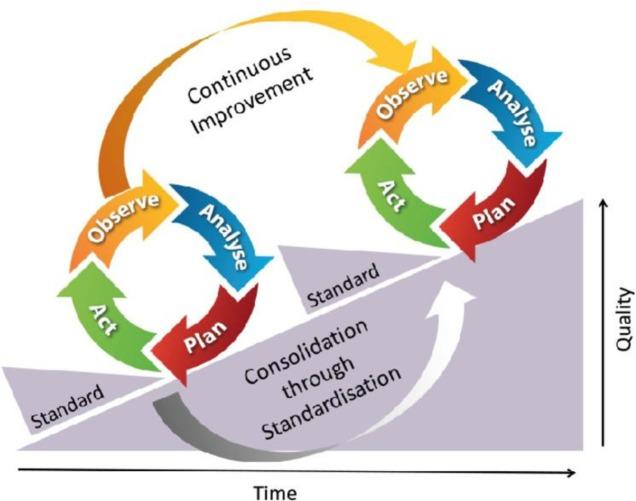
There is a growing recognition of the importance of developing learning health systems which can engage all stakeholders in cycles of evidence generation, reflection, action and learning from action to deal with adaptive problems. There is however limited evaluative evidence of approaches to developing or strengthening such systems, particularly in low-income and middle-income settings. In this protocol, we aim to contribute to developing and sharing knowledge on models of building collaborative learning platforms through our evaluation of the Verbal Autopsy with Participatory Action Research (VAPAR) programme.
METHODS AND ANALYSIS
The evaluation takes a participatory approach, focussed on joint learning on whether and how VAPAR contributes to its aims, and what can be learnt for this and similar settings. A realist-informed theory of change was developed by the research team as part of a broader collaboration with other stakeholders. The evaluation will draw on a wide variety of perspectives and data, including programme data and secondary data. This will be supplemented by in-depth interviews and workshops at the end of each cycle to probe the different domains, understand changes to the positions of different actors within the local health system and feedback into improved learning and action in the next cycle. Quantitative data such as verbal autopsy will be analysed for significant trends in health indicators for different population groups. However, the bulk of the data will be qualitative and will be analysed thematically.
ETHICS AND DISSEMINATION
Ethics in participatory approaches include a careful focus on the power relationships within the group, such that all groups are given voice and influence, in addition to the usual considerations of informed participation. Within the programme, we will focus on reflexivity, relationship building, two-way learning and learning from failure to reduce power imbalances and mitigate against a blame culture. Local engagement and change will be prioritised in dissemination.
简介
越来越多的人认识到开发学习型卫生系统的重要性,这种系统可以让所有利益攸关方参与到证据生成、反思、行动以及从行动中学习的循环中,以应对适应性问题。然而,在开发或加强此类系统的方法方面,评估证据有限,特别是在低收入和中等收入国家。在本方案中,我们旨在通过评估尸检与参与式行动研究(VAPAR)项目,为建立协作学习平台的模式开发和分享知识做出贡献。
方法与分析
评估采用参与式方法,重点关注 VAPAR 是否以及如何有助于实现其目标,以及可以从中学习到什么,以及类似的环境。研究团队作为与其他利益攸关方更广泛合作的一部分,制定了一个基于现实主义的变革理论。评估将借鉴各种观点和数据,包括方案数据和二手数据。这将辅以每个周期结束时的深入访谈和研讨会,以探究不同领域,了解当地卫生系统内不同行为者的立场变化,并为下一个周期的改进学习和行动提供反馈。将对口头尸检等定量数据进行分析,以了解不同人群健康指标的显著趋势。然而,大部分数据将是定性的,并将进行主题分析。
伦理与传播
参与式方法中的伦理包括仔细关注小组内的权力关系,使所有小组都有发言权和影响力,除了通常考虑的知情参与。在方案中,我们将重点关注反思、关系建设、双向学习和从失败中学习,以减少权力失衡,防止指责文化。在传播中,将优先考虑地方参与和变革。

 Zotero 插件