
外源性睾酮应用对情绪调节系统内网络连接的影响。
Effects of exogenous testosterone application on network connectivity within emotion regulation systems.
机构信息
Department of Psychiatry, Psychotherapy and Psychosomatics, Medical Faculty, RWTH Aachen University, 52074, Aachen, Germany.
Institute of Neuroscience and Medicine (INM-10), Research Centre Jülich, Jülich, Germany.
出版信息
Sci Rep. 2020 Feb 11;10(1):2352. doi: 10.1038/s41598-020-59329-0.
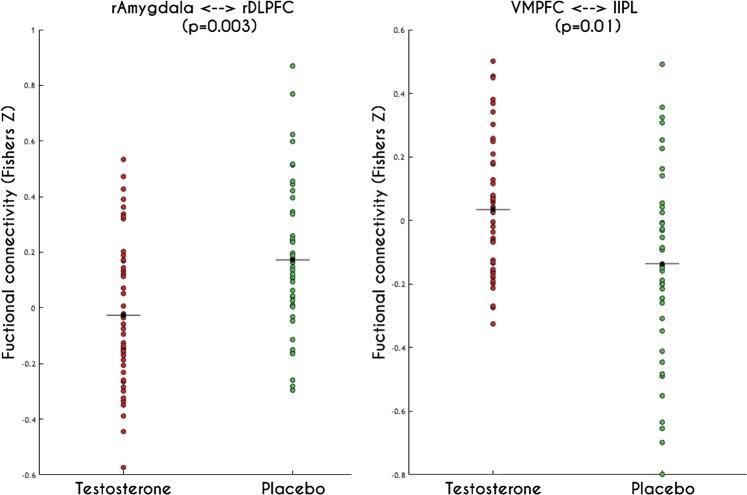
Studies with steroid hormones underlined the vital role of testosterone on social-emotional processing. However, there is still a lack of studies investigating whether testosterone modulates network connectivity during resting-state. Here, we tested how the exogenous application of testosterone would affect functional connectivity between regions implicated in emotion regulation. In total, 96 male participants underwent resting-state fMRI scanning. Before the measurement, half of the subjects received 5 g Testim gel (containing 50 mg testosterone) and the other half a corresponding amount of placebo gel. Seeds for the connectivity analysis were meta-analytically defined. First, all regions associated with emotion regulation were chosen via Neurosynth (data driven). Among those, specific seeds were selected and categorized based on the neural model of emotion regulation by Etkin and colleagues (Etkin et al., 2015) (theory-guided). Resting-state connectivity analysis revealed decreased connectivity between the right DLPFC and the right amygdala as well as between the VMPFC and the left IPL for the testosterone group compared to the placebo group. A complementary dynamic causal modeling (DCM) analysis on findings from the resting-state connectivity analysis underlined a bidirectional coupling which was decreased close to zero by testosterone administration. Our results demonstrate that testosterone administration disrupts resting-state connectivity within fronto-subcortical and fronto-parietal circuits. The findings suggest that even without a specific task (e.g. challenge, reward processing) testosterone modulates brain networks important for social-emotional processing.
研究表明,睾丸激素对社会情感处理具有重要作用。然而,目前仍缺乏研究来调查睾丸激素是否会调节静息状态下的网络连接。在这里,我们测试了外源性应用睾丸激素会如何影响与情绪调节相关的区域之间的功能连接。总共有 96 名男性参与者接受了静息状态 fMRI 扫描。在测量之前,一半的受试者接受了 5g Testim 凝胶(含有 50mg 睾丸激素),另一半接受了相应剂量的安慰剂凝胶。连接分析的种子是通过元分析定义的。首先,通过 Neurosynth(数据驱动)选择了与情绪调节相关的所有区域。在这些区域中,根据 Etkin 等人的情绪调节神经模型(Etkin 等人,2015)(理论指导)选择了特定的种子并进行了分类。与安慰剂组相比,睾丸激素组的右背外侧前额叶皮质和右杏仁核之间以及腹内侧前额叶皮质和左 IPL 之间的连接减少。对静息状态连接分析结果的补充动态因果建模(DCM)分析强调了一种双向耦合,睾丸激素给药使这种耦合接近零。我们的研究结果表明,睾丸激素给药会破坏额皮质下和额顶叶回路中的静息状态连接。研究结果表明,即使没有特定的任务(例如,挑战、奖励处理),睾丸激素也会调节对社会情感处理很重要的大脑网络。


 Zotero 插件