
多发病患者和临床医生在治疗和健康结果方面的优先事项:系统混合研究综述。
Priorities of patients with multimorbidity and of clinicians regarding treatment and health outcomes: a systematic mixed studies review.
机构信息
University of Leicester Diabetes Research Centre, Leicester, UK
School of Social Policy, Health Services Management Centre, University of Birmingham, Birmingham, UK.
出版信息
BMJ Open. 2020 Feb 12;10(2):e033445. doi: 10.1136/bmjopen-2019-033445.
OBJECTIVES
To identify studies that have investigated the health outcome and treatment priorities of patients with multimorbidity, clinicians or both, in order to assess whether the priorities of the two groups are in alignment, or whether a disparity exists between the priorities of patients with multimorbidity and clinicians.
DESIGN
Systematic review.
DATA SOURCES
MEDLINE, EMBASE, CINHAL and Cochrane databases from inception to May 2019 using a predefined search strategy, as well as reference lists containing any relevant articles, as per Preferred Reporting Items for Systematic Reviews and Meta-Analyses and Cochrane guidelines.
ELIGIBILITY CRITERIA
We included studies reporting health outcome and treatment priorities of adult patients with multimorbidity, defined as suffering from two or more chronic conditions, or of clinicians in the context of multimorbidity or both. There was no restriction by study design, and studies using quantitative and/or qualitative methodologies were included.
DATA SYNTHESIS
We used a narrative synthesis approach to synthesise the quantitative findings, and a meta-ethnography approach to synthesise the qualitative findings.
RESULTS
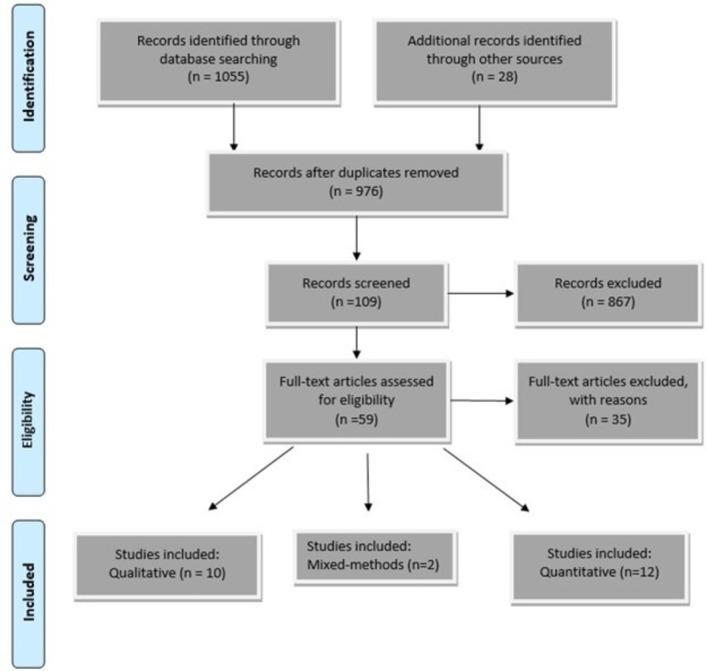
Our search identified 24 studies for inclusion, which comprised 12 quantitative studies, 10 qualitative studies and 2 mixed-methods studies. Twelve studies reported the priorities of both patients and clinicians, 10 studies reported the priorities of patients and 2 studies reported the priorities of clinicians alone. Our findings have shown a mostly low level of agreement between the priorities of patients with multimorbidity and clinicians. We found that prioritisation by patients was mainly driven by their illness experiences, while clinicians focused on longer-term risks. Preserving functional ability emerged as a key priority for patients from across our quantitative and qualitative analyses.
CONCLUSION
Recognising that there may be a disparity in prioritisation and understanding the reasons for why this might occur, can facilitate clinicians in accurately eliciting the priorities that are most important to their patients and delivering patient-centred care.
PROSPERO REGISTRATION NUMBER
CRD42018076076.
目的
确定研究调查了患有多种疾病的患者、临床医生或两者的健康结果和治疗重点,以评估这两组的重点是否一致,或者患有多种疾病的患者和临床医生的重点是否存在差异。
设计
系统评价。
资料来源
使用预定义的搜索策略,从 MEDLINE、EMBASE、CINHAL 和 Cochrane 数据库中检索从成立到 2019 年 5 月的文献,以及包含任何相关文章的参考文献列表,符合系统评价和荟萃分析的首选报告项目和 Cochrane 指南。
入选标准
我们纳入了报告患有多种疾病的成年患者(定义为患有两种或多种慢性疾病)或临床医生在多种疾病背景下或两者的健康结果和治疗重点的研究。研究设计没有限制,包括使用定量和/或定性方法的研究。
数据综合
我们使用叙述性综合方法综合定量研究结果,使用元人种学方法综合定性研究结果。
结果
我们的搜索确定了 24 项研究纳入,其中包括 12 项定量研究、10 项定性研究和 2 项混合方法研究。12 项研究报告了患者和临床医生的重点,10 项研究报告了患者的重点,2 项研究报告了临床医生的重点。我们的研究结果表明,患有多种疾病的患者和临床医生的重点之间大多存在低度一致性。我们发现,患者的重点主要是由他们的疾病经历驱动的,而临床医生则侧重于长期风险。保持功能能力从我们的定量和定性分析中,都成为患者的一个关键重点。
结论
认识到重点可能存在差异,并了解为什么会出现这种情况,可以帮助临床医生准确地确定对患者最重要的重点,并提供以患者为中心的护理。
PROSPERO 注册号:CRD42018076076。
 Zotero 插件