
ZnFeO纳米颗粒中的自旋玻璃转变
Spin-Glass Transitions in ZnFeO Nanoparticles.
作者信息
Felipe S Tupan Lilian, Valerio-Cuadros Marlon I, Oliveira Aline Alves, Barco Reginaldo, Ivashita Flávio Francisco, Lopes Lutiene F, Passamani Edson C, Paesano Andrea
机构信息
Departamento de Física, Maringá State University, Av. Colombo, 5790-Zona 7, Maringá, PR 87020-900, Brazil.
Instituto de Física, Federal University of Rio Grande do Sul, Porto Alegre, RS 91501-970, Brazil.
出版信息
Materials (Basel). 2020 Feb 14;13(4):869. doi: 10.3390/ma13040869.
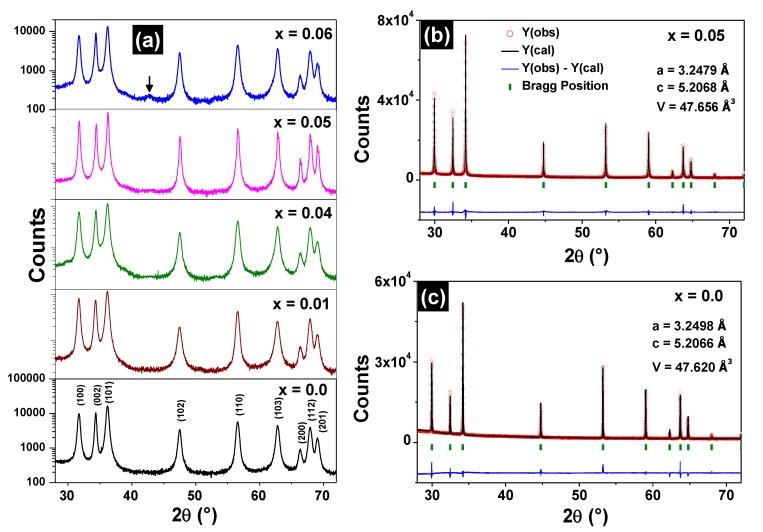
Monophasic ZnFeO nanoparticles with wurtzite structure were synthesized in the 0 ≤ x ≤ 0.05 concentration range using a freeze-drying process followed by heat treatment. The samples were characterized regarding their optical, structural, and magnetic properties. The analyses revealed that iron doping of the ZnO matrix induces morphological changes in the crystallites. Iron is substitutional for zinc, trivalent and distributed in the wurtzite lattice in two groups: isolated iron atoms and iron atoms with one or more neighboring iron atoms. It was also shown that the energy band gap decreases with a higher doping level. The samples are paramagnetic at room temperature, but they undergo a spin-glass transition when the temperature drops below 75 K. The magnetic frustration is attributed to the competition of magnetic interactions among the iron moments. There are a superexchange interaction and an indirect exchange interaction that is provided by the spin (and charge) itinerant carriers in a spin-polarized band situated in the vicinity of the Fermi level of the Fe-doped ZnO semiconductor. The former interaction actuates for an antiferromagnetic coupling among iron ions, whereas the latter constitutes a driving force for a ferromagnetic coupling that weakens, decreasing the temperature. Our results strongly contribute to the literature because they elucidate the controversies reported in the literature for the magnetic state of the Fe-doped ZnO system.
采用冷冻干燥工艺并随后进行热处理,在0≤x≤0.05的浓度范围内合成了具有纤锌矿结构的单相ZnFeO纳米颗粒。对样品的光学、结构和磁性进行了表征。分析表明,ZnO基体的铁掺杂会引起微晶的形态变化。铁取代锌,呈三价,分布在纤锌矿晶格中的两组中:孤立的铁原子和有一个或多个相邻铁原子的铁原子。还表明,随着掺杂水平的提高,能带隙减小。样品在室温下是顺磁性的,但当温度降至75 K以下时会发生自旋玻璃转变。磁阻挫归因于铁磁矩之间磁相互作用的竞争。在掺铁ZnO半导体费米能级附近的自旋极化带中,存在由自旋(和电荷)巡游载流子提供的超交换相互作用和间接交换相互作用。前一种相互作用导致铁离子之间的反铁磁耦合,而后一种相互作用构成了铁磁耦合的驱动力,随着温度降低而减弱。我们的结果对文献有很大贡献,因为它们阐明了文献中报道的关于掺铁ZnO系统磁态的争议。



 Zotero 插件