
黑洞光子环的通用干涉特征。
Universal interferometric signatures of a black hole's photon ring.
作者信息
Johnson Michael D, Lupsasca Alexandru, Strominger Andrew, Wong George N, Hadar Shahar, Kapec Daniel, Narayan Ramesh, Chael Andrew, Gammie Charles F, Galison Peter, Palumbo Daniel C M, Doeleman Sheperd S, Blackburn Lindy, Wielgus Maciek, Pesce Dominic W, Farah Joseph R, Moran James M
机构信息
Center for Astrophysics | Harvard and Smithsonian, 60 Garden Street, Cambridge, MA 02138, USA.
Black Hole Initiative at Harvard University, 20 Garden Street, Cambridge, MA 02138, USA.
出版信息
Sci Adv. 2020 Mar 18;6(12):eaaz1310. doi: 10.1126/sciadv.aaz1310. eCollection 2020 Mar.
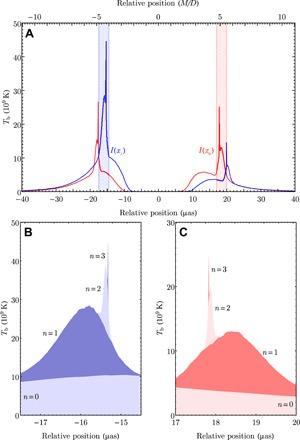
The Event Horizon Telescope image of the supermassive black hole in the galaxy M87 is dominated by a bright, unresolved ring. General relativity predicts that embedded within this image lies a thin "photon ring," which is composed of an infinite sequence of self-similar subrings that are indexed by the number of photon orbits around the black hole. The subrings approach the edge of the black hole "shadow," becoming exponentially narrower but weaker with increasing orbit number, with seemingly negligible contributions from high-order subrings. Here, we show that these subrings produce strong and universal signatures on long interferometric baselines. These signatures offer the possibility of precise measurements of black hole mass and spin, as well as tests of general relativity, using only a sparse interferometric array.
星系M87中超大质量黑洞的事件视界望远镜图像主要由一个明亮的、无法分辨的光环主导。广义相对论预测,在这个图像中存在一个薄的“光子环”,它由一系列无限的自相似子环组成,这些子环由围绕黑洞的光子轨道数索引。子环接近黑洞“阴影”的边缘,随着轨道数的增加,变得指数级变窄但变弱,高阶子环的贡献似乎可以忽略不计。在这里,我们表明这些子环在长干涉基线中产生强烈且普遍的信号。这些信号提供了仅使用稀疏干涉阵列精确测量黑洞质量和自旋以及检验广义相对论的可能性。



 Zotero 插件