
蛋白激酶p38γ改变在路易体痴呆和α-突触核蛋白转基因模型突触病理发生中的作用
Role of Alterations in Protein Kinase p38γ in the Pathogenesis of the Synaptic Pathology in Dementia With Lewy Bodies and α-Synuclein Transgenic Models.
作者信息
Iba Michiyo, Kim Changyoun, Florio Jazmin, Mante Michael, Adame Anthony, Rockenstein Edward, Kwon Somin, Rissman Robert, Masliah Eliezer
机构信息
Laboratory of Neurogenetics, Molecular Neuropathology Section, National Institute on Aging, National Institutes of Health, Bethesda, MD, United States.
Department of Neurosciences, University of California, San Diego, La Jolla, CA, United States.
出版信息
Front Neurosci. 2020 Mar 31;14:286. doi: 10.3389/fnins.2020.00286. eCollection 2020.
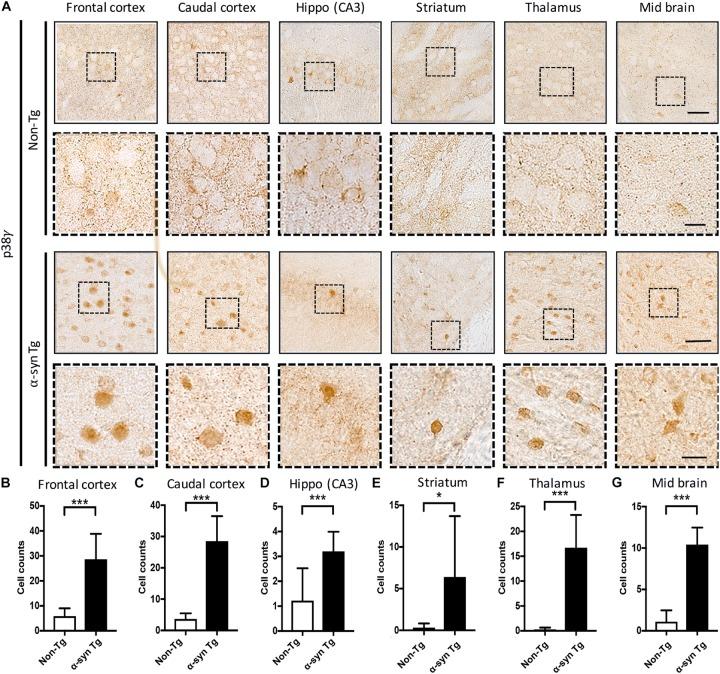
Progressive accumulation of the pre-synaptic protein α-synuclein (α-syn) has been strongly associated with the pathogenesis of neurodegenerative disorders of the aging population such as Alzheimer's disease (AD), Parkinson's disease (PD), dementia with Lewy bodies (DLB), and multiple system atrophy. While the precise mechanisms are not fully understood, alterations in kinase pathways including that of mitogen activated protein kinase (MAPK) p38 have been proposed to play a role. In AD, p38α activation has been linked to neuro-inflammation while alterations in p38γ have been associated with tau phosphorylation. Although p38 has been studied in AD, less is known about its role in DLB/PD and other α-synucleinopathies. For this purpose, we investigated the expression of the p38 family in brains from α-syn overexpressing transgenic mice (α-syn Tg: Line 61) and patients with DLB/PD. Immunohistochemical analysis revealed that in healthy human controls and non-Tg mice, p38α associated with neurons and astroglial cells and p38γ localized to pre-synaptic terminals. In DLB and α-syn Tg brains, however, p38α levels were increased in astroglial cells while p38γ immunostaining was redistributed from the synaptic terminals to the neuronal cell bodies. Double immunolabeling further showed that p38γ colocalized with α-syn aggregates in DLB patients, and immunoblot and qPCR analysis confirmed the increased levels of p38α and p38γ. α1-syntrophin, a synaptic target of p38γ, was present in the neuropil and some neuronal cell bodies in human controls and non-Tg mice. In DLB and and Tg mice, however, α1-syntrophin was decreased in the neuropil and instead colocalized with α-syn in intra-neuronal inclusions. In agreement with these findings, studies showed that α-syn co-immunoprecipitates with p38γ, but not p38α. These results suggest that α-syn might interfere with the p38γ pathway and play a role in the mechanisms of synaptic dysfunction in DLB/PD.
突触前蛋白α-突触核蛋白(α-syn)的渐进性积累与老年人群神经退行性疾病的发病机制密切相关,如阿尔茨海默病(AD)、帕金森病(PD)、路易体痴呆(DLB)和多系统萎缩。虽然确切机制尚未完全明确,但有人提出包括丝裂原活化蛋白激酶(MAPK)p38在内的激酶途径改变起了一定作用。在AD中,p38α激活与神经炎症有关,而p38γ改变与tau蛋白磷酸化有关。尽管p38已在AD中得到研究,但其在DLB/PD和其他α-突触核蛋白病中的作用知之甚少。为此,我们研究了p38家族在过表达α-syn的转基因小鼠(α-syn Tg:61系)和DLB/PD患者大脑中的表达情况。免疫组织化学分析显示,在健康人类对照和非转基因小鼠中,p38α与神经元和星形胶质细胞相关,p38γ定位于突触前终末。然而,在DLB和α-syn Tg大脑中,星形胶质细胞中的p38α水平升高,而p38γ免疫染色从突触终末重新分布到神经元细胞体。双重免疫标记进一步显示,在DLB患者中p38γ与α-syn聚集体共定位,免疫印迹和qPCR分析证实p38α和p38γ水平升高。α1-肌养蛋白是p38γ的突触靶点,在人类对照和非转基因小鼠的神经毡和一些神经元细胞体中存在。然而,在DLB和转基因小鼠中,神经毡中的α1-肌养蛋白减少,而是与α-syn在神经元内包涵体中共定位。与这些发现一致,研究表明α-syn与p38γ共免疫沉淀,但不与p38α共免疫沉淀。这些结果表明,α-syn可能干扰p38γ途径,并在DLB/PD的突触功能障碍机制中起作用。




 Zotero 插件