
茶提取物通过调节细胞表面的DC-STAMP来增加细胞融合。
Tea extract increases cell fusion via regulation of cell surface DC-STAMP.
作者信息
Kuriya Kenji, Nishio Masahiro, Matsuda Tomoko, Umekawa Hayato
机构信息
Department of Life Sciences, Graduate School of Bioresources, Mie University, 1577, Kurimamachiya, Tsu, Mie, 514-8507, Japan.
出版信息
Biochem Biophys Rep. 2020 May 11;22:100759. doi: 10.1016/j.bbrep.2020.100759. eCollection 2020 Jul.
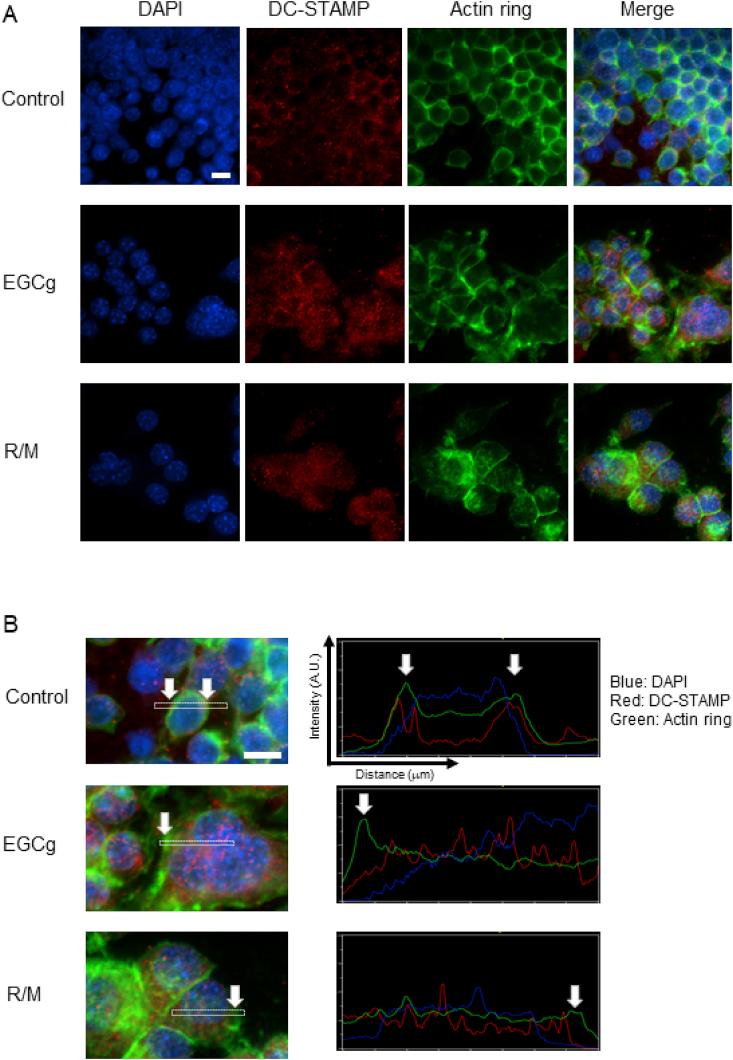
Mononuclear osteoclast precursor cells fuse with each other to become mature multinucleated osteoclasts, which is regulated by dendritic cell-specific transmembrane protein (DC-STAMP). We evaluated the effects of tea extract and catechins on cell-cell fusion and DC-STAMP expression to elucidate their relationship with osteoclast development. When tea extract or epigallocatechin gallate (EGCg) was applied to RAW264.7 cells, multinucleated cells were increased significantly, while tartrate-resistant acid phosphatase (TRAP) activity was hardly upregulated. Flow cytometric analysis revealed that EGCg suppressed DC-STAMP expression on the cell surface, which is similar to osteoclast development. These observations suggest that TRAP activity is not activated even when suppression of both surface DC-STAMP expression and multinucleation occurs, which might be mediated by another pathway.
单核破骨细胞前体细胞相互融合形成成熟的多核破骨细胞,这一过程由树突状细胞特异性跨膜蛋白(DC-STAMP)调控。我们评估了茶提取物和儿茶素对细胞间融合及DC-STAMP表达的影响,以阐明它们与破骨细胞发育的关系。当将茶提取物或表没食子儿茶素没食子酸酯(EGCg)应用于RAW264.7细胞时,多核细胞显著增加,而抗酒石酸酸性磷酸酶(TRAP)活性几乎未上调。流式细胞术分析显示,EGCg抑制细胞表面DC-STAMP的表达,这与破骨细胞发育情况相似。这些观察结果表明,即使表面DC-STAMP表达和多核化均受到抑制,TRAP活性也不会被激活,这可能是由另一条途径介导的。




 Zotero 插件