
定位芳香稻种质资源中营养成分的 QTLs。
Mapping QTLs underpin nutrition components in aromatic rice germplasm.
机构信息
Genetic Resources and Seed Division, Bangladesh Rice Research Institute (BRRI), Gazipur, Bangladesh.
Department of Genetics and Plant Breeding, Hajee Mohammad Danesh Science and Technology University, Dinajpur, Bangladesh.
出版信息
PLoS One. 2020 Jun 11;15(6):e0234395. doi: 10.1371/journal.pone.0234395. eCollection 2020.
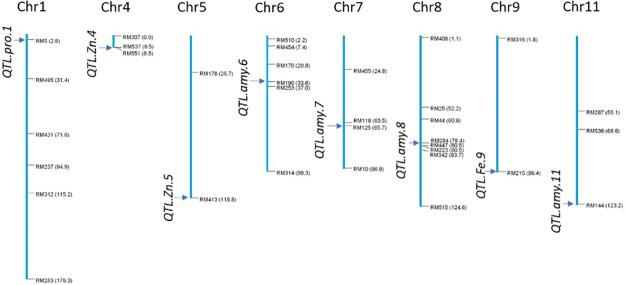
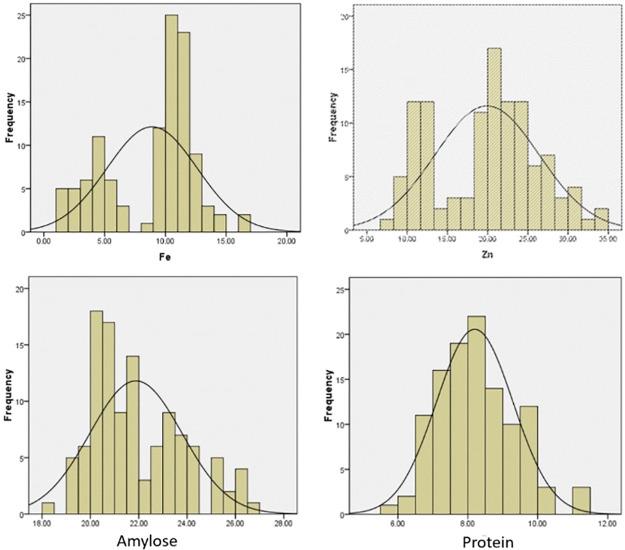
As rice is an important staple food globally, research for development and enhancement of its nutritional value it is an imperative task. Identification of nutrient enriched rice germplasm and exploiting them for breeding programme is the easiest way to develop better quality rice. In this study, we analyzed 113 aromatic rice germplasm in order to identify quantitative trait loci (QTL) underpinning nutrition components and determined by measuring the normal frequency distribution for Fe, Zn, amylose, and protein content in those rice germplasm. Comparatively, the germplasm Radhuni pagal, Kalobakri, Thakurbhog (26.6 ppm) and Hatisail exhibited the highest mean values for Fe (16.9 ppm), Zn (34.1 ppm), amylose (26.6 ppm) and protein content (11.0 ppm), respectively. Moreover, a significant linear relationship (R2 = 0.693) was observed between Fe and Zn contents. Cluster analysis based on Mahalanobis D2 distances revealed four major clusters of 113 rice germplasm, with cluster III containing a maximum 37 germplasm and a maximum inter-cluster distance between clusters III and IV. The 45 polymorphic SSRs and four trait associations exhibited eight significant quantitative trait loci (QTL) located on eight different chromosomes using composite interval mapping (CIM). The highly significant QTL (variance 7.89%, LOD 2.02) for protein content (QTL.pro.1) was observed on chromosome 1 at 94.9cM position. Also, four QTLs for amylose content were observed with the highly significant QTL.amy.8 located on chromosome 8 exhibiting 7.2% variance with LOD 1.83. Only one QTL (QTL.Fe.9) for Fe content was located on chromosome 9 (LOD 1.24), and two (QTL.Zn.4 and QTL.Zn.5) for Zn on chromosome 4 (LOD 1.71) and 5 (LOD 1.18), respectively. Overall, germplasm from clusters III and IV might offer higher heterotic response with the identified QTLs playing a significant role in any rice biofortification breeding program and released with development of new varieties.
由于大米是全球重要的主食,因此研究其营养价值的开发和提高是当务之急。鉴定富含营养的水稻种质资源并将其用于育种计划是开发优质水稻的最简单方法。在这项研究中,我们分析了 113 份芳香稻种质资源,以鉴定支撑营养成分的数量性状基因座(QTL),并通过测量这些水稻种质资源中 Fe、Zn、直链淀粉和蛋白质含量的正态频率分布来确定。相比之下,种质资源 Radhuni pagal、Kalobakri、Thakurbhog(26.6ppm)和 Hatisail 表现出最高的 Fe(16.9ppm)、Zn(34.1ppm)、直链淀粉(26.6ppm)和蛋白质含量(11.0ppm)平均值。此外,观察到 Fe 和 Zn 含量之间存在显著的线性关系(R2=0.693)。基于马哈拉诺比斯 D2 距离的聚类分析揭示了 113 份水稻种质资源的四个主要聚类,其中聚类 III 包含最多的 37 份种质资源,以及聚类 III 和 IV 之间的最大聚类间距离。使用复合区间作图(CIM),在 8 条不同染色体上共发现 45 个多态性 SSR 和 4 个性状关联的 8 个显著数量性状基因座(QTL)。在 94.9cM 位置的第 1 号染色体上观察到蛋白质含量(QTL.pro.1)的高度显著 QTL(方差 7.89%,LOD 2.02)。此外,还观察到 4 个直链淀粉含量的 QTL,其中第 8 号染色体上的高度显著 QTL.amy.8 表现出 7.2%的方差,LOD 为 1.83。只有一个 Fe 含量的 QTL(QTL.Fe.9)位于第 9 号染色体上(LOD 1.24),两个 Zn 含量的 QTL(QTL.Zn.4 和 QTL.Zn.5)分别位于第 4 号染色体(LOD 1.71)和第 5 号染色体(LOD 1.18)上。总的来说,聚类 III 和 IV 的种质资源可能具有更高的杂种优势反应,所鉴定的 QTL 可能在任何水稻生物强化育种计划中发挥重要作用,并随着新品种的开发而被释放。


 Zotero 插件