
用于印刷电子的铜纳米颗粒在环境条件下的反应烧结
Reactive Sintering of Cu Nanoparticles at Ambient Conditions for Printed Electronics.
作者信息
Dai Xiaofeng, Zhang Teng, Shi Hongbin, Zhang Yabing, Wang Tao
机构信息
State Key Laboratory of Chemical Engineering, Department of Chemical Engineering, Tsinghua University, Beijing 10084, P.R. China.
出版信息
ACS Omega. 2020 May 29;5(22):13416-13423. doi: 10.1021/acsomega.0c01678. eCollection 2020 Jun 9.
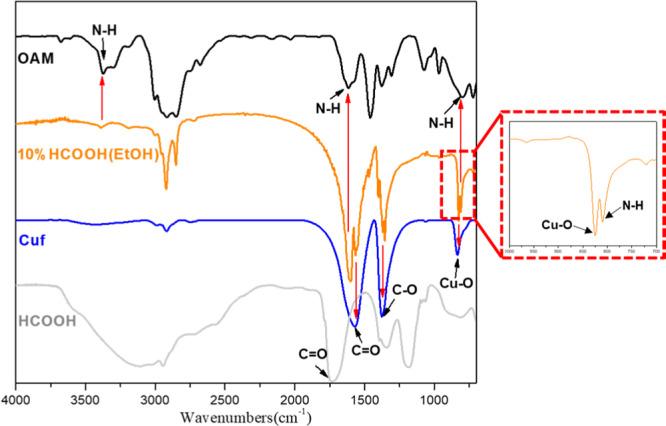
A new approach is presented to overcome the disadvantages of oxidation and harsh sintering conditions of Cu nanoparticle (Cu NP) conductive inks simultaneously. In this process, oleylamine (OAM) adsorbed on particles was effectively eliminated via the reactive desorption by formic acid in alcohols; meanwhile, Cu ion was generated on the surface. The desorption of OAM resulted in more severe surface oxidation of Cu NPs. The oxide (CuO) and Cu distributed on the Cu NP surface could be reduced to Cu(0) by NaBH solution and take on the role of soldering flux to weld particles into a blocky structure. With the compact coalescence of particles without oxides, the resistivity of metal patterns could fall below 20 μΩ·cm and exhibit proper adhesion. Thanks to the sintering of Cu NPs at ambient conditions, the conductive patterns could be facilely formed on thermosensitive substrates. As the oxide state of Cu would be reduced during sintering, the partially oxidized Cu nanoparticles could be directly applied to conductive inks.
提出了一种新方法,以同时克服铜纳米颗粒(Cu NP)导电油墨氧化和苛刻烧结条件的缺点。在此过程中,通过醇中甲酸的反应性解吸有效地消除了吸附在颗粒上的油胺(OAM);同时,在表面上生成了铜离子。OAM的解吸导致Cu NPs的表面氧化更严重。分布在Cu NP表面的氧化物(CuO)和Cu可被NaBH溶液还原为Cu(0),并起到助焊剂的作用,将颗粒焊接成块状结构。随着颗粒在无氧化物情况下的紧密聚结,金属图案的电阻率可降至20μΩ·cm以下,并表现出适当的附着力。由于Cu NPs在环境条件下烧结,导电图案可轻松地在热敏基板上形成。由于Cu的氧化态在烧结过程中会被还原,部分氧化的铜纳米颗粒可直接应用于导电油墨。




 Zotero 插件