
PKAN 神经退行性变和患者红细胞中残留的 PANK2 活性。
PKAN neurodegeneration and residual PANK2 activities in patient erythrocytes.
机构信息
Center for Medical Biochemistry, Max Perutz Labs, Medical University of Vienna, Vienna, Austria.
Department of Structural and Computational Biology, Max Perutz Labs, University of Vienna, Vienna, Austria.
出版信息
Ann Clin Transl Neurol. 2020 Aug;7(8):1340-1351. doi: 10.1002/acn3.51127. Epub 2020 Jul 23.
OBJECTIVE
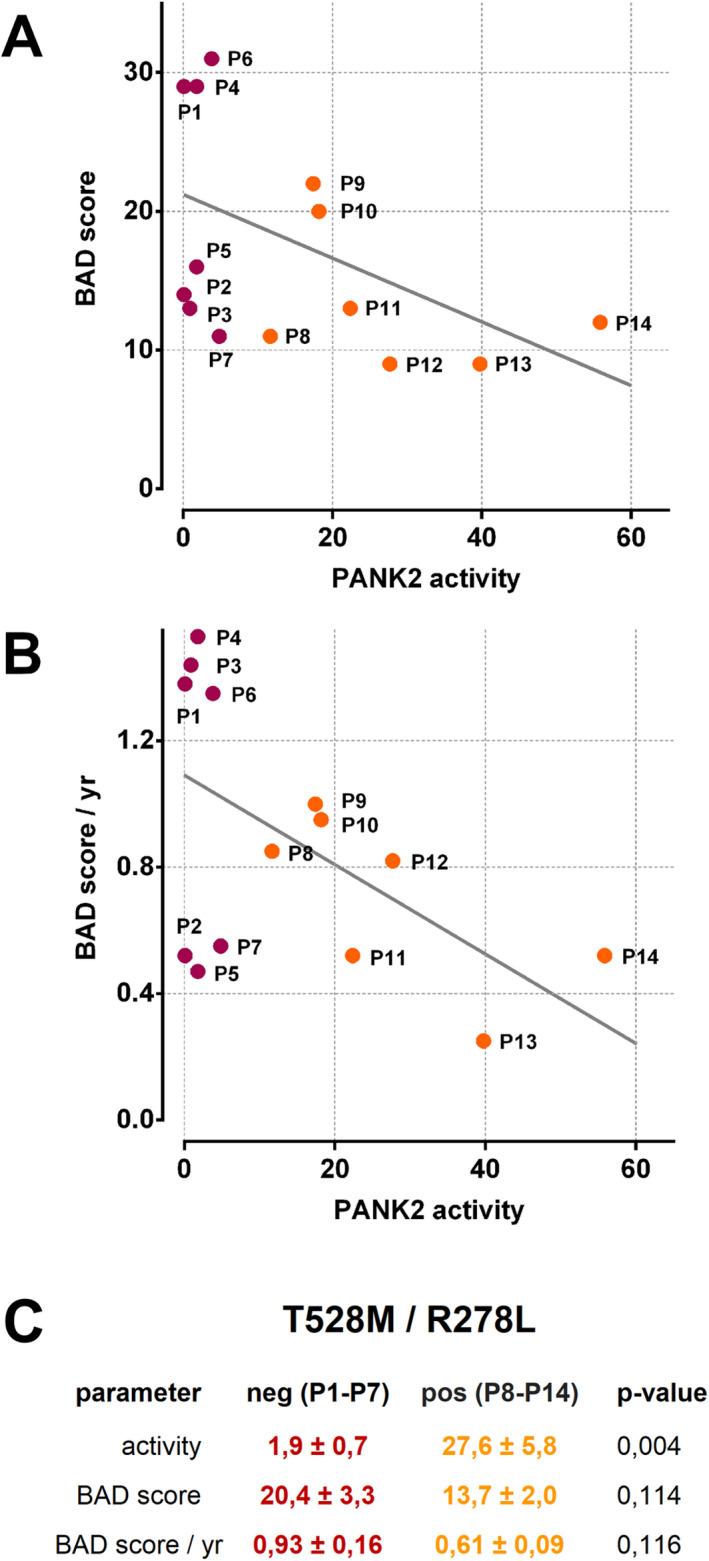
Pantothenate kinase 2-associated neurodegeneration (PKAN) is a rare neurodegenerative disease caused by mutations in the pantothenate kinase 2 (PANK2) gene. PKAN is associated with iron deposition in the basal ganglia and, occasionally, with the occurrence of misshaped erythrocytes (acanthocytes). The aim of this study was to assess residual activity of PANK2 in erythrocytes of PKAN patients and to correlate these data with the type of PANK2 mutations and the progression of neurodegeneration.
METHODS
Residual PANK2 activities in erythrocytes of 14 PKAN patients and 14 related carriers were assessed by a radiometric assay. Clinical data on neurodegeneration included the Barry-Albright Dystonia Scale (BAD-Scale) besides further general patient features. A molecular visualization and analysis program was used to rationalize the influence of the PKAN causing mutations on a molecular level.
RESULTS
Erythrocytes of PKAN patients had markedly reduced or no PANK2 activity. However, patients with at least one allele of the c.1583C > T (T528M) or the c.833G > T (R278L) variant exhibited 12-56% of residual PANK2 activity. In line, molecular modeling indicated only minor effects on enzyme structure for these point mutations. On average, these patients with c.1583C > T or c.833G > T variant had lower BAD scores corresponding to lower symptom severity than patients with other PANK2 point mutations.
INTERPRETATION
Residual erythrocyte PANK2 activity could be a predictor for the progression of neurodegeneration in PKAN patients. Erythrocytes are an interesting patient-derived cell system with still underestimated diagnostic potential.
目的
泛酸激酶 2 相关神经退行性变(PKAN)是一种由泛酸激酶 2(PANK2)基因突变引起的罕见神经退行性疾病。PKAN 与基底节铁沉积有关,偶尔还伴有红细胞形状异常(棘红细胞)。本研究旨在评估 PKAN 患者红细胞中 PANK2 的残留活性,并将这些数据与 PANK2 基因突变的类型和神经退行性变的进展相关联。
方法
通过放射性测定法评估 14 名 PKAN 患者和 14 名相关携带者的红细胞中残留的 PANK2 活性。神经退行性变的临床数据包括 Barry-Albright 运动障碍量表(BAD-Scale)以及其他一般患者特征。使用分子可视化和分析程序从分子水平上合理化导致 PKAN 的突变对 PANK2 活性的影响。
结果
PKAN 患者的红细胞中 PANK2 活性明显降低或没有。然而,至少有一个 c.1583C>T(T528M)或 c.833G>T(R278L)变异等位基因的患者表现出 12-56%的残留 PANK2 活性。分子建模表明,这些点突变对酶结构的影响很小。平均而言,这些携带 c.1583C>T 或 c.833G>T 变异的患者的 BAD 评分较低,表明症状严重程度较低,而其他 PANK2 点突变患者的 BAD 评分较高。
解释
红细胞中残留的 PANK2 活性可能是 PKAN 患者神经退行性变进展的预测因子。红细胞是一种有趣的患者来源细胞系统,其诊断潜力仍被低估。


 Zotero 插件