
利用斯堪的纳维亚半岛干旱敏感区的蓝色强度来改进对过去水文气候变化的重建。
Using Blue Intensity from drought-sensitive in Fennoscandia to improve reconstruction of past hydroclimate variability.
作者信息
Seftigen Kristina, Fuentes Mauricio, Ljungqvist Fredrik Charpentier, Björklund Jesper
机构信息
Regional Climate Group, Department of Earth Sciences, University of Gothenburg, Gothenburg, Sweden.
Georges Lemaître Centre for Earth and Climate Research (TECLIM), Earth and Life Institute, Université Catholique de Louvain (UCL), Louvain-la-Neuve, Belgium.
出版信息
Clim Dyn. 2020;55(3):579-594. doi: 10.1007/s00382-020-05287-2. Epub 2020 May 13.
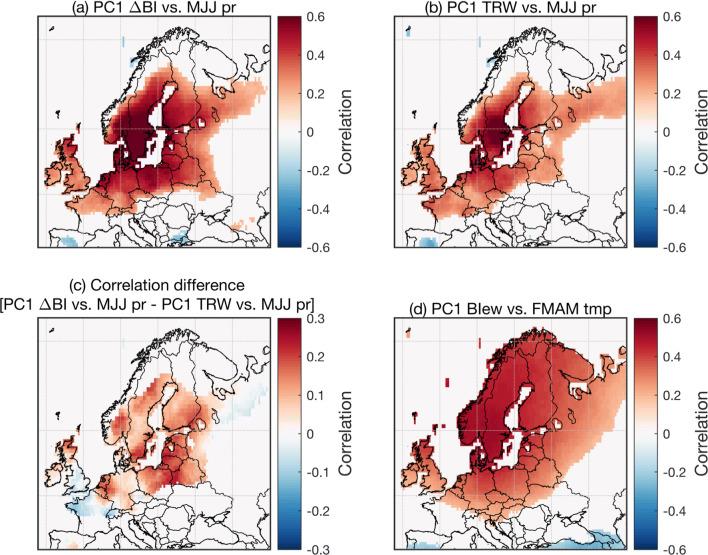
High-resolution hydroclimate proxy records are essential for distinguishing natural hydroclimate variability from possible anthropogenically-forced changes, since instrumental precipitation observations are too short to represent the whole spectrum of natural variability. In Northern Europe, progress in this field has been hampered by a relative lack of long and truly moisture-sensitive proxy records. In this study, we provide the first assessment of the dendroclimatic potential of Blue Intensity (BI) and partial ring-width measurements (latewood and earlywood width series) from a network of cold and drought-prone L. sites in Sweden. Our results show that all tree-ring parameters and sites share a clear and strong sensitivity to warm-season precipitation. The ΔBI parameter, in particular, shows considerable potential for hydroclimate reconstructions, here permitting a cross-validated precipitation reconstruction capable of explaining 56% (1901-2010 period) of regional-scale warm-season high-frequency precipitation variance. Using ΔBI as an alternative to ring-width improves the predictive skill with nearly a 20 percentage points increase in explained variance, reduces signal instability over time as well as allows a broader seasonal window (May-July) to be reconstructed. Additionally, we found that earlywood BI also reflect a positive late winter through early summer temperature signal. These findings emphasize that tree-rings, and in particular wood density parameters such as from BI, are capable of providing fundamental information to advance our understanding of hydroclimate variability in regions with a cool and rather humid climate regime that traditionally has been overlooked in studies of past droughts. Increasing the spatio-temporal coverage of hydroclimate records in northern Europe, and taking full advantage of the opportunities offered by the wood densitometric properties should be considered a research priority.
高分辨率水文气候代用记录对于区分自然水文气候变化与可能的人为强迫变化至关重要,因为仪器观测的降水数据时间太短,无法代表自然变化的整个频谱。在北欧,该领域的进展因相对缺乏长期且真正对湿度敏感的代用记录而受阻。在本研究中,我们首次评估了瑞典寒冷且易干旱地区的一个网络中蓝强度(BI)和部分年轮宽度测量值(晚材和早材宽度序列)的树木气候潜力。我们的结果表明,所有树木年轮参数和站点对暖季降水都有明显且强烈的敏感性。特别是ΔBI参数在水文气候重建方面显示出相当大的潜力,在此能够进行交叉验证的降水重建,可解释区域尺度暖季高频降水方差的56%(1901 - 2010年期间)。使用ΔBI替代年轮宽度可提高预测技能,解释方差增加近20个百分点,减少信号随时间的不稳定性,并允许重建更宽的季节窗口(5月 - 7月)。此外,我们发现早材BI还反映了冬末至初夏的正温度信号。这些发现强调,树木年轮,特别是像BI这样的木材密度参数,能够提供基础信息,以推进我们对气候凉爽且较为湿润地区水文气候变化的理解,而该地区在过去干旱研究中传统上一直被忽视。增加北欧水文气候记录的时空覆盖范围,并充分利用木材密度测量特性提供的机会应被视为研究重点。




 Zotero 插件