
遗传背景突变导致脆性 X 综合征模型中的神经回路过度连接。
Genetic background mutations drive neural circuit hyperconnectivity in a fragile X syndrome model.
机构信息
Department of Biological Sciences, Vanderbilt University and Medical Center, Nashville, TN, 37235, USA.
Department of Cell and Developmental Biology, Vanderbilt University and Medical Center, Nashville, TN, 37235, USA.
出版信息
BMC Biol. 2020 Jul 30;18(1):94. doi: 10.1186/s12915-020-00817-0.
BACKGROUND
Neural circuits are initially assembled during development when neurons synapse with potential partners and later refined as appropriate connections stabilize into mature synapses while inappropriate contacts are eliminated. Disruptions to this synaptogenic process impair connectivity optimization and can cause neurodevelopmental disorders. Intellectual disability (ID) and autism spectrum disorder (ASD) are often characterized by synaptic overgrowth, with the maintenance of immature or inappropriate synapses. Such synaptogenic defects can occur through mutation of a single gene, such as fragile X mental retardation protein (FMRP) loss causing the neurodevelopmental disorder fragile X syndrome (FXS). FXS represents the leading heritable cause of ID and ASD, but many other genes that play roles in ID and ASD have yet to be identified.
RESULTS
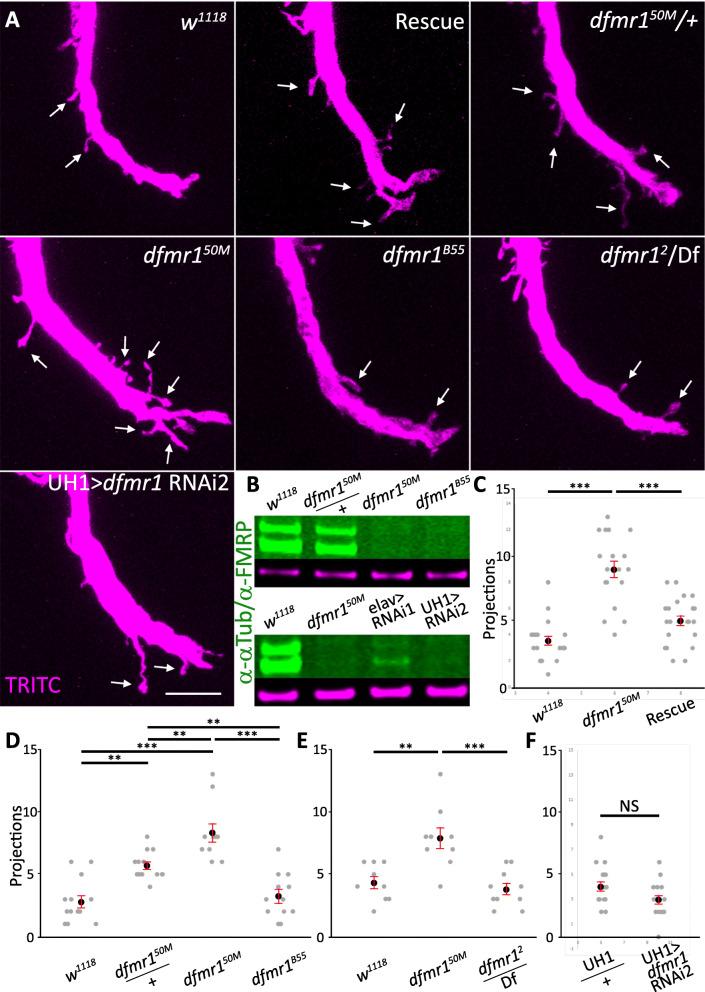
In a Drosophila FXS disease model, one dfmr1 null mutant stock exhibits previously unreported axonal overgrowths at developmental and mature stages in the giant fiber (GF) escape circuit. These excess axon projections contain both chemical and electrical synapse markers, indicating mixed synaptic connections. Extensive analyses show these supernumerary synapses connect known GF circuit neurons, rather than new, inappropriate partners, indicating hyperconnectivity within the circuit. Despite the striking similarities to well-characterized FXS synaptic defects, this new GF circuit hyperconnectivity phenotype is driven by genetic background mutations in this dfmr1 stock. Similar GF circuit synaptic overgrowth is not observed in independent dfmr1 null alleles. Bulked segregant analysis (BSA) was combined with whole genome sequencing (WGS) to identify the quantitative trait loci (QTL) linked to neural circuit hyperconnectivity. The results reveal 8 QTL associated with inappropriate synapse formation and maintenance in the dfmr1 mutant background.
CONCLUSIONS
Synaptogenesis is a complex, precisely orchestrated neurodevelopmental process with a large cohort of gene products coordinating the connectivity, synaptic strength, and excitatory/inhibitory balance between neuronal partners. This work identifies a number of genetic regions that contain mutations disrupting proper synaptogenesis within a particularly well-mapped neural circuit. These QTL regions contain potential new genes involved in synapse formation and refinement. Given the similarity of the synaptic overgrowth phenotype to known ID and ASD inherited conditions, identifying these genes should increase our understanding of these devastating neurodevelopmental disease states.
背景
神经元在发育过程中通过与潜在的靶细胞形成突触来组装神经回路,随后通过适当的连接来稳定成熟的突触,而不合适的连接则被消除,从而进行神经回路的修正。突触发生过程的破坏会损害连接的优化,并可能导致神经发育障碍。智力障碍 (ID) 和自闭症谱系障碍 (ASD) 的特征通常是突触过度生长,不成熟或不合适的突触得以维持。这种突触发生缺陷可能是由于单个基因突变引起的,例如脆性 X 智力低下蛋白 (FMRP) 缺失导致神经发育障碍脆性 X 综合征 (FXS)。FXS 是 ID 和 ASD 最主要的遗传性病因,但仍有许多其他在 ID 和 ASD 中起作用的基因有待确定。
结果
在果蝇 FXS 疾病模型中,一种 dfmr1 缺失突变品系在巨纤维 (GF) 逃避回路的发育和成熟阶段表现出以前未报道的轴突过度生长。这些多余的轴突投射包含化学和电突触标记物,表明混合突触连接。广泛的分析表明,这些多余的突触连接已知的 GF 回路神经元,而不是新的、不合适的靶细胞,表明回路内的超连接。尽管与经过充分研究的 FXS 突触缺陷具有惊人的相似性,但这种新的 GF 回路超连接表型是由该 dfmr1 品系中的遗传背景突变驱动的。在独立的 dfmr1 缺失等位基因中未观察到类似的 GF 回路突触过度生长。大量分离群体分析 (BSA) 与全基因组测序 (WGS) 相结合,鉴定与 dfmr1 突变背景下神经回路超连接相关的数量性状基因座 (QTL)。结果显示,有 8 个 QTL 与不合适的突触形成和维持有关。
结论
突触发生是一个复杂的、精确协调的神经发育过程,涉及大量的基因产物来协调神经元之间的连接、突触强度以及兴奋性/抑制性平衡。这项工作确定了一些包含突变的基因区域,这些突变破坏了特定的、映射良好的神经回路中适当的突触发生。这些 QTL 区域包含参与突触形成和细化的潜在新基因。鉴于突触过度生长表型与已知的 ID 和 ASD 遗传条件相似,鉴定这些基因应能提高我们对这些破坏性神经发育疾病状态的认识。


 Zotero 插件