
据预测,对市售饼干进行微量营养素强化对微量营养素摄入不足患病率的影响微乎其微:喀麦隆国家膳食数据建模分析
Micronutrient Fortification of Commercially Available Biscuits Is Predicted to Have Minimal Impact on Prevalence of Inadequate Micronutrient Intakes: Modeling of National Dietary Data From Cameroon.
作者信息
Haile Demewoz, Luo Hanqi, Vosti Stephen A, Dodd Kevin W, Arnold Charles D, Engle-Stone Reina
机构信息
Department of Nutrition, University of California, Davis, CA, USA.
Department of Agricultural and Resource Economics, University of California, Davis, CA, USA.
出版信息
Curr Dev Nutr. 2020 Aug 10;4(9):nzaa132. doi: 10.1093/cdn/nzaa132. eCollection 2020 Sep.
BACKGROUND
Voluntarily fortified snack products are increasingly available but are not necessarily formulated to meet known dietary nutrient gaps, so potential impacts on population micronutrient intake adequacy are uncertain.
OBJECTIVES
We modeled the impacts of hypothetical micronutrient-fortified biscuits on inadequate micronutrient intake in children and women of reproductive age (WRA) in Cameroon.
METHODS
In a nationally representative survey stratified by macro-region (North, South, and Yaoundé/Douala), 24-h dietary recall data were collected from 883 children aged 12-59 mo and from 912 WRA. We estimated usual nutrient intake by the National Cancer Institute method for vitamin A, folate, vitamin B-12, zinc, and iron. We simulated the impact of biscuit fortification on prevalence of micronutrient intake below the estimated average requirement, given observed biscuit consumption, in the presence and absence of large-scale food fortification (LSFF) programs.
RESULTS
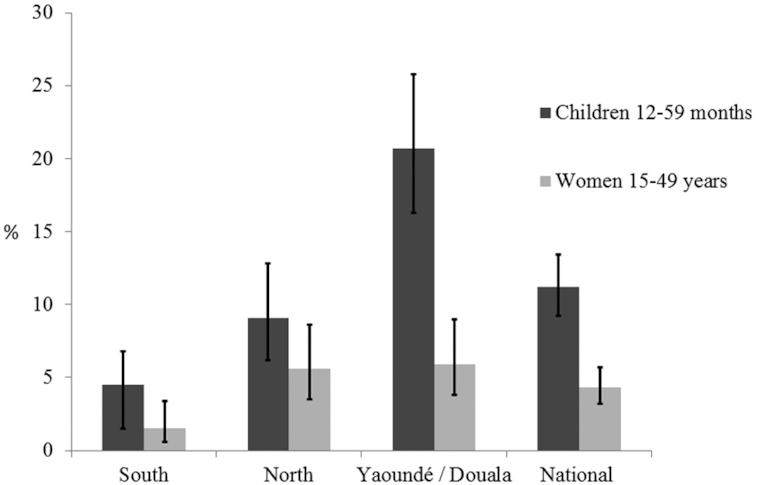
Biscuit consumption in the prior 24-h by children and WRA, respectively, ranged from 4.5% and 1.5% in the South, to 20.7% and 5.9% in Yaoundé/Douala. In the absence of LSFF programs, biscuits fortified with retinol (600 μg/100 g), folic acid (300 μg/100 g), and zinc (8 mg/100 g) were predicted to reduce the prevalence of inadequacy among children by 10.3 ± 4.4, 13.2 ± 4.2, and 12.0 ± 6.1 percentage points, respectively, in Yaoundé/Douala. However, when existing vitamin A-fortified oil, and folic acid-fortified and zinc-fortified wheat flour programs were considered, the additional impacts of fortified biscuits were reduced substantially. Micronutrient-fortified biscuits were predicted to have minimal impact on dietary inadequacy in WRA, with or without LSFF programs.
CONCLUSIONS
Given observed patterns of biscuit consumption in Cameroon, biscuit fortification is unlikely to reduce dietary inadequacy of studied micronutrients, except possibly for selected nutrients in children in urban areas in the absence of LSFF programs. As voluntary fortification becomes increasingly common, modeling studies could help guide efforts to ensure that fortified products align with public health goals.
背景
自愿强化的休闲食品越来越多,但不一定是为填补已知的饮食营养缺口而配制的,因此对人群微量营养素摄入充足性的潜在影响尚不确定。
目的
我们模拟了假设的微量营养素强化饼干对喀麦隆儿童和育龄妇女(WRA)微量营养素摄入不足的影响。
方法
在一项按大区(北部、南部以及雅温得/杜阿拉)分层的全国代表性调查中,收集了883名12至59个月大儿童和912名育龄妇女的24小时饮食回忆数据。我们采用美国国立癌症研究所的方法估算了维生素A、叶酸、维生素B-12、锌和铁的通常营养素摄入量。在有和没有大规模食品强化(LSFF)计划的情况下,根据观察到的饼干消费量,我们模拟了饼干强化对微量营养素摄入量低于估计平均需求量的患病率的影响。
结果
儿童和育龄妇女在前24小时内的饼干消费量,在南部分别为4.5%和1.5%,在雅温得/杜阿拉则分别为20.7%和5.9%。在没有LSFF计划的情况下,预计用视黄醇(600微克/100克)、叶酸(300微克/100克)和锌(8毫克/100克)强化的饼干可使雅温得/杜阿拉儿童中摄入不足的患病率分别降低10.3±4.4、13.2±4.2和12.0±6.1个百分点。然而,当考虑现有的维生素A强化油以及叶酸强化和锌强化小麦粉计划时,强化饼干的额外影响大幅降低。无论有无LSFF计划,预计微量营养素强化饼干对育龄妇女饮食不足的影响都微乎其微。
结论
根据喀麦隆观察到的饼干消费模式,饼干强化不太可能减少所研究微量营养素的饮食不足情况,除非在没有LSFF计划的情况下,城市地区儿童的某些特定营养素可能除外。随着自愿强化变得越来越普遍,模型研究有助于指导相关工作,以确保强化产品符合公共卫生目标。


 Zotero 插件