
日本脓毒症管理的“加拉帕戈斯化”:全国现行做法调查
Galápagosization of sepsis management in Japan: a nationwide survey of current practices.
作者信息
Yamakawa Kazuma, Hasegawa Daisuke, Yasuda Hideto, Sakamoto So, Nishida Kazuki, Yatabe Tomoaki, Egi Moritoki, Ogura Hiroshi, Nishida Osamu
机构信息
Department of Emergency Medicine Osaka Medical College Takatsuki Japan.
Department of Anesthesiology and Critical Care Medicine Fujita Health University School of Medicine Toyoake Japan.
出版信息
Acute Med Surg. 2020 Sep 2;7(1):e561. doi: 10.1002/ams2.561. eCollection 2020 Jan-Dec.
AIM
Sepsis treatment has been standardized in many countries worldwide. However, treatment of sepsis in Japan has developed independently, and how Japanese physicians actually treat sepsis patients nationwide remains uninvestigated. The aim of this study was to clarify the current practice for septic patients in Japan and how it differs from standard care throughout the world.
METHODS
This study was designed as a prospective, cross-sectional, self-reported questionnaire- and Web-based electronic survey in Japan. The survey was undertaken to assess respondents' clinical practices and preferences regarding treatment strategies, sepsis assessment, and management in the setting of critical illness. An exploratory factor analysis and a hierarchical cluster analysis were carried out to identify the treatments distinctive to Japan, called "Galápagos therapies".
RESULTS
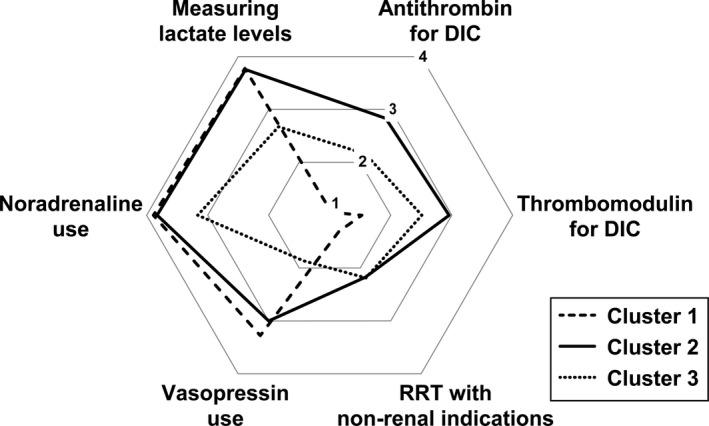
The final analysis included 295 respondents. According to the factor analysis, we defined anticoagulant therapy for disseminated intravascular coagulation, antimediator renal replacement therapy, and others as Galápagos therapies. These Galápagos therapies were undertaken by approximately two-thirds of the Japanese physicians who responded. We classified Japanese physicians according to three patterns of clinical practice carried out for sepsis: (i) those who do not perform Galápagos therapies but do perform worldwide standardized care, (ii) those who perform Galápagos therapies on top of worldwide standardized care, (iii) those who do not perform worldwide standardized care.
CONCLUSION
On the basis of a nationwide questionnaire-based survey in Japan, we clarified distinctive sepsis treatments performed in Japan, such as antimediator renal replacement therapy and treatment for sepsis-induced disseminated intravascular coagulation.
目的
全球许多国家的脓毒症治疗已实现标准化。然而,日本的脓毒症治疗是独立发展的,日本全国范围内医生实际如何治疗脓毒症患者仍未得到研究。本研究的目的是阐明日本目前对脓毒症患者的治疗方法以及它与全球标准治疗的差异。
方法
本研究设计为在日本进行的一项前瞻性、横断面、基于自我报告问卷和网络的电子调查。该调查旨在评估受访者在危重病情况下关于治疗策略、脓毒症评估和管理的临床实践及偏好。进行探索性因素分析和层次聚类分析以确定日本特有的治疗方法,即“加拉帕戈斯疗法”。
结果
最终分析纳入了295名受访者。根据因素分析,我们将针对弥散性血管内凝血的抗凝治疗、抗介质肾替代治疗等定义为加拉帕戈斯疗法。约三分之二做出回应的日本医生采用了这些加拉帕戈斯疗法。我们根据对脓毒症实施的三种临床实践模式对日本医生进行了分类:(i)不采用加拉帕戈斯疗法但采用全球标准化治疗的医生,(ii)在全球标准化治疗基础上采用加拉帕戈斯疗法的医生,(iii)不采用全球标准化治疗的医生。
结论
基于在日本全国范围内进行的问卷调查,我们阐明了日本特有的脓毒症治疗方法,如抗介质肾替代治疗和脓毒症诱导的弥散性血管内凝血的治疗。


 Zotero 插件