
利用免疫相关基因对signature 预测黑色素瘤的临床结局。
Predicting the clinical outcome of melanoma using an immune-related gene pairs signature.
机构信息
Medical School of Chinese PLA, Beijing, China.
Department of Radiology, The First Medical Centre, Chinese PLA General Hospital, Beijing, China.
出版信息
PLoS One. 2020 Oct 8;15(10):e0240331. doi: 10.1371/journal.pone.0240331. eCollection 2020.
OBJECTIVE
Melanoma is rare but dangerous skin cancer, and it can spread rather quickly in the advanced stages of the tumor. Abundant evidence suggests the relationship between tumor development and progression and the immune system. A robust gene risk model could provide an accurate prediction of clinical outcomes. The present study aimed to explore a robust signature of immune-related gene pairs (IRGPs) for estimating overall survival (OS) in malignant melanoma.
METHODS
Clinical and genetic data of skin cutaneous melanoma (SKCM) patients from The Cancer Genome Atlas (TCGA) was performed as a training dataset to identify candidate IRGPs for the prognosis of melanoma. Two independent datasets from the Gene Expression Omnibus (GEO) database (GSE65904) and TCGA dataset (TCGA-UVM) were selected for external validation. Univariate and multivariate Cox regression analyses were then performed to explore the prognostic power of the IRGPs signature and other clinical factors. CIBERSORTx was applied to estimate the fractions of infiltrated immune cells in bulk tumor tissues.
RESULTS
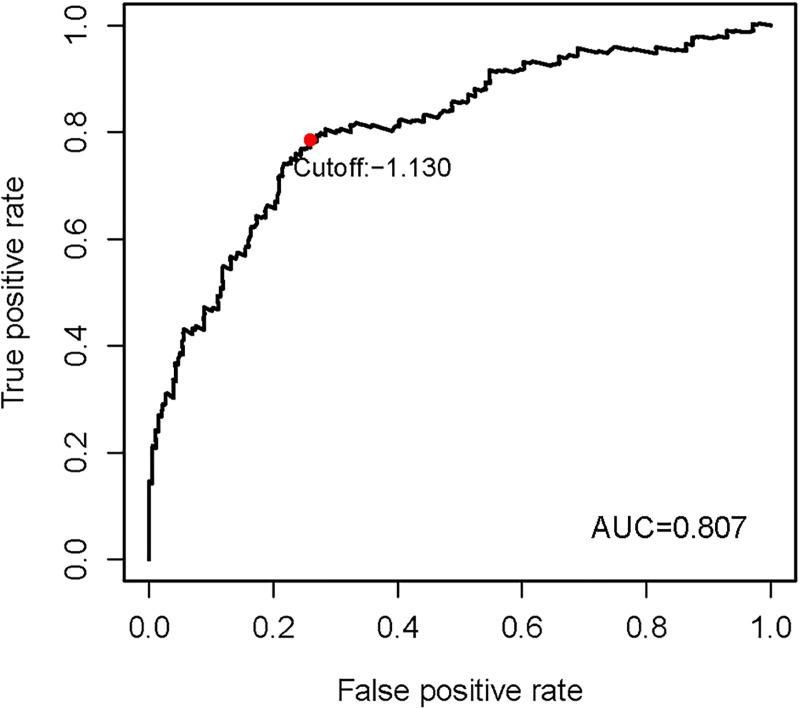
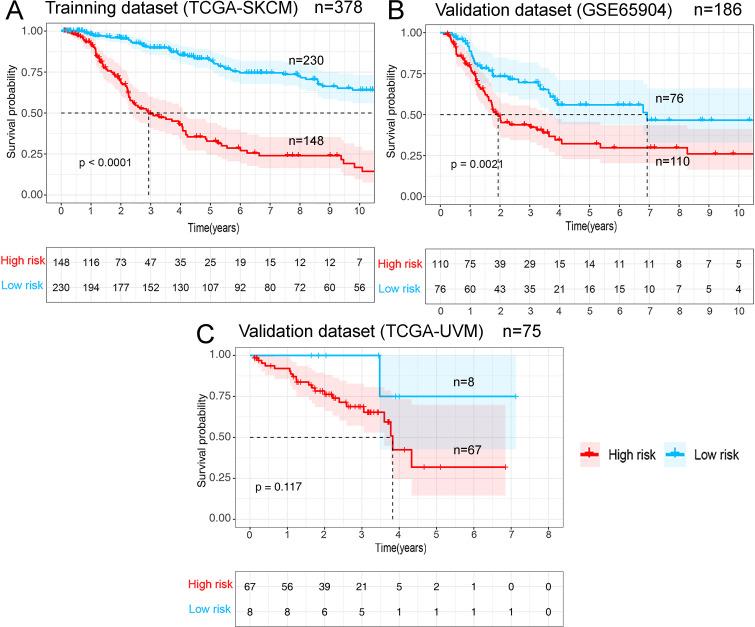
A signature consisted of 33 IRGPs was established which was significantly associated with patients' survival in the TCGA-SKCM dataset (P = 2.0×10⁻¹⁶, Hazard Ratio (HR) = 4.220 (2.909 to 6.122)). We found the IRGPs signature exhibited an independent prognostic factor in all the three independent cohorts in both the univariate and multivariate Cox analysis (P<0.01). The prognostic efficacy of the signature remained unaffected regardless of whether BRAF or NRAS was mutated. As expected, the results were verified in the GSE65904 dataset and the TCGA-UVM dataset. We found an apparent shorter OS in patients of the high-risk group in the GSE65904 dataset (P = 2.1×10⁻³; HR = 1.988 (1.309 to 3.020)). The trend in the results of the survival analysis in TCGA-UVM was as we expected, but the result was not statistically significant (P = 0.117, HR = 4.263 (1.407 to 12.91)). CD8 T cells, activated dendritic cells (DCs), regulatory T cells (Tregs), and activated CD4 memory T cells presented a significantly lower fraction in the high-risk group in the TCGA-SKCM dataset(P <0.01).
CONCLUSION
The results of the present study support the IRGPs signature as a promising marker for prognosis prediction in melanoma.
目的
黑色素瘤是一种罕见但危险的皮肤癌,在肿瘤的晚期阶段,它会迅速扩散。大量证据表明肿瘤的发展和进展与免疫系统有关。一个强大的基因风险模型可以提供对临床结果的准确预测。本研究旨在探索用于估计恶性黑色素瘤总生存期(OS)的免疫相关基因对(IRGPs)的稳健特征。
方法
从癌症基因组图谱(TCGA)中对皮肤黑色素瘤(SKCM)患者的临床和遗传数据进行分析,以确定用于黑色素瘤预后的候选 IRGPs。从基因表达综合数据库(GEO)数据库(GSE65904)和 TCGA 数据集(TCGA-UVM)中选择两个独立数据集进行外部验证。然后进行单变量和多变量 Cox 回归分析,以探讨 IRGPs 特征和其他临床因素的预后能力。应用 CIBERSORTx 估计大块肿瘤组织中浸润免疫细胞的分数。
结果
建立了一个由 33 个 IRGPs 组成的特征,该特征在 TCGA-SKCM 数据集的患者生存中具有显著相关性(P=2.0×10⁻¹⁶,风险比(HR)=4.220(2.909 至 6.122))。我们发现,该 IRGPs 特征在所有三个独立队列的单变量和多变量 Cox 分析中均是独立的预后因素(P<0.01)。无论 BRAF 或 NRAS 是否发生突变,该特征的预后效果均不受影响。正如预期的那样,在 GSE65904 数据集和 TCGA-UVM 数据集中验证了该结果。我们发现 GSE65904 数据集中高风险组的患者 OS 明显更短(P=2.1×10⁻³;HR=1.988(1.309 至 3.020))。TCGA-UVM 中生存分析的结果趋势与我们预期的一致,但结果无统计学意义(P=0.117,HR=4.263(1.407 至 12.91))。在 TCGA-SKCM 数据集中,高风险组的 CD8 T 细胞、活化树突状细胞(DCs)、调节性 T 细胞(Tregs)和活化 CD4 记忆 T 细胞的分数明显较低(P<0.01)。
结论
本研究的结果支持 IRGPs 特征作为黑色素瘤预后预测的有前途的标志物。



 Zotero 插件