
灾难前创伤后应激症状轨迹的预测因素:卡特里娜飓风后低收入妇女的分析。
Predisaster predictors of posttraumatic stress symptom trajectories: An analysis of low-income women in the aftermath of Hurricane Katrina.
机构信息
Department of Social and Behavioral Sciences, Yale School of Public Health, New Haven, CT, United States of America.
Department of Sociology, Harvard University, Cambridge, MA, United States of America.
出版信息
PLoS One. 2020 Oct 21;15(10):e0240038. doi: 10.1371/journal.pone.0240038. eCollection 2020.
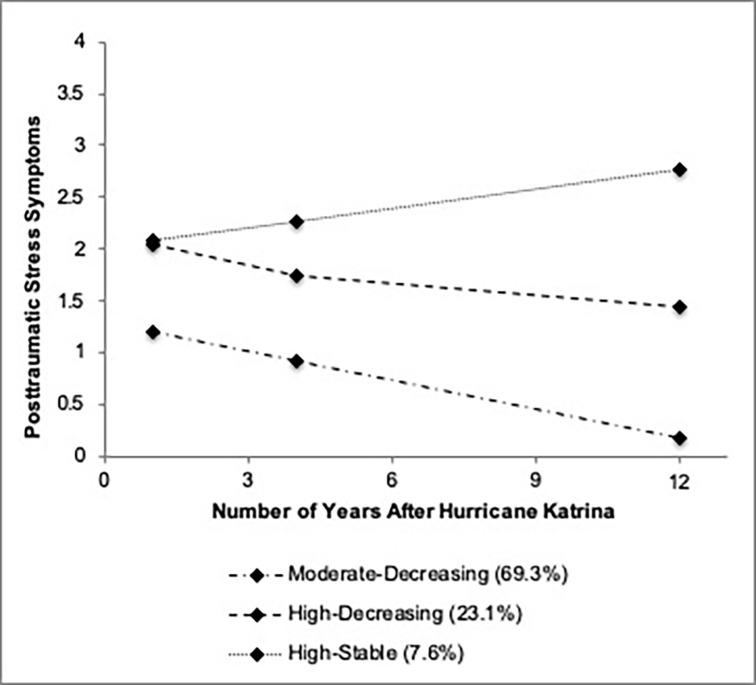
Exposure to disasters is associated with a range of posttraumatic stress symptom (PTSS) trajectories. However, few studies have tracked PTSS for more than a decade postdisaster, and none to our knowledge has explored the role of predisaster resources and vulnerabilities in shaping the likelihood of trajectory membership. The current study included participants from the Resilience in Survivors of Katrina Study (N = 885). Participants were originally part of a community college intervention study and were assessed prior to the hurricane (6-21 months predisaster), and approximately 1 year, 4 years, and 12 years postdisaster. Latent class growth analysis identified PTSS trajectories. Perceived social support, probable mental illness, and physical health conditions or problems-all assessed predisaster-were examined as predictors of trajectory membership at the univariate level and in multivariable models without and with adjustment for disaster exposure. Three PTSS trajectories were detected: Moderate-Decreasing (69.3%), High-Decreasing (23.1%), and High-Stable (7.6%). In the multivariable predictive model without adjustment for disaster exposure, probable predisaster mental illness was significantly associated with greater odds of the High-Decreasing and High-Stable trajectories, and physical health conditions or problems with greater odds of the High-Decreasing trajectory, relative to the Moderate-Decreasing trajectory. However, when disaster exposure was adjusted, only the association between predisaster mental illness and the odds of the High-Stable trajectory remained statistically significant. Lower predisaster perceived social support was significantly associated with membership in the High-Decreasing trajectory, relative to the Moderate-Decreasing, at the univariate level, but not in either multivariable model. Whereas predisaster mental illness confers risk for chronic postdisaster PTSS, other impacts of predisaster resources and vulnerabilities on elevated PTSS trajectories do not go beyond those of disaster exposure. The results support disaster preparedness efforts targeting those with mental and physical health conditions, and postdisaster mental health services addressing preexisting vulnerabilities in addition to disaster-related PTSS.
受灾暴露与一系列创伤后应激症状(PTSS)轨迹有关。然而,很少有研究在灾难后超过十年跟踪 PTSD,据我们所知,也没有研究探讨灾难前资源和脆弱性在塑造轨迹成员可能性方面的作用。本研究包括来自卡特里娜飓风幸存者韧性研究(N=885)的参与者。参与者最初是社区学院干预研究的一部分,在飓风前(6-21 个月前)、大约 1 年、4 年和 12 年后进行了评估。潜在类别增长分析确定了 PTSD 轨迹。在单变量水平和多变量模型中,在不考虑和考虑灾害暴露的情况下,分别检查了灾难前评估的感知社会支持、可能的精神疾病以及身体健康状况或问题,以作为轨迹成员身份的预测因素。检测到三种 PTSD 轨迹:中度减少型(69.3%)、高度减少型(23.1%)和高度稳定型(7.6%)。在不考虑灾害暴露的多变量预测模型中,可能的灾难前精神疾病与高度减少型和高度稳定型轨迹的可能性更大相关,而身体健康状况或问题与高度减少型轨迹的可能性更大相关,而与中度减少型轨迹相比。然而,当调整灾害暴露时,只有灾难前精神疾病与高度稳定型轨迹的可能性之间的关联仍然具有统计学意义。灾难前感知社会支持较低与高度减少型轨迹的成员身份显著相关,与中度减少型相比,在单变量水平上,但在多变量模型中都没有。虽然灾难前精神疾病会增加慢性灾后 PTSD 的风险,但灾难前资源和脆弱性对 PTSD 轨迹升高的其他影响并不超出灾难暴露的影响。研究结果支持针对有精神和身体健康状况的人进行灾害准备工作,并支持在提供针对与灾害相关 PTSD 的服务之外,为解决预先存在的脆弱性而提供灾后心理健康服务。
 Zotero 插件