
无机养分体系和基因调控光养多细胞细菌的细胞和丝状体大小及形态。
The Inorganic Nutrient Regime and the Genes Regulate Cell and Filament Size and Morphology in the Phototrophic Multicellular Bacterium .
机构信息
Instituto de Bioquímica Vegetal y Fotosíntesis, CSIC and Universidad de Sevilla, Seville, Spain.
Instituto de Bioquímica Vegetal y Fotosíntesis, CSIC and Universidad de Sevilla, Seville, Spain
出版信息
mSphere. 2020 Oct 28;5(5):e00747-20. doi: 10.1128/mSphere.00747-20.
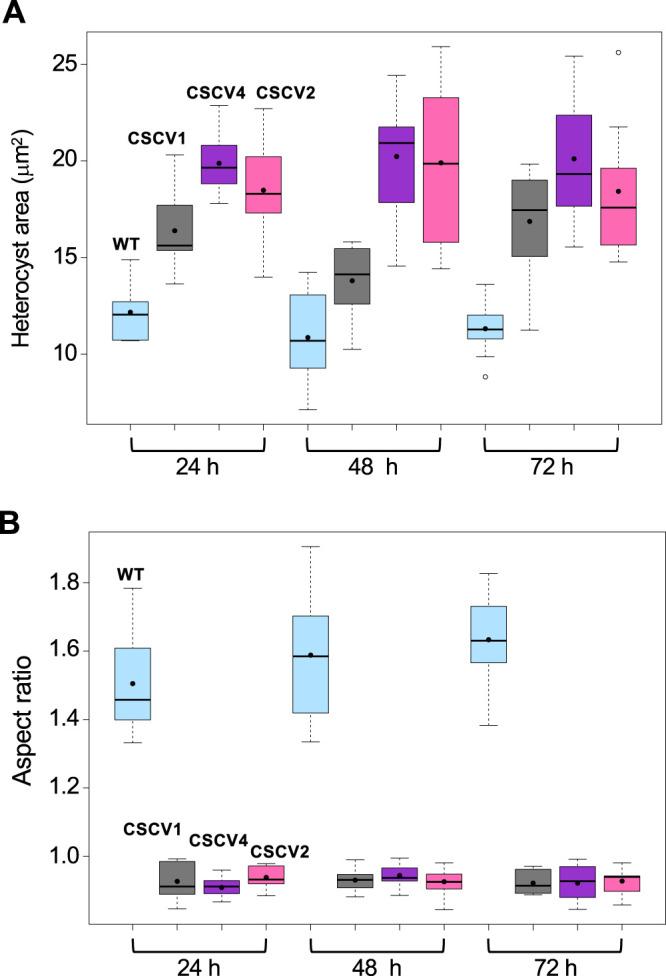
The model cyanobacterium sp. PCC 7120 exhibits a phototrophic metabolism relying on oxygenic photosynthesis and a complex morphology. The organismic unit is a filament of communicated cells that may include cells specialized in different nutritional tasks, thus representing a paradigm of multicellular bacteria. In , the inorganic carbon and nitrogen regime influenced not only growth, but also cell size, cell shape, and filament length, which also varied through the growth cycle. When using combined nitrogen, especially with abundant carbon, cells enlarged and elongated during active growth. When fixing N, which imposed lower growth rates, shorter and smaller cells were maintained. In , gene homologs to , , and form an operon that was expressed at higher levels during the phase of fastest growth. In an mutant, transcript levels were higher than in the wild type and, consistently, cells were longer. Negative regulation by NtcA can explain that cells were longer in the presence of combined nitrogen than in diazotrophic cultures, in which the levels of NtcA are higher. , , and mutants could grow with combined nitrogen, but only the latter mutant could grow diazotrophically. Cells were always larger and shorter than wild-type cells, and their orientation in the filament was inverted. Consistent with increased peptidoglycan width and incorporation in the intercellular septa, filaments were longer in the mutants, suggesting a role for MreB, MreC, and MreD in the construction of septal peptidoglycan that could affect intercellular communication required for diazotrophic growth. Most studies on the determination of bacterial cell morphology have been conducted in heterotrophic organisms. Here, we present a study of how the availability of inorganic nitrogen and carbon sources influence cell size and morphology in the context of a phototrophic metabolism, as found in the multicellular cyanobacterium In , the expression of the MreB, MreC, and MreD proteins, which influence cell size and length, are regulated by NtcA, a transcription factor that globally coordinates cellular responses to the C-to-N balance of the cells. Moreover, MreB, MreC, and MreD also influence septal peptidoglycan construction, thus affecting filament length and, possibly, intercellular molecular exchange that is required for diazotrophic growth. Thus, here we identified new roles for Mre proteins in relation to the phototrophic and multicellular character of a cyanobacterium, .
模式蓝藻 sp. PCC 7120 表现出依赖于光合作用的光养代谢和复杂的形态。生物体是由相互连通的细胞组成的丝状结构,其中可能包括专门从事不同营养任务的细胞,因此代表了多细胞细菌的范例。在这项研究中,无机碳和氮的供应不仅影响生长,还影响细胞大小、形状和丝状体长度,这些也随着生长周期而变化。当使用组合氮,特别是在有丰富碳源的情况下,细胞在活跃生长时会增大和伸长。当固定氮时,生长速度较低,细胞维持在较短和较小的状态。在这项研究中,与 、 和 同源的基因形成了一个操纵子,在生长最快的阶段表达水平更高。在 突变体中, 转录物水平高于野生型,并且细胞较长。NtcA 的负调控可以解释在有组合氮存在的情况下, 细胞比固氮培养中的细胞更长,因为固氮培养中的 NtcA 水平更高。 、 和 突变体可以用组合氮生长,但只有后者突变体可以固氮生长。细胞总是比野生型细胞更大和更短,并且它们在丝状体中的取向相反。与肽聚糖在细胞间隔中的宽度和掺入增加一致,突变体中的丝状体更长,这表明 MreB、MreC 和 MreD 在构建影响固氮生长所需的细胞间通讯的隔肽聚糖中起作用。大多数关于细菌细胞形态决定的研究都是在异养生物中进行的。在这里,我们研究了在光养代谢的背景下,无机氮和碳源的可利用性如何影响细胞大小和形态,这在多细胞蓝藻 中可以找到。在这项研究中,影响细胞大小和长度的 MreB、MreC 和 MreD 蛋白的表达受 NtcA 转录因子的调节,NtcA 转录因子全局协调细胞对细胞 C 到 N 平衡的反应。此外,MreB、MreC 和 MreD 还影响隔肽聚糖的构建,从而影响丝状体的长度,并且可能影响固氮生长所需的细胞间分子交换。因此,在这里,我们确定了 Mre 蛋白在与蓝藻的光养和多细胞特性相关的新作用 。




 Zotero 插件