
水胶体敷料通过增加糖尿病小鼠的M2巨噬细胞极化来促进伤口愈合。
Hydrocolloid dressing improves wound healing by increasing M2 macrophage polarization in mice with diabetes.
作者信息
Takeuchi Tamaki, Ito Morihiro, Yamaguchi Seiji, Watanabe Saki, Honda Masashi, Imahashi Takuya, Yamada Tsuyoshi, Kokubo Tadashi
机构信息
Department of Biomedical Sciences, College of Life and Health Science, Chubu University, Kasugai, Japan.
Graduate School of Life and Health Sciences, Chubu University, Kasugai, Japan.
出版信息
Nagoya J Med Sci. 2020 Aug;82(3):487-498. doi: 10.18999/nagjms.82.3.487.
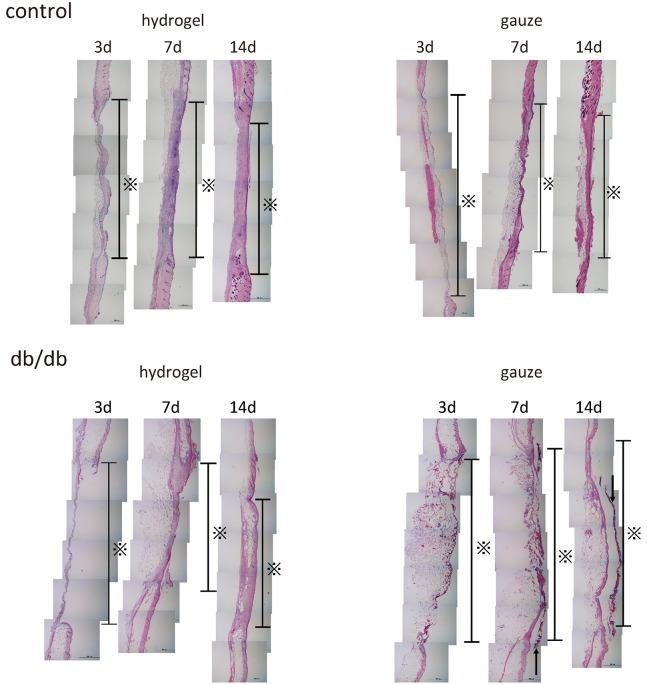
Impaired wound healing is one of the most common complications of diabetes, and is known to be caused by multiple complicated factors. For instance, impaired angiogenesis, neuropathy, and hyperglycemia all function to delay subsequent wound closure. Alternatively, moist wound healing, which provides an appropriate environment for wounds, was reported to permit rapid healing by managing wound exudate. Accordingly, wound dressing materials that facilitate moist healing have been developed. The present study sought to clarify the effects of wound dressing material for moist healing of diabetic wounds, in terms of the dynamics of angiogenic factors and macrophages, using a mouse model of naturally occurring diabetes. Wounds with full-thickness skin defects were inflicted on the backs of mice and covered with dressing materials of hydrogel or gauze (control), which were retained for 3, 5, 7, 10, or 14 days following wound generation. During this time, the localization of neutrophils, fibroblasts and macrophages as well as the expression of vascular endothelial growth factor (VEGF) in the wounds and surrounding areas was observed each day. Healing clearly occurred in the hydrogel group with an increase in neutrophils and the angiogenic factor, VEGF. Moreover, the use of hydrogel resulted in a rapid rise in M1 macrophages, which appeared in the early stage of the injury, as well as rapid subsequent appearance of M2 macrophages. Thus, herein, we demonstrate that the formation of a moist environment via wound dressing material effectively improves diabetic wound healing.
伤口愈合受损是糖尿病最常见的并发症之一,已知是由多种复杂因素引起的。例如,血管生成受损、神经病变和高血糖都会导致伤口愈合延迟。另外,湿性伤口愈合为伤口提供了适宜的环境,据报道通过处理伤口渗出液可促进伤口快速愈合。因此,已开发出有助于湿性愈合的伤口敷料材料。本研究旨在利用自然发生糖尿病的小鼠模型,从血管生成因子和巨噬细胞的动态变化方面,阐明用于糖尿病伤口湿性愈合的伤口敷料材料的效果。在小鼠背部造成全层皮肤缺损伤口,并用凝胶或纱布(对照)敷料覆盖,在伤口形成后保留3、5、7、10或14天。在此期间,每天观察伤口及周围区域中性粒细胞、成纤维细胞和巨噬细胞的定位以及血管内皮生长因子(VEGF)的表达。凝胶组伤口明显愈合,中性粒细胞和血管生成因子VEGF增加。此外,使用凝胶导致损伤早期出现的M1巨噬细胞迅速增多,随后M2巨噬细胞也迅速出现。因此,我们在此证明,通过伤口敷料材料形成湿性环境可有效改善糖尿病伤口愈合。




 Zotero 插件