
墨西哥虫媒病毒的临床症状
Clinical Symptoms of Arboviruses in Mexico.
作者信息
Ananth Sushmitha, Shrestha Nistha, Treviño C Jesús A, Nguyen Uyen-Sa, Haque Ubydul, Angulo-Molina Aracely, Lopez-Lemus Uriel A, Lubinda Jailos, Sharif Rashed Md, Zaki Rafdzah Ahmad, Sánchez Casas Rosa María, Cervantes Diana, Nandy Rajesh
机构信息
Department of Biostatistics and Epidemiology, University of North Texas Health Science Center, Fort Worth, TX 76107, USA.
Department of Urban Affairs at the School of Architecture, Universidad Autónoma de Nuevo León, San Nicolás de los Garza 66455, Nuevo Léon, Mexico.
出版信息
Pathogens. 2020 Nov 19;9(11):964. doi: 10.3390/pathogens9110964.
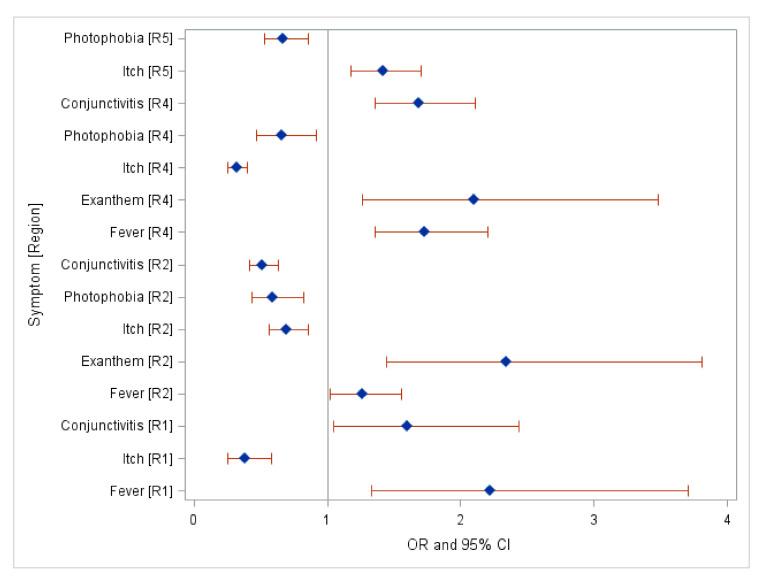
Arboviruses such as Chikungunya (CHIKV), Dengue (DENV), and Zika virus (ZIKV) have emerged as a significant public health concern in Mexico. The existing literature lacks evidence regarding the dispersion of arboviruses, thereby limiting public health policy's ability to integrate the diagnosis, management, and prevention. This study seeks to reveal the clinical symptoms of CHIK, DENV, and ZIKV by age group, region, sex, and time across Mexico. The confirmed cases of CHIKV, DENV, and ZIKV were compiled from January 2012 to March 2020. Demographic characteristics analyzed significant clinical symptoms of confirmed cases. Multinomial logistic regression was used to assess the association between clinical symptoms and geographical regions. Females and individuals aged 15 and older had higher rates of reported significant symptoms across all three arboviruses. DENV showed a temporal variation of symptoms by regions 3 and 5, whereas ZIKV presented temporal variables in regions 2 and 4. This study revealed unique and overlapping symptoms between CHIKV, DENV, and ZIKV. However, the differentiation of CHIKV, DENV, and ZIKV is difficult, and diagnostic facilities are not available in rural areas. There is a need for adequately trained healthcare staff alongside well-equipped lab facilities, including hematological tests and imaging facilities.
基孔肯雅病毒(CHIKV)、登革热病毒(DENV)和寨卡病毒(ZIKV)等虫媒病毒已成为墨西哥重大的公共卫生问题。现有文献缺乏关于虫媒病毒传播的证据,从而限制了公共卫生政策整合诊断、管理和预防的能力。本研究旨在揭示墨西哥各地不同年龄组、地区、性别和时间的基孔肯雅病毒、登革热病毒和寨卡病毒的临床症状。2012年1月至2020年3月期间收集了基孔肯雅病毒、登革热病毒和寨卡病毒的确诊病例。通过人口统计学特征分析确诊病例的显著临床症状。采用多项逻辑回归评估临床症状与地理区域之间的关联。在所有这三种虫媒病毒中,女性以及15岁及以上的个体报告有显著症状的比例更高。登革热病毒在第3和第5地区表现出症状的时间变化,而寨卡病毒在第2和第4地区呈现出时间变量。本研究揭示了基孔肯雅病毒、登革热病毒和寨卡病毒之间独特且重叠的症状。然而,区分基孔肯雅病毒、登革热病毒和寨卡病毒很困难,而且农村地区没有诊断设施。需要训练有素的医护人员以及配备完善的实验室设施,包括血液学检测和成像设施。



 Zotero 插件